The Jellyfish Nebula IC443
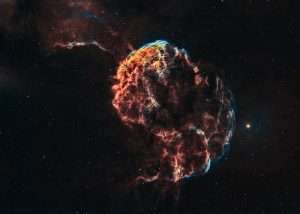 The Jellyfish Nebula
IC 443 or Sharpless 248, is a supernova remnant located in the constellation Gemini. It is approximately 5,000 light-years away from Earth. The nebula gets its name from its resemblance to a jellyfish, with its tentacle-like structures extending outward.
Key Features:
- Origin: The Jellyfish Nebula is the result of a supernova explosion that occurred roughly 30,000 years ago. The explosion left behind a rapidly expanding shell of gas and dust.
- Structure: The nebula spans about 70 light-years across and is characterized by its complex structure, including filaments and shock waves. These features are the result of the supernova’s shock wave interacting with the surrounding interstellar medium.
- Emission: The nebula emits light in various wavelengths, including radio, optical, and X-ray. The optical emission is primarily due to ionized hydrogen, which gives the nebula its characteristic red and green colours.
- Neutron Star: Within the Nebula lies a neutron star, which is the dense remnant of the supernova’s core. This neutron star is a pulsar, emitting regular pulses of radiation as it rotates.
Observation:
- Telescopes: I observed the Jellyfish Nebula with a four-inch refractor. However, professional instruments like the Hubble Space Telescope or large ground-based observatories capture the details.
- Filters: Astronomers often use narrowband filters to isolate the light emitted by specific elements, such as hydrogen-alpha and oxygen-III, to enhance the contrast and detail of the nebula. I captured this image with my Esprit 100ED using narrowband filters. I took 35x300s Ha, 31x300s OIII and 30x300s SII images. And was processed in Pixinsight.
Scientific Interest:
The Jellyfish Nebula is of great interest to astronomers because it provides insights into the dynamics of supernova remnants and their interactions with the interstellar medium. Studying such nebulae helps scientists understand stars’ life cycles and the galaxy’s distribution of elements.
In summary, the Nebula is a fascinating and complex structure resulting from a supernova explosion, offering a wealth of information about the processes that shape our universe.
Deepseek AI created this summary