Filter posts by category

The Jellyfish nebula

The Jellyfish Nebula

The Jellyfish Nebula IC443
The Jellyfish Nebula

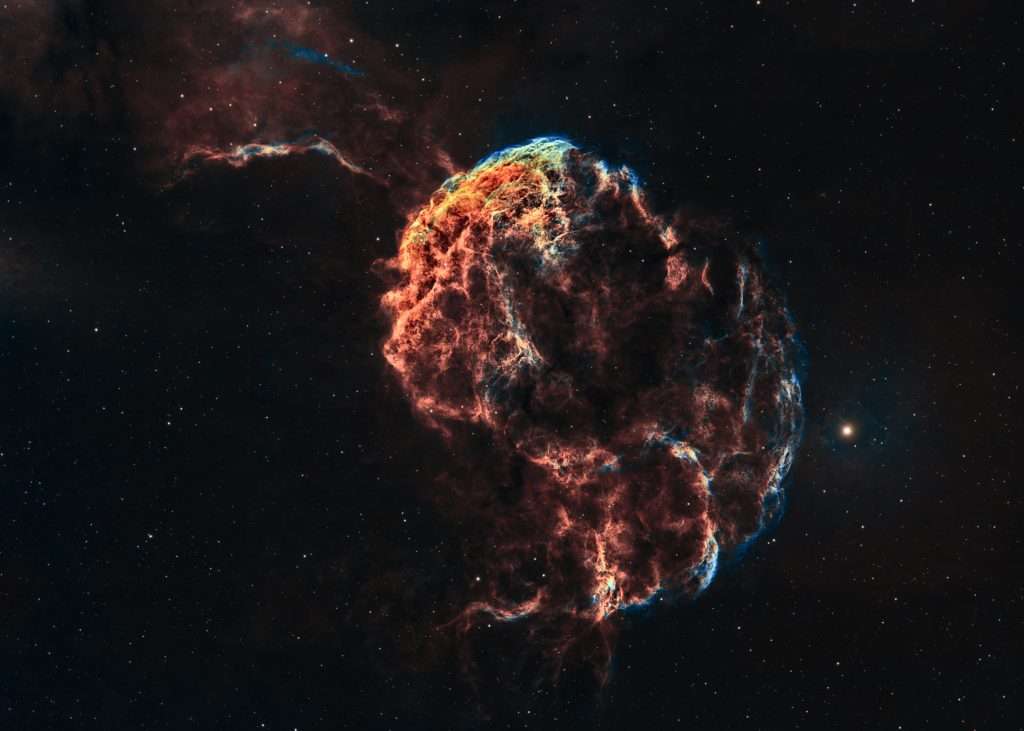
IC 443 or Sharpless 248, is a supernova remnant located in the constellation Gemini. It is approximately 5,000 light-years away from Earth. The nebula gets its name from its resemblance to a jellyfish, with its tentacle-like structures extending outward.

Key Features:

  1. Origin: The Jellyfish Nebula is the result of a supernova explosion that occurred roughly 30,000 years ago. The explosion left behind a rapidly expanding shell of gas and dust.
  2. Structure: The nebula spans about 70 light-years across and is characterized by its complex structure, including filaments and shock waves. These features are the result of the supernova’s shock wave interacting with the surrounding interstellar medium.
  3. Emission: The nebula emits light in various wavelengths, including radio, optical, and X-ray. The optical emission is primarily due to ionized hydrogen, which gives the nebula its characteristic red and green colours.
  4. Neutron Star: Within the Nebula lies a neutron star, which is the dense remnant of the supernova’s core. This neutron star is a pulsar, emitting regular pulses of radiation as it rotates.

Observation:

  • Telescopes: I observed the Jellyfish Nebula with a four-inch refractor.  However, professional instruments like the Hubble Space Telescope or large ground-based observatories capture the details.
  • Filters: Astronomers often use narrowband filters to isolate the light emitted by specific elements, such as hydrogen-alpha and oxygen-III, to enhance the contrast and detail of the nebula. I captured this image with my Esprit 100ED using narrowband filters. I took 35x300s Ha, 31x300s OIII and 30x300s SII images. And was processed in Pixinsight.

Scientific Interest:

The Jellyfish Nebula is of great interest to astronomers because it provides insights into the dynamics of supernova remnants and their interactions with the interstellar medium. Studying such nebulae helps scientists understand stars’ life cycles and the galaxy’s distribution of elements.

In summary, the Nebula is a fascinating and complex structure resulting from a supernova explosion, offering a wealth of information about the processes that shape our universe.

Deepseek AI created this summary
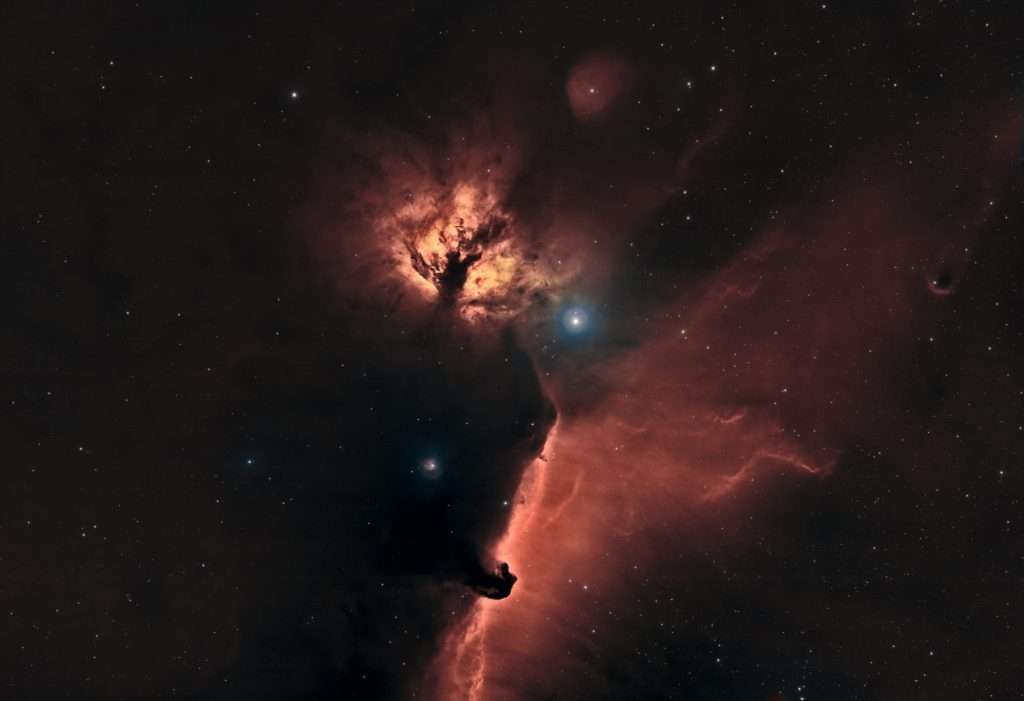
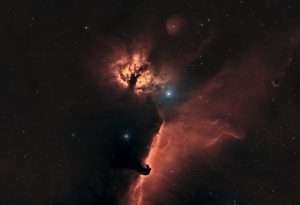
The Flame Nebula

The Flame Nebula

The Flame Nebula (NGC 2024)

The Flame Nebula

The Flame Nebula (NGC 2024) is a glowing region of gas and dust located in the constellation Orion, near the bright star Alnitak, the easternmost star in Orion’s Belt. It is part of the Orion Molecular Cloud Complex, a rich star-forming region that also includes the Horsehead Nebula and Orion Nebula. Here’s a detailed look at the Flame Nebula:

About NGC 2024

  • The Flame Nebula is an emission nebula, meaning its glow comes from ionized gas energized by ultraviolet radiation from nearby stars.

  • Location and Distance:

    • It lies about 1,350 light-years from Earth.
    • It is located just to the south of Alnitak in Orion’s Belt, making it a prominent object in the winter sky of the Northern Hemisphere.
  • Size:
    The Flame Nebula spans about 12 light-years across.

  • Apparent Magnitude:
    Its brightness is obscured by foreground dust, but under dark skies, it can be observed with medium to large telescopes.

Star Formation

  1. Stellar Nursery:

    • The Nebula is an active stellar nursery, where new stars are forming within its dense molecular clouds.
    • Infrared observations reveal numerous young stars and protostars hidden within the dusty regions.
  2. Relation to Orion Molecular Cloud Complex:

    • It is part of a much larger network of star-forming regions, including the Horsehead Nebula and the Orion Nebula, making this area one of the most studied star formation regions.


The Christmas Tree Cluster

The Christmas Tree Cluster

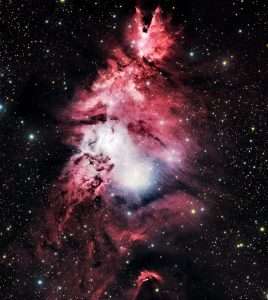
The Christmas Tree Cluster in Monoceros

The Christmas Tree Cluster
The Christmas Tree Cluster, officially designated as NGC 2264, is an open cluster of stars in the constellation Monoceros. It is part of a complex region that includes a nebula and star-forming regions, and it gets its name because the arrangement of its stars resembles the shape of a Christmas tree when viewed from Earth.

Key Facts about the Christmas Tree Cluster:

  1. Distance: Approximately 2,500 light-years from Earth.
  2. Age: The cluster is relatively young, about 3–5 million years old.
  3. Size: The cluster spans about 20 light-years across.
  4. Components:
    • The Cone Nebula forms part of this complex, appearing as a dark interstellar dust and gas pillar.
    • The Fox Fur Nebula is another feature in the same region, showing a textured, fur-like appearance.
  5. Visibility:
    • It can be seen with small telescopes or binoculars under dark skies.
    • Best observed during winter in the Northern Hemisphere which is when I imaged this.

Why the Name?

The bright stars form a triangular shape reminiscent of a Christmas tree, with the “trunk” pointing downward. One of the brightest stars at the top of the tree is S Monocerotis.

The Christmas Tree Cluster is an active site of star formation, with many young, hot, blue stars illuminating the surrounding nebulae. It is a favorite target for amateur astronomers and astrophotographers due to its unique appearance and location in a relatively rich star field

The Triffid Nebula

The Trifid Nebula

The Trifid Nebula

The Triffid Nebula

Key Features of the Trifid Nebula

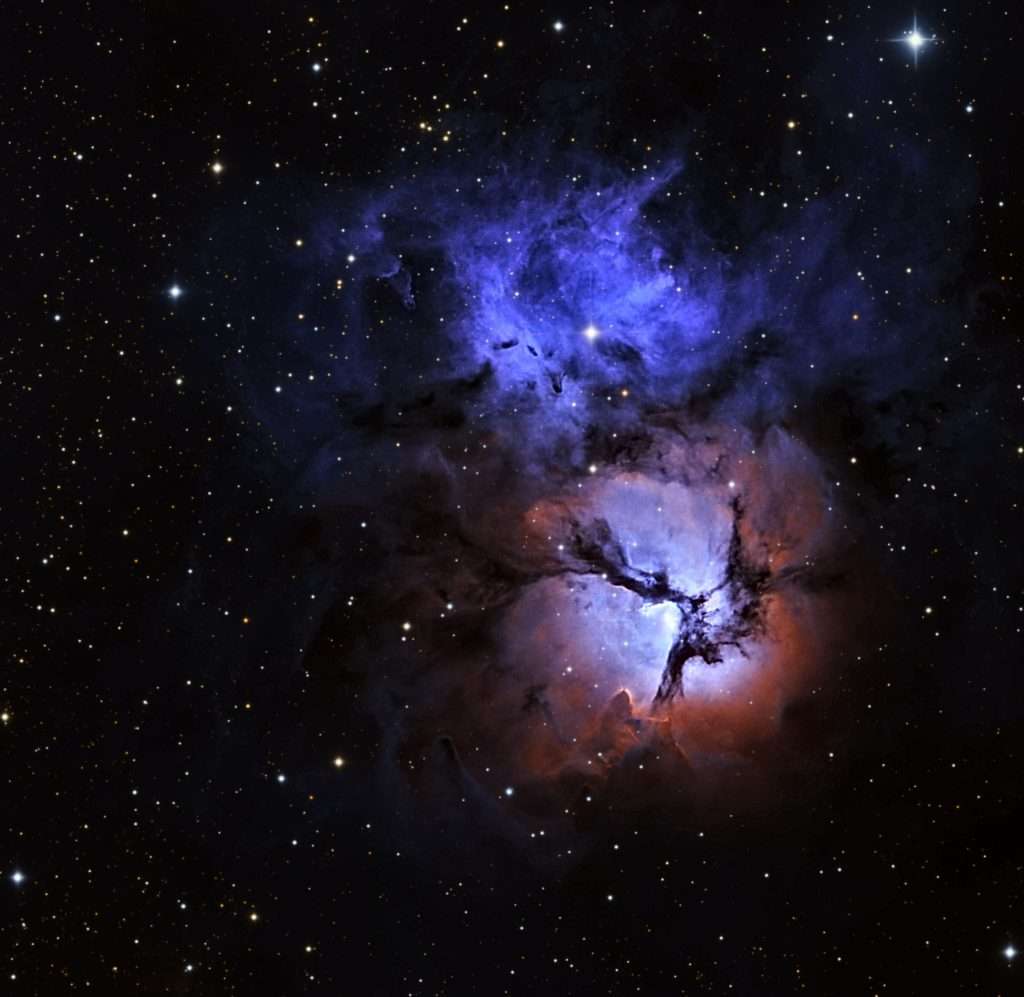
The Trifid Nebula (Messier 20, or M20) is a complex Nebula in the constellation Sagittarius. Known for its striking combination of emission, reflection, and dark nebulae, it is a favourite among astronomers and astrophotographers (see the full image here).

  1. Type: The Trifid Nebula is a combination nebula, consisting of:
    • Emission nebula: Glowing red regions from ionized hydrogen gas energized by ultraviolet radiation from nearby hot stars.
    • Reflection nebula: Bluish regions where starlight is scattered by surrounding dust particles.
    • Dark nebula: Opaque regions of dense dust obscuring the background light, creating the nebula’s characteristic “trifid” (three-lobed) appearance.
  2. Location and Distance:
    • The Trifid Nebula is about 4,100 light-years from Earth.
    • It is located in the Milky Way‘s Sagittarius arm, in the direction of the galactic centre.
  3. Size: The nebula spans about 50 light-years across, appearing roughly 28 arcminutes wide in the sky, about the size of the full moon.
  4. Illuminating Star: The bright, massive star at the centre of the emission nebula, HD 164492, is the primary source of ultraviolet radiation that ionizes the surrounding gas.

Features and Structure

  1. Three Lobes (Trifid): The dark nebula at the centre divides the red emission region into three distinct sections, giving the nebula its name, “Trifid.”
  2. Reflection Nebula: The blue regions of the Nebula result from the reflection of starlight off surrounding dust particles. These regions contrast beautifully with the red emission nebula.
  3. Star Formation:
    • The Nebula is a stellar nursery, containing numerous young stars and protostars in various stages of development.
    • Herbig-Haro objects (jets of gas from young stars) highlight active star formation.
  4. Dark Nebula: Dense dust clouds obscure parts of the nebula, creating intricate patterns and adding depth to the nebula’s appearance.

Acquisition Trifid Nebula

This image was stacked and processed in Pixinsight from GHaSIIOIII data from Telescope Live. I emphasised the faint blue glow from the reflection nebula to show its complex structure.


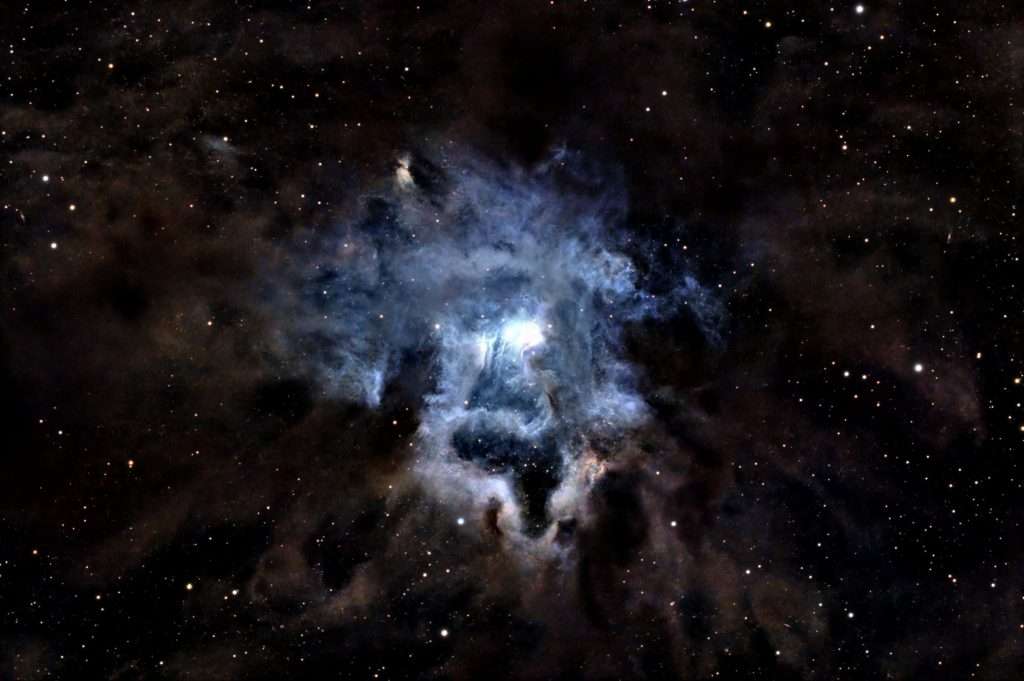
The Iris Nebula

The Iris Nebula

The Iris Nebula

The Iris Nebula (NGC 7023) is a beautiful reflection nebula located in the constellation Cepheus. Known for its striking blue hues and intricate dust structures, it is a popular target for astronomers and astrophotographers. I created this image using my Celestron Edge 800 HD telescope and ASI294mm pro camera from 76x 3-minute exposures. This gave a total integration time of 3.9 hours. I then processed the data in Pixinsight.

Key Characteristics

  1. The Iris Nebula is a reflection nebula its glow comes from starlight scattered off interstellar dust rather than being produced by ionized gas.
  2. The nebula is approximately 1,300 light-years from Earth and spans about 6 light years.
  3. The central star of the Iris Nebula is a hot, young star called HD 200775. A B-type star that provides the energy responsible for the nebula’s glow.
  4. The nebula glows predominantly blue due to light scattering by fine interstellar dust particles, similar to why Earth’s sky appears blue, Surrounding the central blue region are darker, dense clouds of dust, adding depth and contrast to the nebula’s appearance. You can see in some areas a faint reddish hue which is caused by emissions from complex hydrocarbons known as polycyclic aromatic hydrocarbons (PAHs).

The structure of the Iris Nebula

  1. Reflection Nebulae: The Iris Nebula is an excellent example of how starlight interacts with interstellar dust. Its study helps astronomers understand the composition and properties of cosmic dust.
  2. Star Formation: The region contains dense molecular clouds, indicating ongoing or future star formation activity. HD 200775 is a young star that is still evolving, making the nebula a valuable laboratory for studying early stellar evolution.
  3. Dust Properties: The dense clouds around the nebula provide insights into the size, shape, and composition of interstellar dust grains.

Cultural and Aesthetic Appeal

  • The Iris Nebula gets its name from its resemblance to the iris of a flower. Its intricate structure and interplay of light and shadow have made it a favourite for astrophotographers.

The Iris Nebula (NGC 7023) is a stunning and scientifically rich object, showcasing the beauty of the cosmos, while offering a glimpse into the mysteries of interstellar dust and star formation. Its serene blue glow contrasts dramatically with the dark clouds that surround it, making it a captivating sight in the night sky.

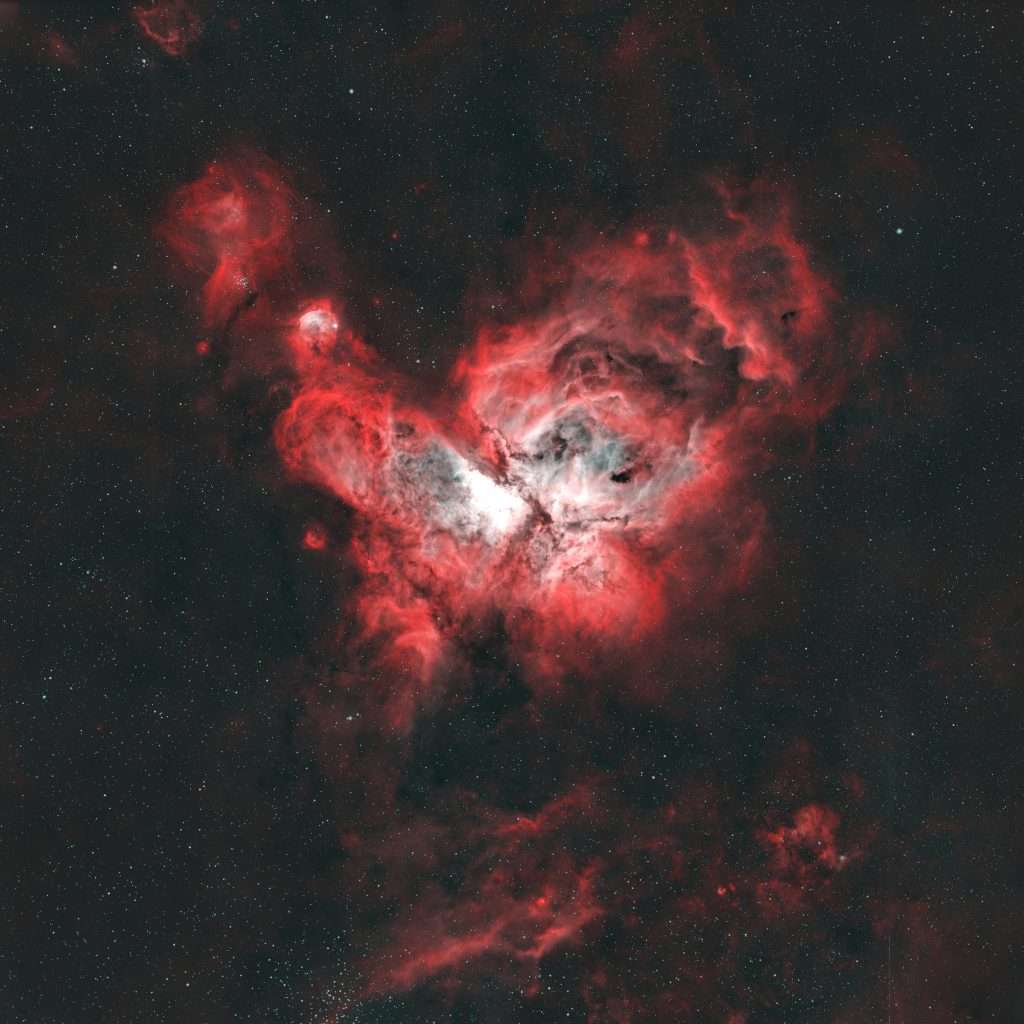
The Carina Nebula

Carina Nebula

The Carina Nebula

The Carina Nebula (NGC 3372) is one of the largest, brightest, and most dynamic star-forming regions in the Milky Way. It is in the constellation Carina and is a spectacular area of gas, dust, and young stars.

Key Characteristics

  1. The Carina Nebula is a giant emission nebula and stellar nursery, known for active star formation and massive, luminous stars.
  2. It lies about 8,500 light-years away from Earth and spans roughly 460 light-years across. This makes it one of the largest nebulae visible in our galaxy.
  3. The nebula is a vibrant mix of red, pink, and orange hues, produced by ionized hydrogen gas emitting light due to intense ultraviolet radiation from nearby massive stars.
  4. It also features dark nebulae, intricate filaments of dense dust, which block light from behind.
  5. The Carina Nebula is roughly four times the size and significantly brighter than the Orion Nebula, but its southern location makes it less known to observers in the Northern Hemisphere.
Prominent Stars and Features:
    • Eta Carinae: One of the most famous stars in the nebula, Eta Carinae is a volatile and massive binary star system with an estimated mass of over 100 solar masses. This binary system will end in a supernova or hypernova soon (astronomically speaking).
    • Trumpler 14 and 16: These are young, bright open star clusters within the nebula.
    • Homunculus Nebula: A bipolar nebula surrounding Eta Carinae, formed by a massive eruption in the 19th century.

Scientific Importance

  1. Star Formation:
    • The Carina Nebula is a stellar nursery where hundreds of massive stars and thousands of smaller stars are being born.
    • Proto and newborn stars can be observed in it’s dense gas clouds. This gives us valuable insights into the early stages of stellar evolution.
  2. Massive Stars and Supernovae:
    • Many of the stars in the nebula are among the most massive and luminous known, contributing to the nebula’s intense radiation and energetic winds.
    • The Carina Nebula contains remnants of past supernovae and is likely to produce more, particularly when Eta Carinae eventually explodes.
  3. Dust and Molecular Clouds:
    • Dense molecular clouds in the nebula are sites of star formation, while the radiation from massive stars sculpts and disperses the gas and dust, creating striking structures.

Visibility

  • The Carina Nebula is in the Southern Hemisphere and this image was created using a remote telescope in Australia using Telescope Live.   Pixinsight was used to stack and process the  12 hours of LRGB data.
  • It is visible to the naked eye as a diffuse patch of light under dark skies and in binoculars or telescopes, the nebula reveals intricate details of its glowing gas and star clusters.


Rho Ophiuchi

Rho Ophiuchi

Rho Ophiuchi

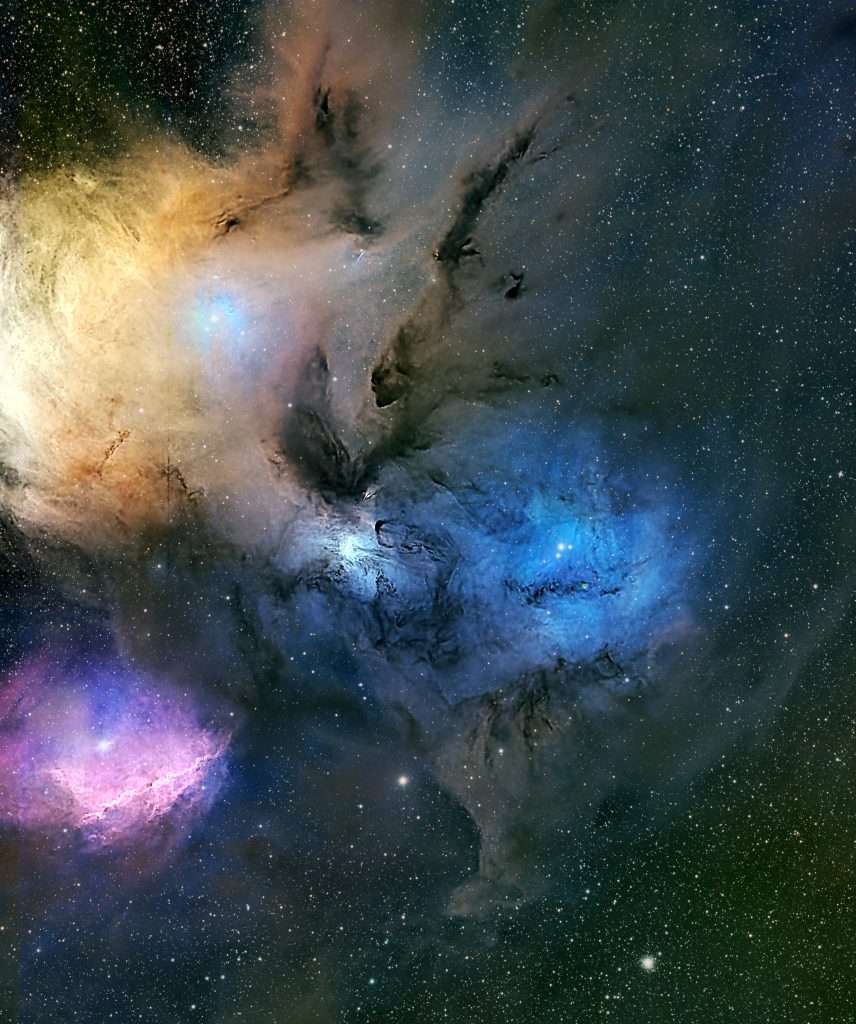
The Rho Ophiuchi complex is a molecular cloud and star-forming region, containing areas of both dark nebulae and reflection nebulae. It is also home to emission nebulae, where ionized gas glows due to energetic radiation. This image was created from six hours of RGB data from Telescope Live. The FITS images had several annoying defects but I was able to remove these during processing. Pixinsight was used to preprocess,  stack, and stretch the images.

Rho Ophiuchi

Some details about Rho Ophiuchi

  • Location and Distance:
    It is located about 394 light-years from Earth, making it one of the closest star-forming regions to our solar system.
  • Size and Structure:
    The cloud complex spans about 14 light-years and is divided into several distinct regions. These are identified by their catalogue designations, such as L1688 one of the most active star-forming parts of the complex.
  • Associated Stars:
    • The Rho Ophiuchi complex gets its name from Rho Ophiuchi, a multiple-star system embedded in the region. This system has young, hot stars that contribute to the illumination of the surrounding gas and dust.
    • Young stars and protostars, surrounded by disks of gas and dust, are scattered throughout the complex.
  • Features:
    • Reflection Nebulae: The bluish glow in some parts of the complex comes from light scattering off dust particles again from hot, young stars.
    • Dark Nebulae: Other areas appear as dark patches when dense dust clouds block the background starlight.
    • Emission Nebulae: Intense ultraviolet radiation from nearby stars ionises hydrogen gas causing the Red and Pink hues seen in the image.
  • Star Formation:
    • The Rho Ophiuchi complex is an active stellar nursery, with stars in various stages of formation, from collapsing protostars to fully formed young stars.
    • Many of these young stars are T Tauri stars, which are in the pre-main-sequence phase of stellar evolution
The Rosette Nebula

Rosette Nebula

The Rosette Nebula

Key Features of this Nebula

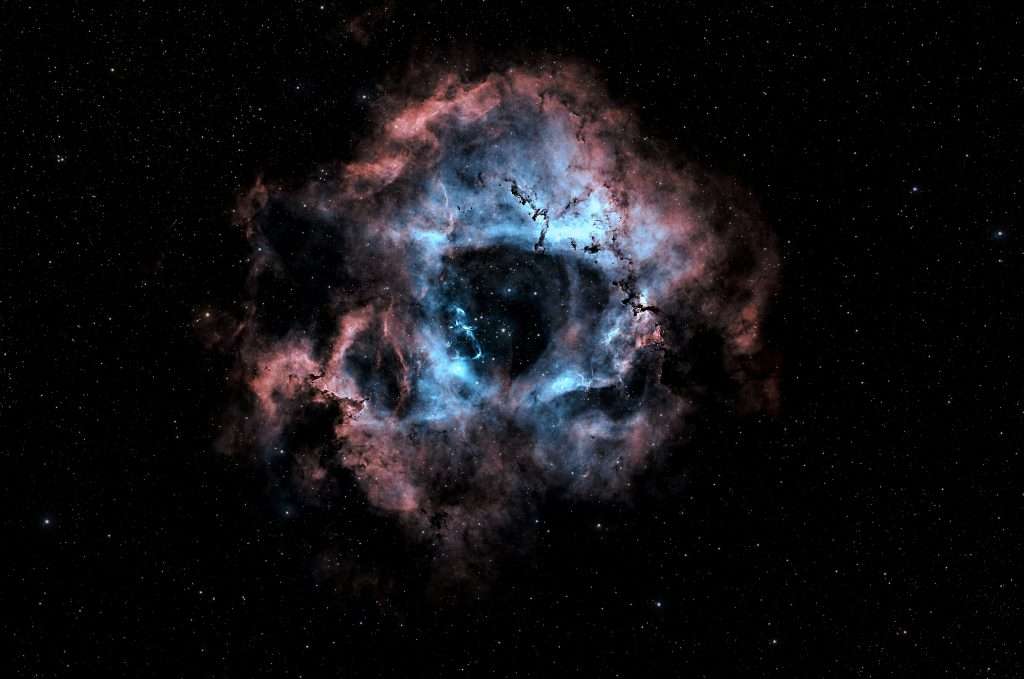
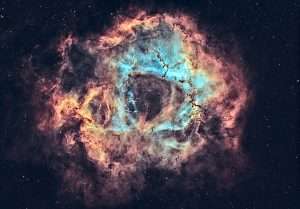
The Rosette Nebula  (NGC2237) is a large, circular region of ionized hydrogen gas and dust in the constellation Monoceros. And near the border with the constellation Orion. It is an emission nebula and glows because of the intense radiation of nearby stars, which ionises hydrogen gas.

Key Features of the Nebula:

  1. Distance: The nebula is approximately 5,000 light-years away from Earth.
  2. Size: It spans about 130 light-years across, making it one of the largest observable nebulae in the sky.
  3. Star Formation: At its centre is a cluster of young, massive stars known as NGC 2244. These stars were formed from the nebula’s material and their intense ultraviolet radiation causes the surrounding hydrogen gas to glow.
  4. Shape: The name “Rosette” comes from its resemblance to a Tudor rose in astrophotographs, with its circular shape and intricate structure of gas and dust.

Observation:

  •  You can see this Nebula with binoculars or small telescopes under dark skies. Astrophotography is better to capture the details. I captured this image using a dual narrow-band filter and a Canon 1200D-modified camera with my Esprit 100ED.
  • Coordinates: It lies in the celestial coordinates near RA 06h 33m, Dec +04° 59′.

Image of Rosette Nebula using Narrowband filers

I captured this extra image on a moonlit night (65%) in January using Ha/OIII/SII filters. The scope I used was an Esprit 100ED with ZWO filters and 100x lights at 60 seconds for each filter. I stacked and processed the image set in Pixinsight.

The Rosette Nebula in narrowband.

The Tarantula Nebula

Tarantula Nebula

The Tarantula Nebula

The Tarantula Nebula

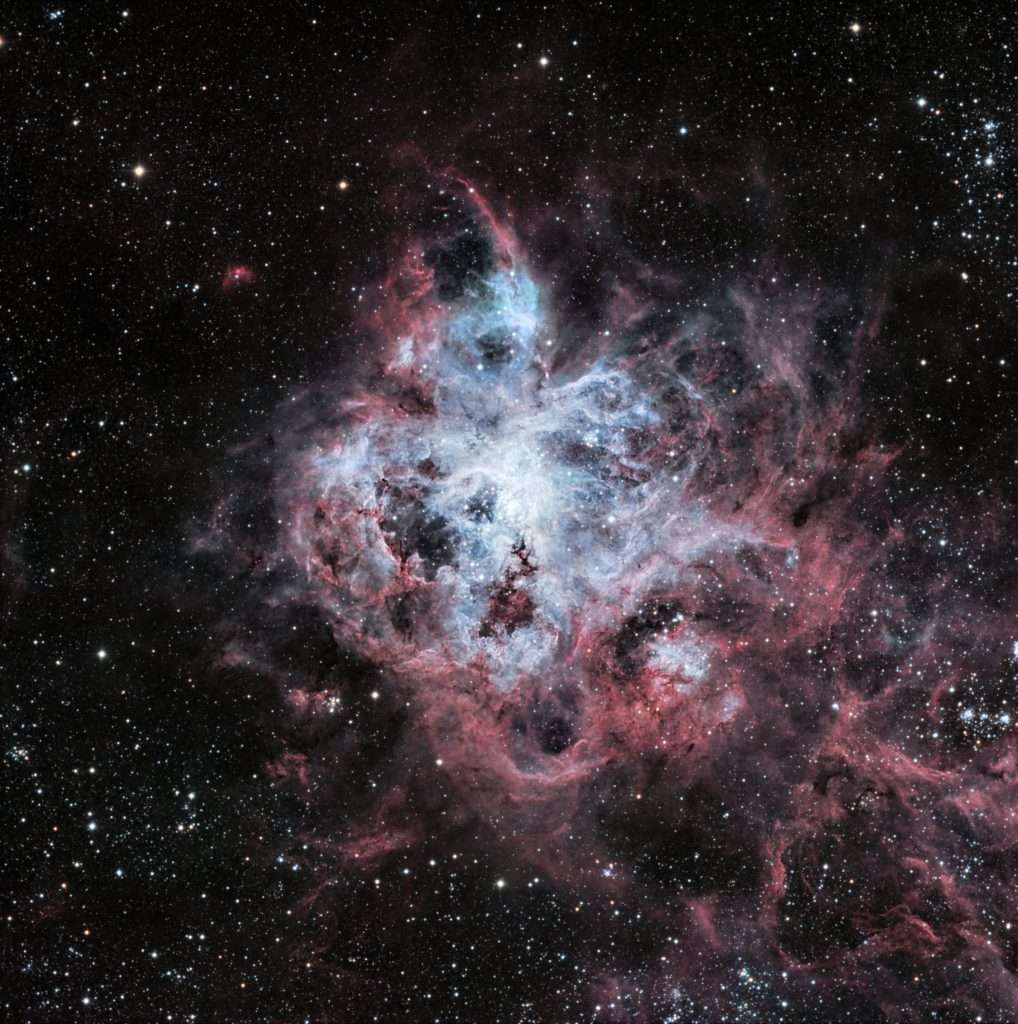
The Tarantula Nebula (also known as 30 Doradus) is a giant star-forming region in the Large Magellanic Cloud (LMC), a satellite galaxy of the Milky Way, about 160,000 light-years away from Earth. Located in the constellation Dorado, the nebula is one of the largest and most active star nurseries in our local group of galaxies, spanning about 1,000 light-years across. Its structure is filled with gas and dust filaments resembling a spider’s legs, which is how it earned the name “Tarantula.”

Key Features of the Tarantula Nebula:

  1. Star Formation: The Tarantula Nebula is an extremely active region where new stars are constantly forming. The intense ultraviolet radiation from young, massive stars within the nebula causes it to glow brightly and energizes the surrounding gas.
  2. Massive Stars: Within the nebula lies the R136 star cluster, home to some of the most massive and luminous stars known, some exceeding 100 times the mass of our Sun. These stars are incredibly hot and emit intense radiation, shaping the surrounding gas and dust.
  3. Supernovae: The nebula has been a site for supernova explosions, the most famous being SN 1987A, one of the brightest supernovae observed in the last few centuries. The remnants of these explosions interact with the surrounding material, creating shock waves and further triggering star formation.
  4. Potential Future: With so many massive stars concentrated in one area, the Tarantula Nebula could eventually form a super star cluster, a rare cluster with a high concentration of stars.

In visible light, the nebula’s structure is bright and detailed, while in other wavelengths, such as infrared and X-rays, it reveals hidden details like newborn stars still embedded in clouds of dust and energetic outflows from massive stars. Because of its proximity and intensity, the Tarantula Nebula is an invaluable site for studying star formation and the evolution of massive stars.

The Orion Nebula M42

The Orion Nebula

The Orion Nebula M42

The Orion Nebula M42

Characteristics

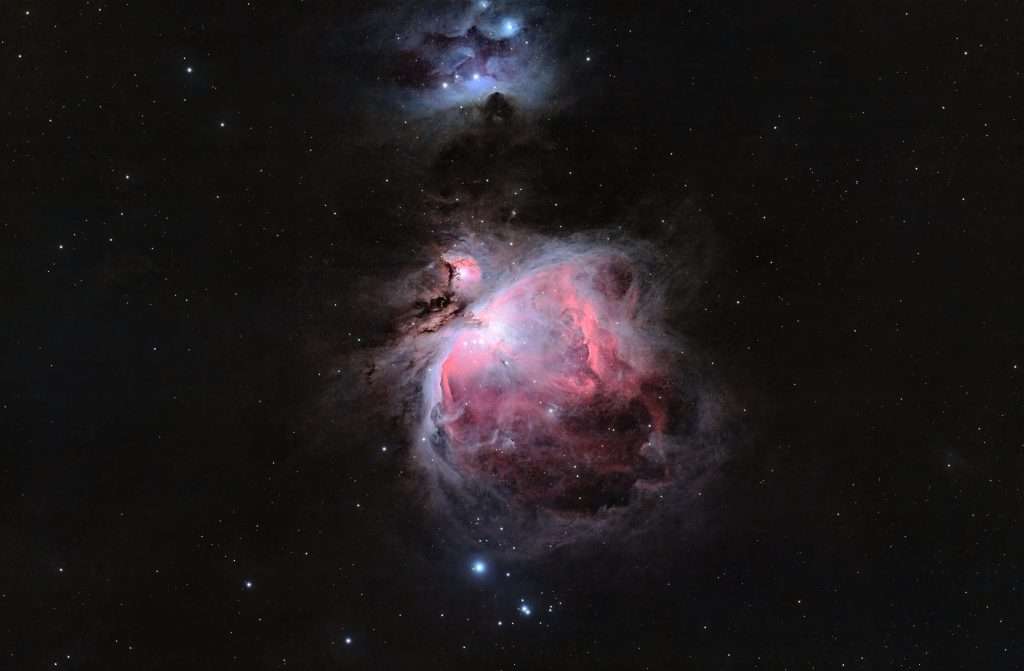
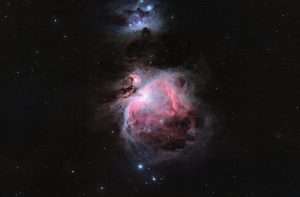
The Orion Nebula (Messier 42) is located in the constellation Orion, approximately 1,344 light-years from Earth. The nebula spans about 24 light-years, making it one of the brightest and most massive star-forming regions visible in the night sky.

  1. Star Formation: The Orion Nebula is a stellar nursery, where new stars are born from vast clouds of gas and dust. It contains young, hot stars that emit powerful radiation, shaping the surrounding nebula.
  2. Trapezium Cluster: At its core is the Trapezium Cluster, a group of four massive, young stars that illuminate much of the nebula. Unfortunately, they are only just visible in this image. Their intense ultraviolet radiation causes the surrounding hydrogen gas to glow, giving the nebula its distinctive bright and colourful appearance.
  3. HII Region: The Orion Nebula is classified as an HII region and is filled with ionized hydrogen, which emits light when the high-energy radiation from young stars excites it.
  4. Protoplanetary Disks (Proplyds): The nebula contains many protoplanetary disks, or proplyds, which are the early stages of solar system formation. These disks around young stars could one day evolve into planets.
  5. Observability: The Orion Nebula is visible to the naked eye under good conditions and appears as a faint, fuzzy patch in the “sword” of Orion. Through a pair of binoculars or a telescope, the nebula reveals its intricate, glowing structure.

Acquisition:

I imaged this target during a brief respite in the weather and was only able to collect limited data. The strategy was to take two sets of images at 30-second and 180-second exposures. This was a mistake. The 180-second exposures aimed to catch the outer fainter nebula while the 30-second frames hopefully caught the core without overexposure. And could be used in processing as a mask to control the longer exposure images. This approach was only partially successful due to extreme exposure of the core at 180 seconds.

  • Esprit 100ED triplet using a Canon 1200D modified camera on a Skywatcher EQ6R-pro,
  • Lights 28X at 180 seconds, 14X at 30; 20X Flats, 24X biases and 20X darks at 180 and 30 seconds respectively.
  • Weather poor rain moving in the moon was at 5%.
Scroll to Top