The double cluster Caldwell 14
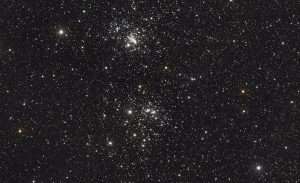
The Double Cluster or Caldwell 14 are two open star clusters NGC 869 and NGC 884 in the constellation Perseus. They are among the most famous and beautiful clusters visible in the night sky, known for their bright, densely packed stars.
Here are key details about the Double Cluster:
Key Characteristics
- Type: Both NGC 869 and NGC 884 are open star clusters, which are groups of stars formed from the same molecular cloud and gravitationally bound to each other.
- Location: The Double Cluster lies in the constellation Perseus and is approximately 7,500 light-years away from Earth. It is positioned between the constellations Perseus and Cassiopeia, making it visible from northern latitudes.
- Age: NGC 869 is about 14 million years old, while NGC 884 is slightly younger at approximately 12.5 million years. This youthful age means both clusters are rich in hot, blue stars, which are young and massive.
- Appearance: The Double Cluster appears as two dense, sparkling regions of stars when viewed through binoculars or a small telescope. Both clusters are roughly the same apparent size and brightness, giving the appearance of a “double” formation. The clusters contain many blue and red supergiants, which add to their visual appeal.
- Brightness and Magnitude: Both clusters are bright, with a combined apparent magnitude of around 4.3, making them visible to the naked eye under dark skies. Each cluster is about 30 arcminutes in diameter, roughly the size of the full moon.
Significance and importance
- The Double Cluster has been known since antiquity and was cataloged by Greek astronomer Hipparchus around 130 B.C. It was later included in the Caldwell catalog as Caldwell 14 by British astronomer Sir Patrick Moore.
- The Double Cluster serves as an excellent laboratory for studying stellar formation and evolution, particularly in young clusters. The stars within the clusters are of similar age and composition, making them ideal for understanding the lifecycle of massive stars.
- Visibility: The Double Cluster is best observed in the autumn and winter months for observers in the Northern Hemisphere. It is a favorite target for amateur astronomers due to its striking appearance and ease of observation.
Background
This was the first light object I viewed with a Bresser 127L achromatic refractor some years ago and I returned to it several years later to take this image:
Acquisition:
- Esprit 100ED triplet on Skywatcher EQ6R-pro mount, Canon 1200D astro modified camera.
- 60×60 second exposures, 20 Darks, 20 flats, 30 biases.
- Processed and stacked in SIRIL