Filter posts by category

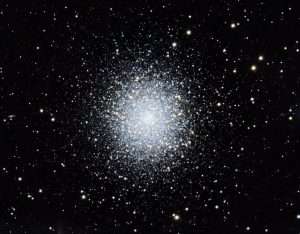
M15

Globular Clusters

What are Globular Clusters

Globular clusters are dense, spherical collections of ancient stars that orbit the cores of galaxies. Their origin is still an active area of astrophysical research, but several key theories explain how they might have formed:

Formation in the Early Universe
  • Globular clusters are among the oldest known stellar systems, with ages often exceeding 10–13 billion years (nearly as old as the Universe itself).
  • They likely formed during the early epochs of galaxy formation, when the Universe was rich in gas and star formation occurred in intense bursts.
  • Their high stellar density suggests they formed in regions where gas was extremely compressed, possibly due to turbulence, dark matter halos, or cosmic filaments.
Connection to Galaxy Formation
  • Many globular clusters appear to have formed alongside their host galaxies, possibly within giant molecular clouds or protogalactic fragments.
  • Some may have originated in dwarf galaxies and later been absorbed by larger galaxies (like the Milky Way). This may explain why some clusters have distinct chemical compositions.
Role of Dark Matter
  • Some theories suggest that the earliest clusters may have formed within small dark matter halos in the young Universe, before galaxies fully assembled.
  • However, observations show that most globular clusters today have little to no dark matter. This means they either lost it over time or formed differently.
Multiple Generations of Stars
  • Unlike typical star clusters (which have a single stellar population), some globular clusters show multiple generations of stars with varying chemical abundances.
  • This suggests they underwent prolonged star formation, possibly due to gas accretion or self-enrichment from supernovae and stellar winds.
Tidal Stripping and Dynamical Evolution
  • Over billions of years, they have been shaped by tidal forces from their host galaxies, leading to mass loss and, in some cases, complete dissolution.
  • The most massive and dense clusters survived, while weaker ones were torn apart.

Key Observations Supporting These Theories

  • Hubble Space Telescope studies show globular clusters in distant, young galaxies, supporting their early formation.
  • Chemical signatures (e.g., helium and nitrogen variations) hint at complex star-forming environments.
  • Kinematic studies suggest some clusters were captured from satellite galaxies.
Outstanding Mysteries
  • Why do some galaxies (like the Milky Way) have hundreds of globular clusters, while others have very few?
  • How did some clusters retain multiple stellar generations despite their strong gravity preventing gas retention?
  • Did dark matter play a role in their formation, or were they always dark-matter-free?

Conclusion

Globular clusters are fossils of the early Universe, offering clues about the conditions of star and galaxy formation. While much progress has been made, their exact origins remain a fascinating topic in astrophysics.

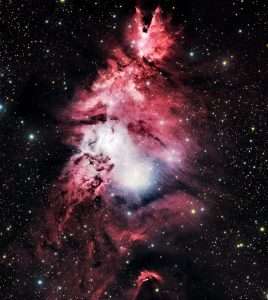
The Christmas Tree Cluster

The Christmas Tree Cluster

The Christmas Tree Cluster in Monoceros

The Christmas Tree Cluster
The Christmas Tree Cluster, officially designated as NGC 2264, is an open cluster of stars in the constellation Monoceros. It is part of a complex region that includes a nebula and star-forming regions, and it gets its name because the arrangement of its stars resembles the shape of a Christmas tree when viewed from Earth.

Key Facts about the Christmas Tree Cluster:

  1. Distance: Approximately 2,500 light-years from Earth.
  2. Age: The cluster is relatively young, about 3–5 million years old.
  3. Size: The cluster spans about 20 light-years across.
  4. Components:
    • The Cone Nebula forms part of this complex, appearing as a dark interstellar dust and gas pillar.
    • The Fox Fur Nebula is another feature in the same region, showing a textured, fur-like appearance.
  5. Visibility:
    • It can be seen with small telescopes or binoculars under dark skies.
    • Best observed during winter in the Northern Hemisphere which is when I imaged this.

Why the Name?

The bright stars form a triangular shape reminiscent of a Christmas tree, with the “trunk” pointing downward. One of the brightest stars at the top of the tree is S Monocerotis.

The Christmas Tree Cluster is an active site of star formation, with many young, hot, blue stars illuminating the surrounding nebulae. It is a favorite target for amateur astronomers and astrophotographers due to its unique appearance and location in a relatively rich star field

Sapta Matrikas

Krittikas (the Pleiades) in Hindu Culture

 Krittikas, a group of six (or sometimes seven) sisters in Hindu mythology is the Pleiades star cluster and plays a significant role in Vedic and Puranic traditions.

Krittikas in Hindu Mythology

  1. Identity as the Wives of the Saptarishis:
    • In Hindu mythology, the Krittikas were the wives of the Saptarishis (the seven great sages).
    • They were separated from their husbands due to a celestial event. This gave rise to their connection with the Pleiades.
  2. Association with Kartikeya (Skanda):
    • The Krittikas are the foster mothers of Kartikeya, the god of war and son of Shiva and Parvati.
    • The six Krittikas raised and nurtured Kartikeya who was born from the divine sparks of Shiva and Pavitti.
    • Kartikeya is thus sometimes called Kartikeya (or Kartik)  after the Krittikas.
  3. Astronomical and Vedic Significance:
    • The Pleiades are Krittika Nakshatra in Vedic astrology and are one of the 27 lunar mansions or nakshatras.
    • It is considered a fiery and transformative nakshatra, associated with the deity Agni, the fire god. The connection with Agni symbolizes purification, courage, and energy.
    • The nakshatra is significant in the Hindu calendar and determines auspicious days and festivals.
  4. Symbolism:
    • The Krittikas represent nurturing and maternal qualities as well as fierceness and independence.
    • Their association with Kartikeya emphasizes their protective and warrior-like aspects, as they prepared Kartikeya to defeat the demon Tarakasura.
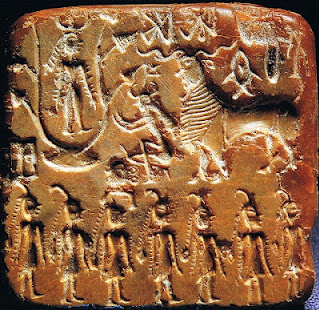
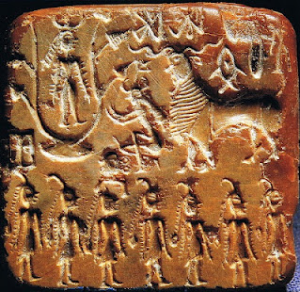
The Sapta Kritikas (the seven divine mothers)

Sapta Matrikas

Mythological Stories

  1. Separation from the Saptarishis:
    • In some versions of the mythology, the Krittikas were estranged from their husbands due to a misunderstanding. This separation is reflected in the fact that only six stars of the Pleiades are prominently visible, with the seventh being faint or “hidden.”
  2. Role in the Skanda Purana:
    • The Krittikas’ role in nurturing and raising Kartikeya is detailed in the Skanda Purana which is one of the major Hindu scriptures. The Skanda Purana illustrates their devotion and importance in preparing Kartikeya to fulfil his destiny as a demon slayer.

Cultural Importance

  • Festivals: The Pleiades’ rising often coincides with agricultural festivals and rituals in honour of fertility, fire, and protection.
  • Astronomical Observation: The visibility of the Krittika Nakshatra in the sky was historically used to mark the transition between seasons and to align religious rituals.

The Tale of the Separation of the Krittikas (ChatGPT’s summary)

  1. Agni’s Infatuation:
    • Agni, the fire god, was overwhelmed by a divine passion for the wives of the Saptarishis, the Krittikas. His desire grew uncontrollable but he was torn by guilt because the Krittikas were devoted and chaste.
    • To resolve his inner turmoil Agni went into the forest to perform penance and rid himself of this desire.
  2. The Encounter with Svaha:
    • Svaha, a goddess who loved him deeply met Agni in the forest. Svaha realized Agni’s feelings for the Krittikas and devised a plan to win his affection.
    • Svaha transformed herself into the likeness of each Krittikas, one by one, and approached Agni, convincing him that his desire was fulfilled.
  3. The Rumor of Infidelity:
    • Svaha’s actions started a rumour that the Krittikas had been unfaithful to their husbands. The Saptarishis, misled by appearances became suspicious.
    • Feeling dishonoured and unable to live with the perceived betrayal the sages decided to leave their wives.
  4. The Birth of Kartikeya (Skanda):
    • Svaha collected the divine essence of Agni and the sages’ blessings, which led to the birth of Kartikeya (Skanda), the god of war.
  5. Ascension to the Sky:
    •  The Krittikas remained estranged from their husbands because their honour had been questioned and were elevated to the heavens where they became the stars of the Krittika Nakshatra (Pleiades).
    • The faintness of one of the stars is sometimes explained as the hidden or “lost” seventh wife who is absent in some versions of the story.

Symbolism of the Story

  • Chastity and Duty: The Krittikas symbolize purity and their role as foster mothers to Kartikeya underscores their nurturing and protective nature.
  • Cosmic Order: The separation and ascension of the Krittikas signify the cosmic consequences of human emotions like jealousy, desire, and misunderstanding.
  • Astronomical Connection: The “missing” seventh star of the Pleiades mirrors the mythological account of one estranged or hidden wife.


The Pleiades

The Pleiades

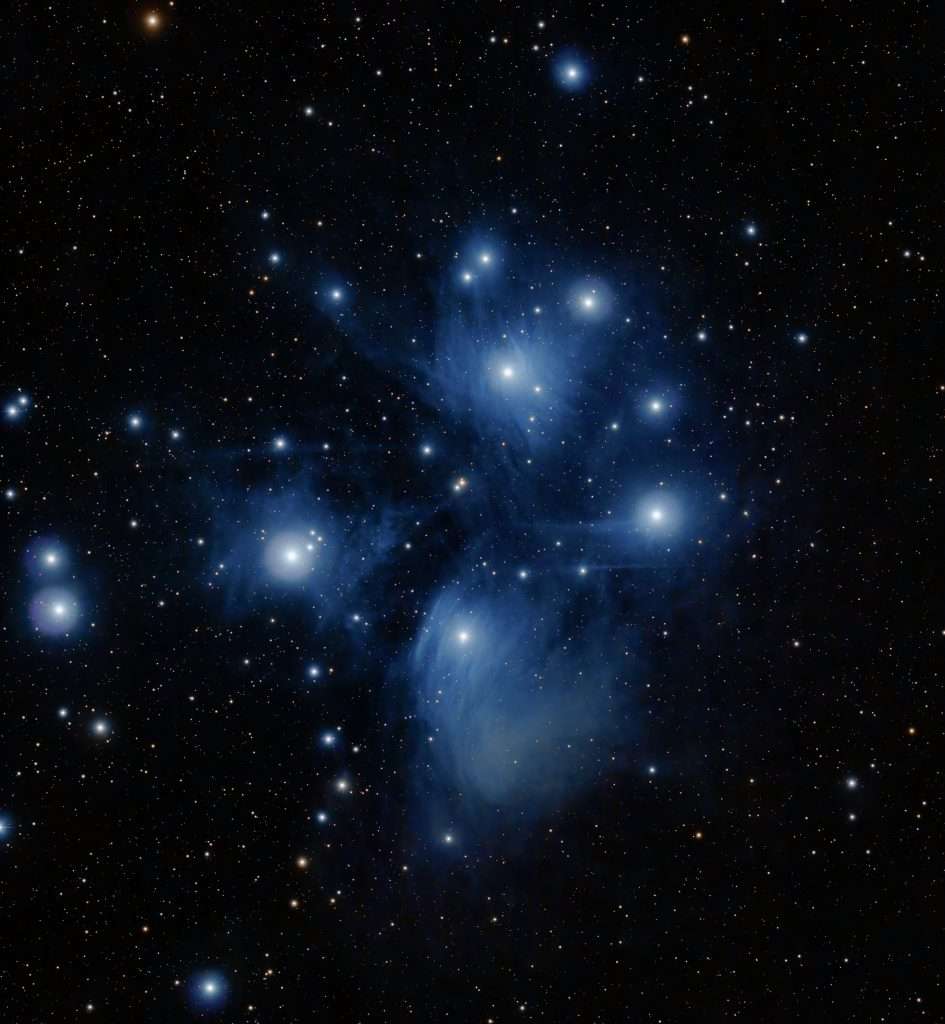
The Pleiades Star Cluster

The Pleiades, also known as Messier 45 (M45) or the Seven Sisters, is one of the most famous open star clusters in the night sky. Located in the constellation Taurus, the Pleiades is a stunning group of young, bright stars known since antiquity.

The Pleiades

Here’s an overview:

  • Type: An open star cluster, consisting of stars formed from the same molecular cloud.
  • Location: The Pleiades lies about 444 light-years away from Earth, making it one of the closest star clusters to us.
  • Age: The cluster is relatively young at about 100 million years old. Its stars are still in their early stages of stellar evolution.
  • Size: The cluster spans about 17.5 light-years and contains over 1,000 stars, though only a few are visible to the naked eye.
  • Brightest Stars:
    The brightest stars in the cluster are:

    • Alcyone
    • Atlas
    • Electra
    • Maia
    • Merope
    • Taygeta
    • Pleione

These stars give the Pleiades its nickname, the “Seven Sisters,” although most people can see only 6 or fewer stars with the naked eye.

The Mythology is world-wide

  • In Greek mythology, the Pleiades were seven sisters, daughters of the titan Atlas and the oceanid Pleione.  Zeus placed the seven sisters in the sky to escape Orion the hunter when he pursued them.
  • Similar stories about the Pleiades exist in cultures worldwide, including in Native American, Aboriginal, Japanese (where it is called “Subaru”), and Hindu mythology.

The Nebula

  • A blue reflection nebula surrounds the cluster, (shown in my image above), caused by interstellar dust scattering the light of its hot, blue stars. This nebula was originally thought to be leftover material from the stars’ formation but is now believed to be a cloud of interstellar dust that the cluster is passing through.
  • Visibility:
    • The Pleiades are visible from most parts of the world to the naked eye.
    • It appears as a small, glittering cluster in the night sky and is best seen during autumn and winter in the Northern Hemisphere. This cluster makes an easy and striking astrophotography target and I have imaged it many times through different telescopes.
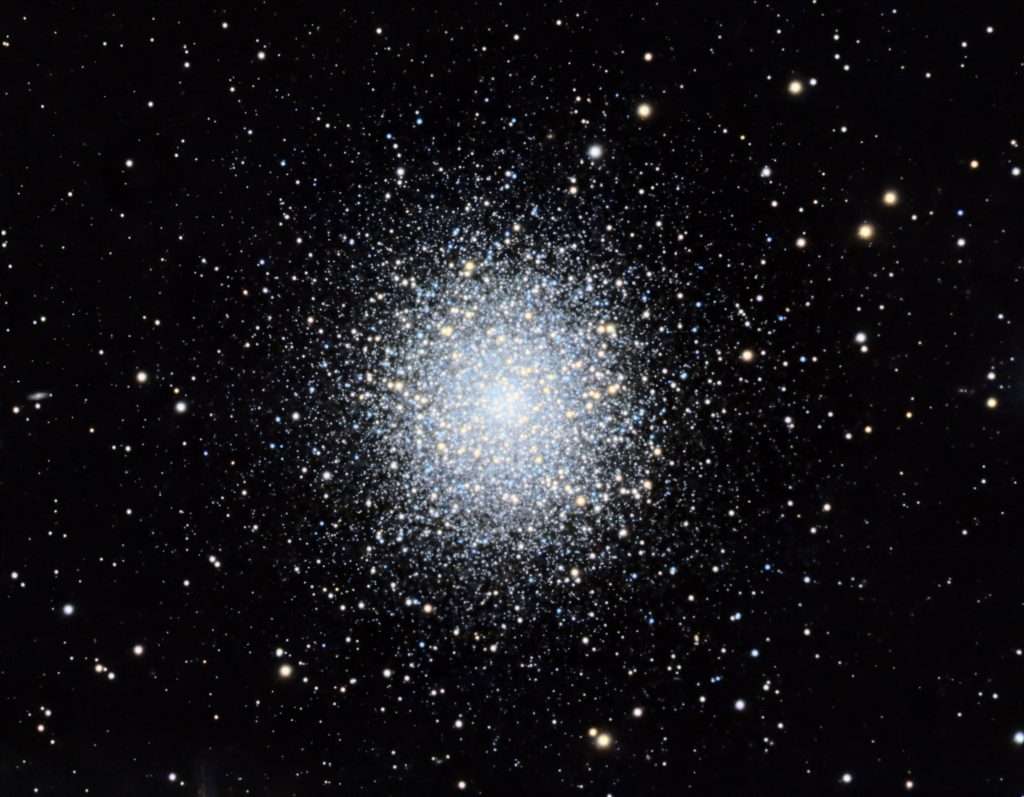
M15

The M15 Globular Cluster

The M15 Globular Cluster


M15

M15 (also known as NGC 7078) is a remarkable globular cluster in the constellation Pegasus lying about 33,600 light-years away from Earth. It’s one of the oldest and most densely packed globular clusters known, . 

M15 Characteristics:

  • Apparent Magnitude: Around 6.2 means it’s just on the edge of naked-eye visibility under excellent conditions.
  • Its age is roughly 12 billion years, making it one of the oldest known globular clusters.
  • Its Diameter is approximately 175 light-years across.
  • A low abundance of elements heavier than hydrogen and helium makes M15 metal-poor and is a feature of ancient stellar populations.

Structure and Stellar Population:

  • M15 contains over 100,000 stars packed into a relatively small volume, making it extremely dense.
  • It exhibits a phenomenon known as core collapse where its core has contracted significantly due to gravitational interactions between its stars. This has resulted in an extremely bright, dense core.
  • The cluster is home to many blue stragglers stars that appear younger than the rest of the cluster’s stars.  Stellar mergers and interactions have likely played a role in their formation.
  • M15 also contains a pulsar (PSR B2127+11C) and several variable stars, including RR Lyrae variables.

Central Black Hole:

There is some evidence that M15 might harbour a central black hole.  If true M15 would be added to the list of globular clusters with intermediate-mass black holes at their centers.

Nebula:

M15 contains a planetary nebula known as Pease 1.  Planetary nebulae are rare for globular clusters and are normally associated with individual stars in less dense regions of space.

Acquisition:

I targeted M15 due to very limited time for imaging due to continued poor weather in the southern UK.

  • Celestron Edge HD 800 on Skywatcher EQ6R-pro imaging camera ZwoASI 294mc pro,
  • I took; 81X 60-second lights,  23 flats, 23 dark flats and 20 darks,
  • Processed in Pixinsight with basic background extraction and noise reduction

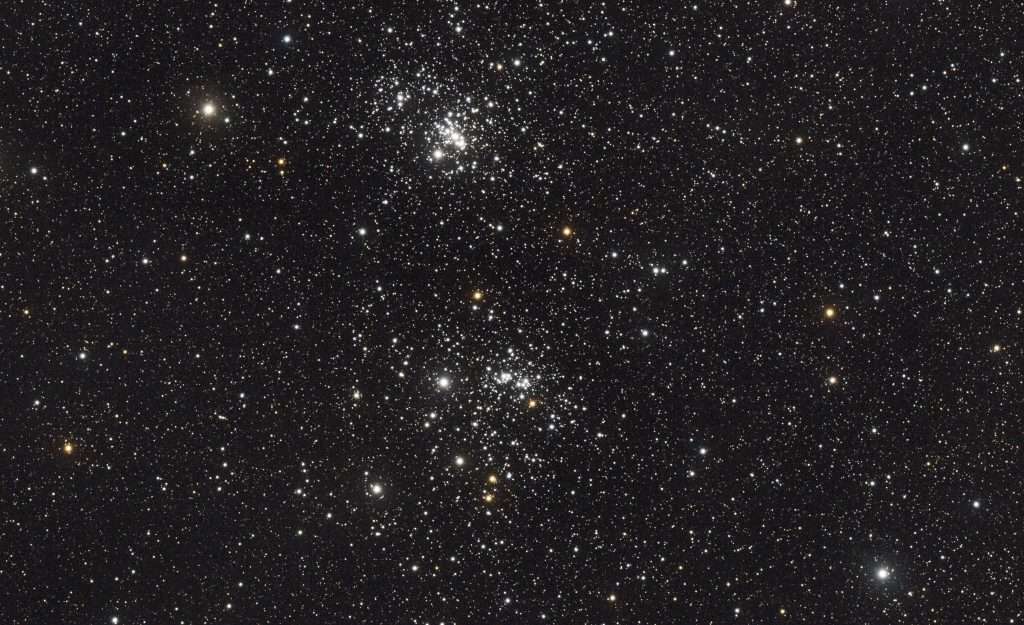
Caldwell 14 – the double cluster

The double cluster Caldwell 14

The Double Cluster or Caldwell 14 are two open star clusters NGC 869 and NGC 884 in the constellation Perseus. They are among the most famous and beautiful clusters visible in the night sky, known for their bright, densely packed stars.

Here are key details about the Double Cluster:

Key Characteristics

  1. Type: Both NGC 869 and NGC 884 are open star clusters, which are groups of stars formed from the same molecular cloud and gravitationally bound to each other.
  2. Location: The Double Cluster lies in the constellation Perseus and is approximately 7,500 light-years away from Earth. It is positioned between the constellations Perseus and Cassiopeia, making it visible from northern latitudes.
  3. Age: NGC 869 is about 14 million years old, while NGC 884 is slightly younger at approximately 12.5 million years. This youthful age means both clusters are rich in hot, blue stars, which are young and massive.
  4. Appearance: The Double Cluster appears as two dense, sparkling regions of stars when viewed through binoculars or a small telescope. Both clusters are roughly the same apparent size and brightness, giving the appearance of a “double” formation. The clusters contain many blue and red supergiants, which add to their visual appeal.
  5. Brightness and Magnitude: Both clusters are bright, with a combined apparent magnitude of around 4.3, making them visible to the naked eye under dark skies. Each cluster is about 30 arcminutes in diameter, roughly the size of the full moon.

Significance and importance

  1. The Double Cluster has been known since antiquity and was cataloged by Greek astronomer Hipparchus around 130 B.C. It was later included in the Caldwell catalog as Caldwell 14 by British astronomer Sir Patrick Moore.
  2. The Double Cluster serves as an excellent laboratory for studying stellar formation and evolution, particularly in young clusters. The stars within the clusters are of similar age and composition, making them ideal for understanding the lifecycle of massive stars.
  3. Visibility: The Double Cluster is best observed in the autumn and winter months for observers in the Northern Hemisphere. It is a favorite target for amateur astronomers due to its striking appearance and ease of observation.

Background

This was the first light object I viewed with a Bresser 127L achromatic refractor some years ago and I returned to it several years later to take this image:

Acquisition:

  • Esprit 100ED triplet on Skywatcher EQ6R-pro mount, Canon 1200D astro modified camera.
  • 60×60 second exposures, 20 Darks, 20 flats, 30 biases.
  • Processed and stacked in SIRIL
Scroll to Top