The Cigar Galaxy Messier 82
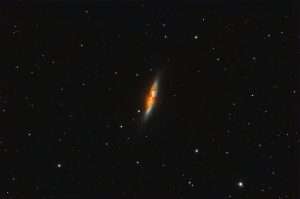
Messier 82 (M82), also known as the Cigar Galaxy, is a starburst galaxy located in the constellation Ursa Major. It is about 12 million light-years away from Earth and has a cigar-like shape when viewed from Earth. This is how it got its name.
Here are some key points about the Cigar Galaxy
Characteristics
- M82 is classified as an irregular starburst galaxy due to its high rate of star formation. This is about ten times higher than in our Milky Way galaxy.
- The galaxy appears elongated, or cigar-shaped, due to its nearly edge-on orientation to our line of sight. It has a bright core, powerful stellar winds and supernova explosions are visible, giving it a distinctive, dynamic look.
- M82’s intense star formation is likely triggered by gravitational interactions with its nearby neighbor, the large spiral galaxy Messier 81 (M81). These interactions have stirred up gas and dust in M82, fueling rapid star formation.
- The galaxy exhibits superwinds, where gas is being blown out from the galaxy’s center due to the combined energy of many supernovae and stellar winds from massive stars. These outflows can be observed in various wavelengths, including X-rays and infrared.
- M82 is famous for its bright red hydrogen emission nebulae, which are seen bursting from its central region. These emissions are caused by the outflowing gas. This glows brightly due to ionization from the intense radiation of young stars.
Discovery and Observation:
- M82 was discovered by Johann Elert Bode in 1774. It is one of the most studied galaxies due to its proximity, brightness, and active star formation and is a popular target for astronomers.
- M82 hosted a notable supernova, SN 2014J, which was a Type Ia supernova discovered in January 2014. It was one of the closest and brightest supernovae observed in recent decades.
M82 is a fascinating object because it gives insights into the processes driving star formation and the impact of superwinds on galaxy evolution. Its vibrant activity and close proximity make it an excellent subject for study across multiple wavelengths, revealing the dynamic nature of starburst galaxies.