Filter posts by category

M101 Pinwheel Galaxy

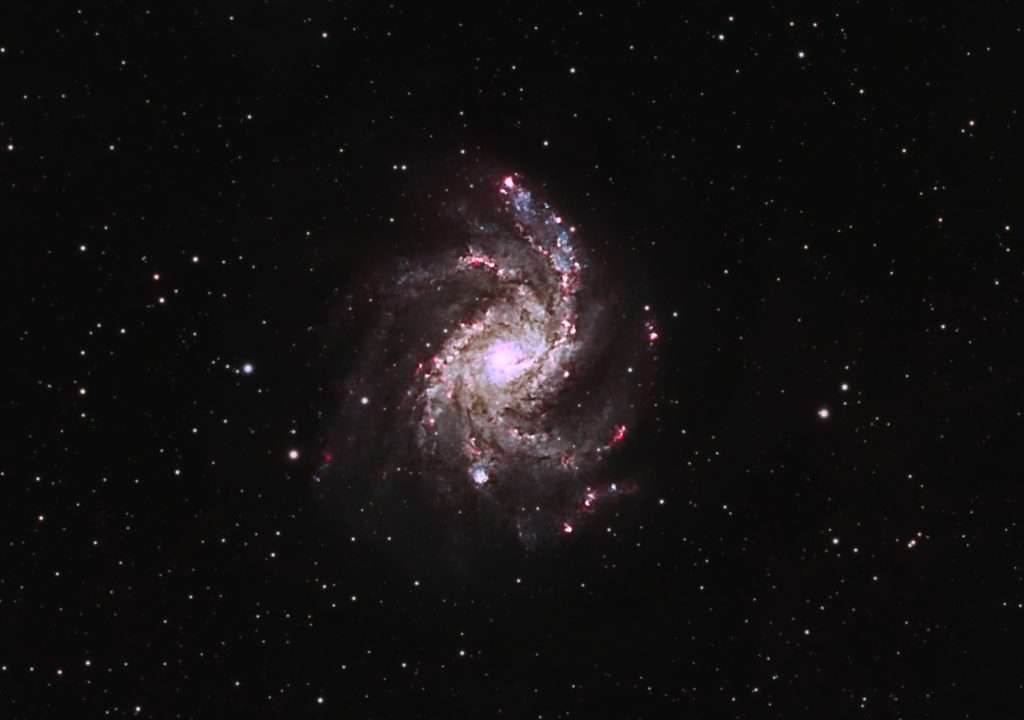
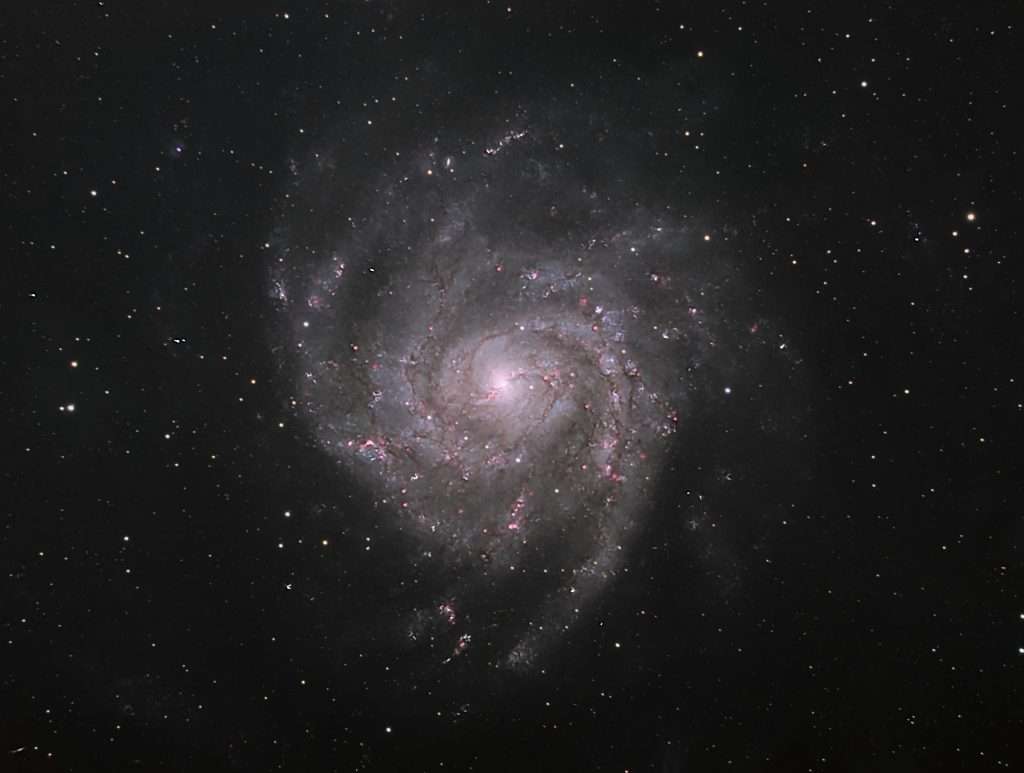
The Pinwheel Galaxy M101

M101 the Pinwheel Galaxy
M101 Pinwheel Galaxy

Messier 101 (M101) – The Pinwheel Galaxy:

M101 is a spiral galaxy in the constellation Ursa Major, approximately 21 million light-years from Earth. It’s also known as the Pinwheel Galaxy due to its prominent spiral arms. It was discovered by Pierre Méchain in 1781 and later catalogued by Charles Messier as part of his famous list. It’s a popular target for amateur astronomers because of its brightness and structure. And I have imaged this target many times.

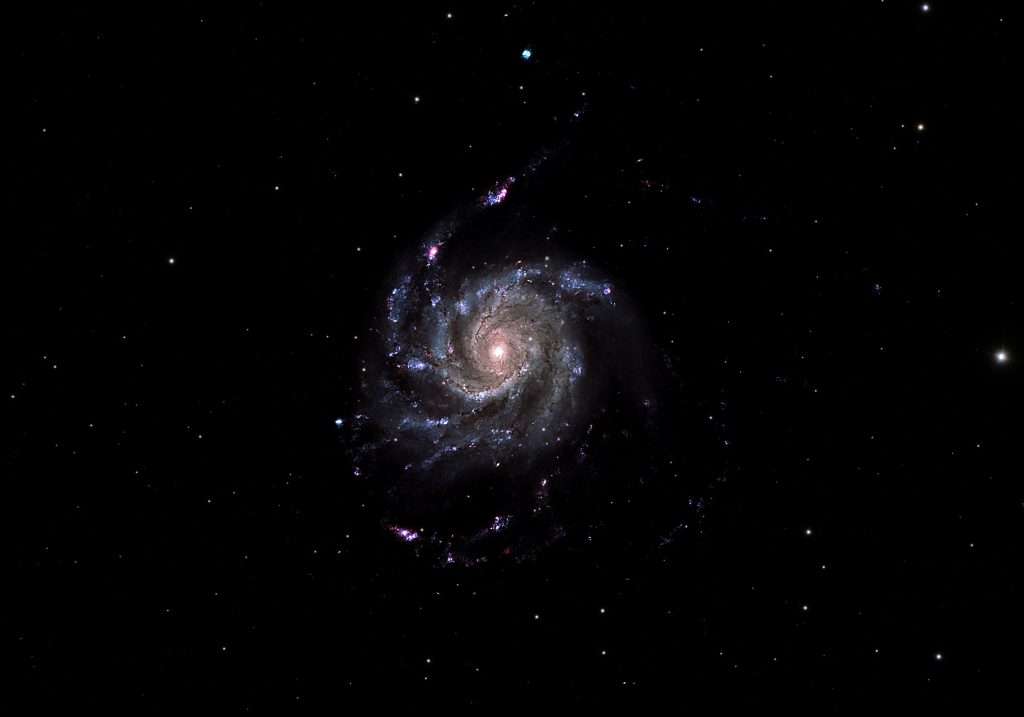
  1. Appearance: The Pinwheel Galaxy is notable for its grand design spiral structure. It has well-defined spiral arms that radiate from its centre. These arms are rich in star-forming regions illuminated by young, hot stars.
  2. Size: It has a diameter of about 170,000 light-years and is bigger than our Milky Way galaxy, which has a diameter of about 100,000 light-years.
  3. Brightness and Magnitude: The galaxy has an apparent magnitude of about 7.9, making it relatively bright and observable with amateur telescopes under good conditions.
  4. Star Formation: The Pinwheel Galaxy is known for its vigorous star formation activity. The spiral arms contain numerous Ha regions –  large clouds of ionized hydrogen where new stars are being born. You can see these areas in the image above.
  5. Companion Galaxies: M101 has several satellite galaxies, including NGC 5474, NGC 5477, and NGC 5485, which interact gravitationally with the main galaxy, influencing its structure and star formation.
  6. Discovery: The galaxy was discovered by Pierre Méchain in 1781 and later catalogued by Charles Messier.

Observation

  1. I imaged the Pinwheel Galaxy during February when Ursa Major was high in the sky. You can see in this image the detail of the spiral arms and Ha regions of intense star formation. Take a look at the image in the gallery is you need a full-sized photo.
  2. Acquisition: I photographed this image with an ASI294MC pro OSC camera in 56x300s shots plus 30x300s Duo narrowband from which I extracted the Ha.
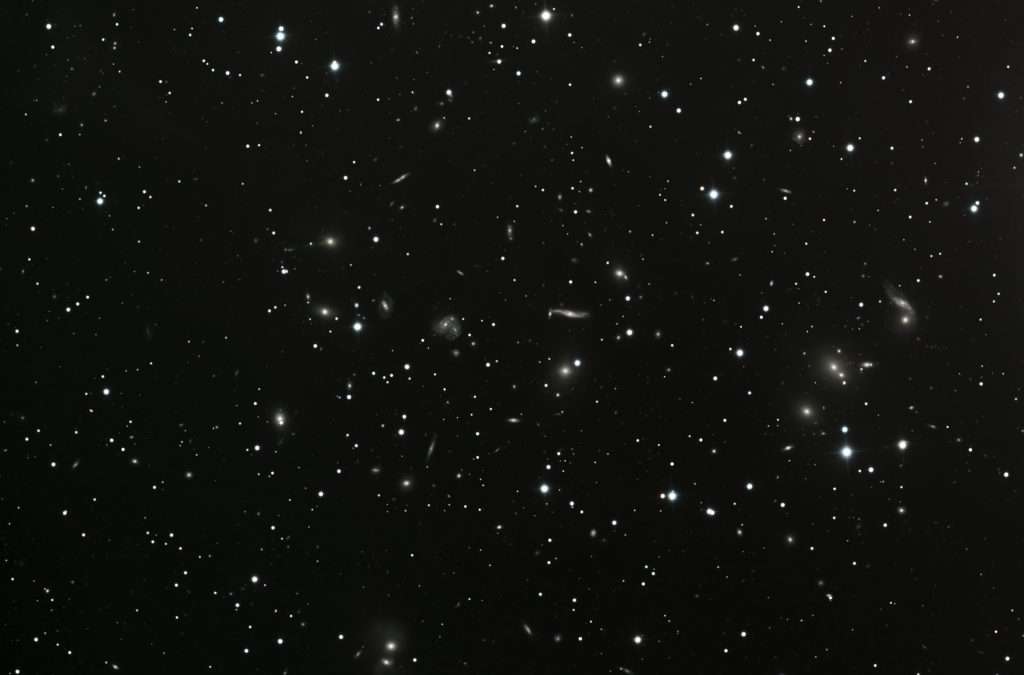
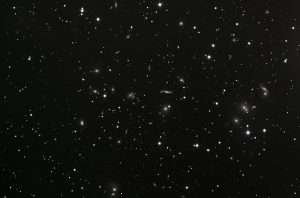
The hercules galxy cluster

The Hercules Galaxy Cluster

Abell 2152: Hercules Galaxy Cluster


The hercules galxy cluster

The Hercules Galaxy Cluster (Abell 2151) is a rich cluster of galaxies in the Hercules’ constellation. It is known for its diverse mix of spiral, elliptical, and irregular galaxies, many actively interacting and merging. This cluster provides valuable insights into galaxy evolution and large-scale cosmic structures.

Structure and Features

  1. Diverse Galaxy Types:
    • Unlike many galaxy clusters that are dominated by massive elliptical galaxies, the Hercules Cluster has a higher proportion of spiral galaxies and irregular galaxies.
    • This suggests that it is still in the process of forming and evolving.
  2. Galaxy Interactions and Mergers:
    • Many of the galaxies in Abell 2151 show signs of collisions, tidal interactions, and distortions, which provide a unique view of galaxy evolution.
    • Several galaxies have extended tidal tails, caused by gravitational interactions.
  3. Brightest Cluster Galaxies (BCGs):
    • The cluster does not have a single dominant brightest cluster galaxy (BCG) like other clusters such as the Virgo Cluster.
    • Instead, it has several prominent galaxies of similar brightness.
  4. Presence of Dark Matter and Hot Gas:
    • Observations in X-rays (from telescopes like Chandra) suggest that the cluster contains hot intergalactic gas, which is a key characteristic of large galaxy clusters.
    • This gas is held together by the cluster’s gravity and suggests the presence of dark matter, which makes up most of the cluster’s total mass.
The Fireworks Galaxy

The Fireworks Galaxy

The Fireworks Galaxy

The Fireworks Galaxy

The Fireworks Galaxy (NGC 6946) is a beautiful, face-on spiral galaxy known for its vibrant appearance and extraordinary rate of supernova events. Located on the border of the constellations Cepheus and Cygnus, it is a prominent target for both professional astronomers and amateur astrophotographers.

Key Characteristics

  1. Type:
    The Fireworks Galaxy is classified as an intermediate spiral galaxy, meaning it has features of both barred and unbarred spirals.

  2. Location and Distance:

    • NGC 6946 is about 25.2 million light-years away from Earth.
    • It is positioned near the plane of the Milky Way, which causes its light to be somewhat obscured by interstellar dust in our galaxy.
  3. Size:
    The galaxy spans about 40,000 light-years, making it smaller than the Milky Way.

  4. Apparent Magnitude:
    NGC 6946 has an apparent magnitude of 9.6, meaning it is too faint to be seen with the naked eye but can be observed with small telescopes under dark skies.

Features and Appearance

  1. Spiral Structure:

    • The Fireworks Galaxy has loosely wound spiral arms filled with bright star-forming regions, giving it a vibrant and “explosive” appearance resembling fireworks.
  2. Star Formation:

    • It is a starburst galaxy, with extremely high rates of star formation compared to other galaxies.
    • Bright, blue areas in the spiral arms indicate regions of young, hot stars.
  3. Dust and Gas:

    • The galaxy contains significant amounts of gas and dust, fueling its star-forming activity.
    • Its core is obscured by interstellar dust, making observations in infrared and radio wavelengths particularly valuable.

Supernova Activity

  1. “Supernova Factory”:

    • NGC 6946 is famously referred to as a “supernova factory” because it has hosted 10 supernovae over the past century—an unusually high number for a galaxy of its size.
    • This high rate of supernova explosions is linked to its vigorous star formation.
  2. Supernova History:

    • The galaxy’s recorded supernovae include SN 1917A, SN 2004et, and SN 2017eaw, among others. These events provide valuable opportunities to study the life cycles of massive stars and their explosive deaths.


M33 Triangulum galaxy

M33 Galaxy

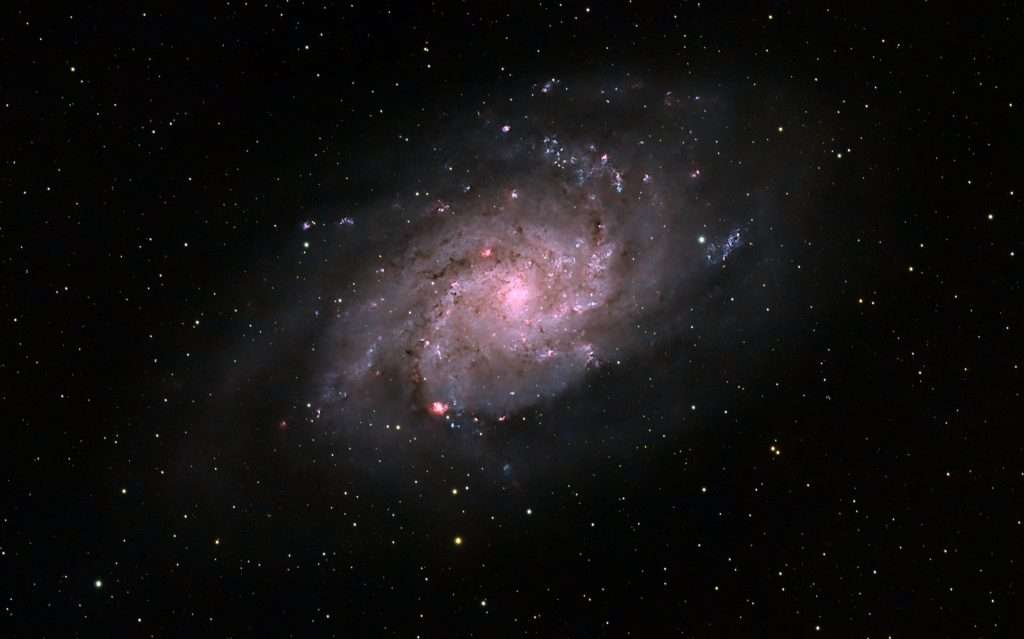
M33 the Triangulum Galaxy


The Triangulum Galaxy (Messier 33, or M33) is a stunning spiral galaxy in the small northern constellation Triangulum. It is one of the closest galaxies to the Milky Way and an important member of the Local Group of galaxies. Key Features

  • Type: The Triangulum Galaxy is classified as a spiral galaxy with a flocculent (loosely wound and fragmented) structure, giving it a less-defined appearance compared to tightly wound spirals like the Andromeda Galaxy.
  • Location and Distance:
    • M33 lies about 2.73 million light-years from Earth.
    • It is in the Triangulum constellation, near the Andromeda Galaxy (M31).
  • Size and Mass:
    • M33 spans about 60,000 light-years in diameter, making it smaller than the Milky Way and Andromeda.
    • It contains an estimated 40 billion stars (compared to the Milky Way’s 100-400 billion).
    • Its mass is roughly 10-20 billion solar masses.
  • Brightness: With an apparent magnitude of 5.7, M33 is faintly visible to the naked eye under very dark skies and appears as a diffuse object in binoculars or small telescopes.

Structure and Features

  1. Spiral Arms:
    • M33’s spiral arms are rich in gas and dust, showing ongoing star formation. The arms are dotted with bright regions of young, hot stars.
  2. Star-Forming Regions:
    • M33 is home to some of the most active H II regions (areas of ionized hydrogen gas) in the Local Group.
    • NGC 604, a massive star-forming region within M33, is one of the largest H II regions known, spanning nearly 1,500 light-years. This is very prominent in the image I took above.
  3. Nucleus:
    • The central nucleus of M33 is relatively small and faint compared to other spiral galaxies.
  4. Metallicity:
    • The galaxy has a relatively low metallicity (abundance of elements heavier than hydrogen and helium), typical of smaller galaxies.

Acquisition Details


The hidden galaxy

The Hidden Galaxy

The Hidden Galaxy IC 342

The hidden galaxy

Key Features of IC 342:

IC 342, often called the “Hidden Galaxy,” is a barred spiral galaxy located in the constellation Camelopardalis. Its nickname comes from its challenging visibility due to its position near the plane of the Milky Way, where dense clouds of gas, dust, and stars obscure it. Despite this, IC 342 is relatively close in astronomical terms, at approximately 7 million light-years from Earth.

  1. Type: IC 342 is classified as a SAB(rs)cd galaxy, indicating it is an intermediate spiral galaxy with loosely wound arms and a small central bar.
  2. Size: It spans about 75,000 light-years in diameter, making it one of the larger nearby galaxies.
  3. Proximity to the Milky Way: IC 342 is part of the IC 342/Maffei Group, one of the closest galaxy groups to our Local Group.
  4. Active Star Formation: The galaxy’s central region is rich in gas and dust, fueling intense star formation. Its core is particularly bright and shows evidence of nuclear activity.
  5. Challenges in Observation: The interstellar dust from the Milky Way dims and reddens the light from IC 342, making detailed studies more difficult compared to other nearby galaxies.

Despite the challenges, IC 342 is of significant interest to astronomers because of its proximity and its close resemblance to our own Milky Way, providing valuable insights into the structure and dynamics of spiral galaxies.

Whale Galaxy

The Whale Galaxy NGC 4631

The Whale Galaxy

The Whale Galaxy (NGC 4631), also known as the Herring Galaxy, is a barred spiral galaxy located about 25 million light-years away in the constellation Canes Venatici. It has an apparent magnitude of 9.8 and appears almost edge-on. When viewed from Earth the shape resembles a whale, hence its name. It is classified as a starburst galaxy, meaning that it has an unusually high rate of star formation compared to most galaxies.

Characteristics of the NGC4631

  • Size: The galaxy spans approximately 140,000 light-years, making it slightly larger than the Milky Way.
  • Companion: The Whale Galaxy has a small elliptical companion galaxy, NGC 4627, often referred to as the “Pup.” Together, they form a system catalogued as Arp 281.
  • Starburst activity: The high rate of star formation is likely due to gravitational interactions with nearby galaxies, which can trigger bursts of star formation.
  • X-ray halo: Observations in X-rays show that the Whale Galaxy has a large, hot gas halo around it, indicating vigorous star formation and supernova activity.
Acquisition

The optical disk of NGC 4631 occupies an area of 15’.5 by 2’.7

The Cigar Galaxy

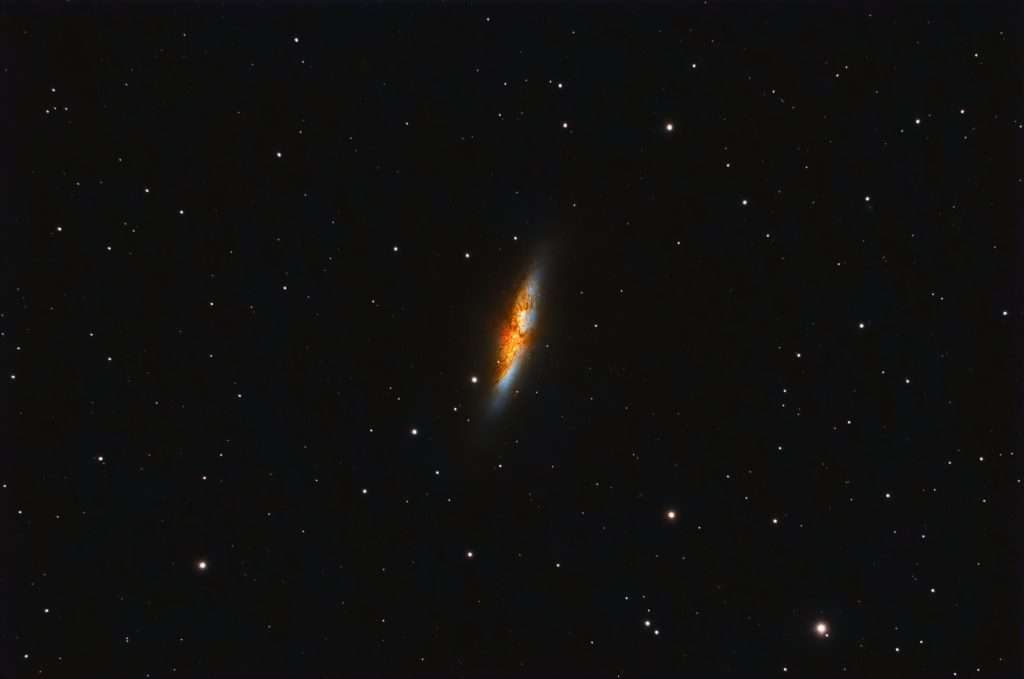
The Cigar Galaxy Messier 82

Messier 82 (M82), also known as the Cigar Galaxy, is a starburst galaxy located in the constellation Ursa Major. It is about 12 million light-years away from Earth and has a cigar-like shape when viewed from Earth. This is how it got its name.

Here are some key points about the Cigar Galaxy

Characteristics

  • M82 is classified as an irregular starburst galaxy due to its high rate of star formation. This is about ten times higher than in our Milky Way galaxy.
  • The galaxy appears elongated, or cigar-shaped, due to its nearly edge-on orientation to our line of sight. It has a bright core, powerful stellar winds and supernova explosions are visible, giving it a distinctive, dynamic look.
  • M82’s intense star formation is likely triggered by gravitational interactions with its nearby neighbor, the large spiral galaxy Messier 81 (M81). These interactions have stirred up gas and dust in M82, fueling rapid star formation.
  • The galaxy exhibits superwinds, where gas is being blown out from the galaxy’s center due to the combined energy of many supernovae and stellar winds from massive stars. These outflows can be observed in various wavelengths, including X-rays and infrared.
  • M82 is famous for its bright red hydrogen emission nebulae, which are seen bursting from its central region. These emissions are caused by the outflowing gas. This glows brightly due to ionization from the intense radiation of young stars.

Discovery and Observation:

  • M82 was discovered by Johann Elert Bode in 1774. It is one of the most studied galaxies due to its proximity, brightness, and active star formation and is a popular target for astronomers.
  • M82 hosted a notable supernova, SN 2014J, which was a Type Ia supernova discovered in January 2014. It was one of the closest and brightest supernovae observed in recent decades.

M82 is a fascinating object because it gives insights into the processes driving star formation and the impact of superwinds on galaxy evolution. Its vibrant activity and close proximity make it an excellent subject for study across multiple wavelengths, revealing the dynamic nature of starburst galaxies.

The Needle Galaxy

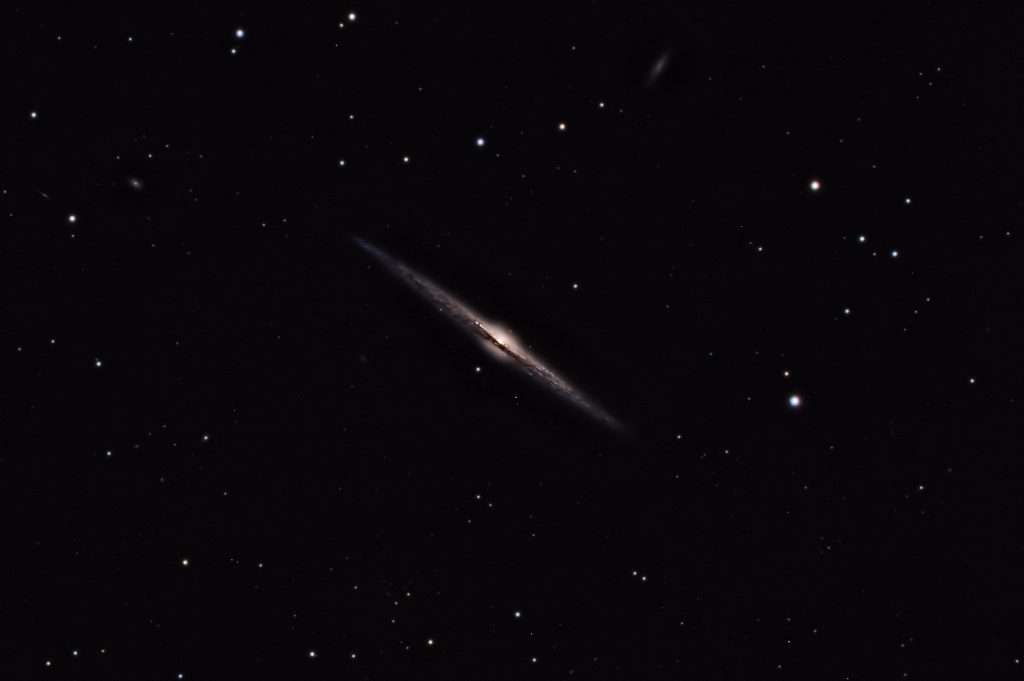
The Needle Galaxy NGC 4565


The Needle Galaxy, also known as NGC 4565, is a stunning spiral galaxy located about 30 to 50 million light-years away in the constellation Coma Berenices. It was discovered by the astronomer William Herschel in 1785 and is considered one of the finest examples of an edge-on spiral galaxy, which is why it is often referred to as the Needle Galaxy due to its slender, needle-like appearance.

Key Characteristics:

  • NGC 4565 is classified as an edge-on spiral galaxy, specifically an Sb-type galaxy, meaning it has moderately tight spiral arms.
  • From Earth, the galaxy is viewed edge-on, presenting a thin, bright central bulge bisected by a prominent dark dust lane. This dust lane outlines the spiral structure and adds to the galaxy’s striking visual appeal.
  • The Needle Galaxy is quite large, spanning about 100,000 light-years in diameter, similar in size to our Milky Way. Its bulge is bright and elongated, tapering off at the edges, enhancing the needle-like look.
  • It has an apparent magnitude of around 10, making it visible with small telescopes under good conditions, though larger telescopes reveal more details of its structure.
  • The prominent dust lane running along the galaxy’s midline is a defining feature. This dust absorbs light, creating a dark band that contrasts with the luminous star-filled disk.

NGC 4565 is part of the Coma I Group, a collection of galaxies that includes other nearby members such as NGC 4559 and NGC 4725.

Acquisition of Image

  • Equipment: Celestron Edge HD on Skywatcher EQ6R-pro using ASI294MC pro camera,
  • 46X240 second lights, 25 Flats, 25 Biases and 15 Darks,
  • Processed in Pixinsight

The Andromeda Galaxy M31

The Andromeda Galaxy M31 (NGC 224)

Andromeda M31 our closest neighbour

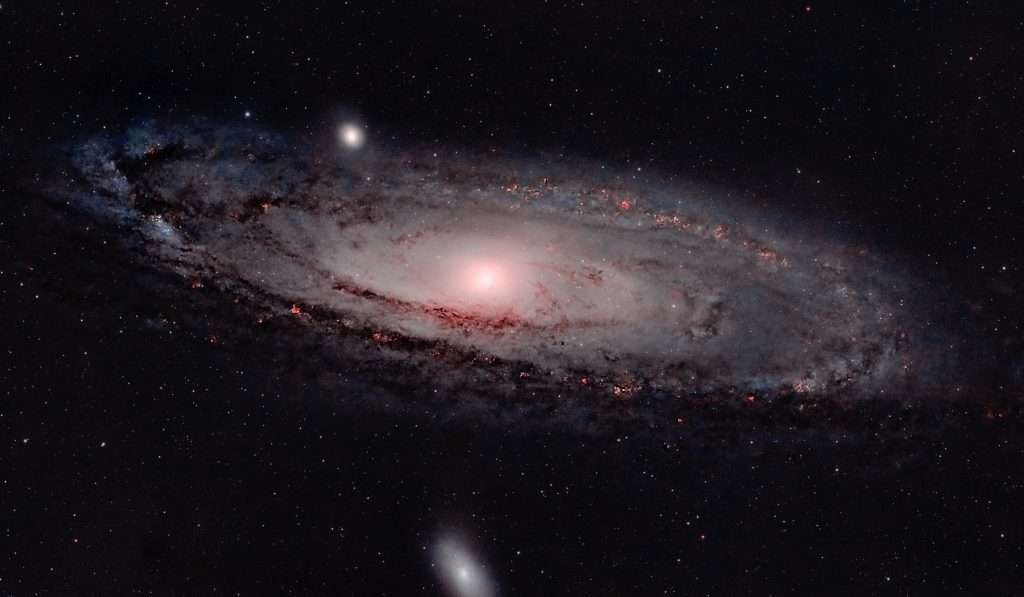
The Andromeda Galaxy is located in the constellation of andromeda with a bright core is visible to the naked eye under dark skies.  Andromeda is the nearest spiral galaxy to our own milky way and the farthest object that can be seen with the naked eye. It lies at a distance of approximately 2.537 million light-years.

M31 brief details
  • It spans a diameter of about 220,000 light-years, making it significantly larger than the milky way. The Milky way has a diameter of about 100,000 light years.
  • M31 is a barred spiral galaxy, similar in structure to the milky way. It contains billions of stars, as well as dust and gas clouds that form new stars.
  • M31 has several satellite galaxies, including m32 and m110, which are visible as smaller, fainter patches of light near m31 as shown above.
  • It’s also large in the sky, spanning around 3deg at its greatest extent (physically, about 220,000 light years), six times the diameter of the full moon along its major axis.

Andromeda is getting closer!

In around 4 billion years, the Andromeda galaxy is projected to collide with the Milky Way. This event is known as the Andromeda–Milky Way collision. This will result in the formation of a single larger galaxy.

Acquisition details: 
  • Esprit 100ED Triplet on AM5 mount,
  • Canon 1200D modified with optolong duo-narrowband filter canon camera,
  • Integration time 6.9 hours with 5 min exposures,
  • Weather clear with with moon > 90% full.
  • Processed in SIRIL to extract Ha and OIII and create RGB stars image processed in Pixinsight.

An earlier image of the andromeda galaxy 

The Andromeda Galaxy in RGB

Scroll to Top