The Needle Galaxy NGC 4565
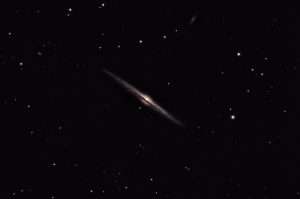
The Needle Galaxy, also known as NGC 4565, is a stunning spiral galaxy located about 30 to 50 million light-years away in the constellation Coma Berenices. It was discovered by the astronomer William Herschel in 1785 and is considered one of the finest examples of an edge-on spiral galaxy, which is why it is often referred to as the Needle Galaxy due to its slender, needle-like appearance.
Key Characteristics:
- NGC 4565 is classified as an edge-on spiral galaxy, specifically an Sb-type galaxy, meaning it has moderately tight spiral arms.
- From Earth, the galaxy is viewed edge-on, presenting a thin, bright central bulge bisected by a prominent dark dust lane. This dust lane outlines the spiral structure and adds to the galaxy’s striking visual appeal.
- The Needle Galaxy is quite large, spanning about 100,000 light-years in diameter, similar in size to our Milky Way. Its bulge is bright and elongated, tapering off at the edges, enhancing the needle-like look.
- It has an apparent magnitude of around 10, making it visible with small telescopes under good conditions, though larger telescopes reveal more details of its structure.
- The prominent dust lane running along the galaxy’s midline is a defining feature. This dust absorbs light, creating a dark band that contrasts with the luminous star-filled disk.
NGC 4565 is part of the Coma I Group, a collection of galaxies that includes other nearby members such as NGC 4559 and NGC 4725.
Acquisition of Image
- Equipment: Celestron Edge HD on Skywatcher EQ6R-pro using ASI294MC pro camera,
- 46X240 second lights, 25 Flats, 25 Biases and 15 Darks,
- Processed in Pixinsight