The Bubble Nebula NGC 7635
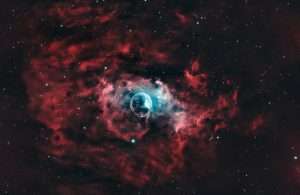
The Bubble Nebula (also known as NGC 7635) is a dynamic emission nebula located in the constellation Cassiopeia. Its nickname comes from its distinctive ‘bubble-like’ appearance. Which is formed by the interaction between a hot, massive star and the surrounding interstellar material.
The Bubble Nebula:
- Location and Distance:
- The Bubble Nebula lies about 7,100 light-years away from Earth.
- It is part of a larger complex of interstellar gas and dust interacting with nearby star-forming regions.
- Central Star (SAO 20575):
- A massive O-type star called SAO 20575 (BD+60°2522) is at the heart of the Bubble Nebula. It is about 40 times more massive than the Sun and much hotter and brighter. It has a surface temperature of 37,500K and is 400,000 times more luminous than the sun.
- This star is classified as a Wolf-Rayet star. A Wolf-Rayet star is a class of very hot and massive stars that are in a late stage of evolution and losing mass at a very high rate through powerful stellar winds.
Formation of the Bubble Nebula
- The intense stellar wind (streams of charged particles) emanating from the central star formed the “bubble”. These stellar winds, moving at speeds of around 6.5 million km/h (4 million mph), push the surrounding gas outward, creating a spherical cavity or “bubble” in the surrounding interstellar gas.
- The expanding bubble is 7 light-years in diameter, meaning it is large on a cosmic scale, though it appears small in telescopes due to its distance.
- The gas in the nebula glows due to ionization from the central star’s radiation. The star’s intense ultraviolet radiation excites the gas in the surrounding material, causing it to emit light, predominantly in the H-alpha line and is why the nebula is classified as an emission nebula. An emission nebular shines due to the excitation of its gas by the central star.
- The nebula is not a perfect sphere because its expansion is slowed down by denser regions of the interstellar medium. In other directions, the bubble expands more freely.
Acquisition:
This was imaged when the moon was 74% illuminated so I elected to use a duo narrow-band filter to manage moon glow.
- Celestron Edge HD800 on EQ6R-pro camera ASI294MC-pro with optolong duo L-Enhanced filter,
- 74X300 second lights, 30 Flats, 15 Darks and 30 Biases,
- Processed in SIRIL for stacking of separate Ha and OIII channels post this Pixinsight for final processing.