The Butterfly Nebula in Cygnus
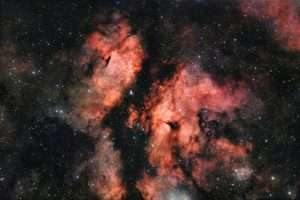
The Butterfly Nebula, IC 1318 in the constellation Cygnus, is a prominent emission nebula surrounding the bright star Sadr** (Gamma Cygni). The nebula is called Gamma Cygni although, the star Sadr is not associated with the nebula – it is much closer. This region is a complex, bright area of hydrogen gas ionised by nearby young, massive stars. Its red glow appears in images taken through H-alpha (Ha) filters. IC 1318 has its distinctive shape, reminiscent of butterfly wings, caused by a dense band of dark dust, known as LDN 889, separating the nebula’s two main lobes. This dust band obscures parts of the nebula and gives it a striking appearance.
The Butterfly Nebula lies approximately 2,000 to 5,000 light-years from Earth and spans about three degrees of the sky. To capture its detailed structure, astrophotographers often use narrowband filters, like Hα or OIII. These will emphasize the rich red hues of ionized hydrogen gas and the blue-green shades of oxygen and sulfur. Narrow-band imaging enables false-colour imaging techniques. A Canon 1200D captured the image in broadband without filters.
Acquisition:
- 45X 4 minute exposures for a total integration time of 3.8 hours,
- Skywatcher Esprit 100ED super triplet on EQR-pro,
- Canon 1200D modified camera.
To enhance the details in the nebula structure this object will be reimaged using narrow-band filters.
**With an apparent visual magnitude of 2.23 Gamma Cygni is among the brighter stars in the night sky. The star’s stellar classification is F8 Iab, indicating that it has reached the supergiant stage of its stellar evolution see more about Sadr on Wikipedia.