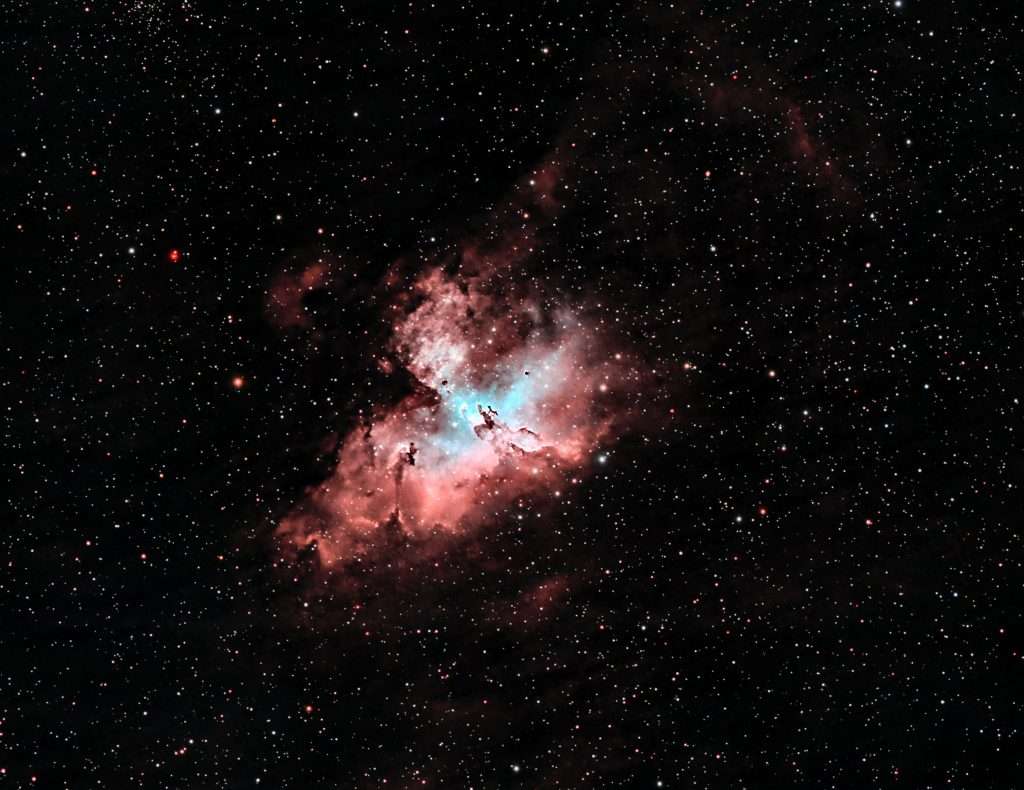
The Orion Nebula M42
Characteristics
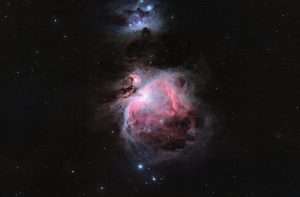
The Orion Nebula (Messier 42) is located in the constellation Orion, approximately 1,344 light-years from Earth. The nebula spans about 24 light-years, making it one of the brightest and most massive star-forming regions visible in the night sky.
- Star Formation: The Orion Nebula is a stellar nursery, where new stars are born from vast clouds of gas and dust. It contains young, hot stars that emit powerful radiation, shaping the surrounding nebula.
- Trapezium Cluster: At its core is the Trapezium Cluster, a group of four massive, young stars that illuminate much of the nebula. Unfortunately, they are only just visible in this image. Their intense ultraviolet radiation causes the surrounding hydrogen gas to glow, giving the nebula its distinctive bright and colourful appearance.
- HII Region: The Orion Nebula is classified as an HII region and is filled with ionized hydrogen, which emits light when the high-energy radiation from young stars excites it.
- Protoplanetary Disks (Proplyds): The nebula contains many protoplanetary disks, or proplyds, which are the early stages of solar system formation. These disks around young stars could one day evolve into planets.
- Observability: The Orion Nebula is visible to the naked eye under good conditions and appears as a faint, fuzzy patch in the “sword” of Orion. Through a pair of binoculars or a telescope, the nebula reveals its intricate, glowing structure.
Acquisition:
I imaged this target during a brief respite in the weather and was only able to collect limited data. The strategy was to take two sets of images at 30-second and 180-second exposures. This was a mistake. The 180-second exposures aimed to catch the outer fainter nebula while the 30-second frames hopefully caught the core without overexposure. And could be used in processing as a mask to control the longer exposure images. This approach was only partially successful due to extreme exposure of the core at 180 seconds.
- Esprit 100ED triplet using a Canon 1200D modified camera on a Skywatcher EQ6R-pro,
- Lights 28X at 180 seconds, 14X at 30; 20X Flats, 24X biases and 20X darks at 180 and 30 seconds respectively.
- Weather poor rain moving in the moon was at 5%.