The Tarantula Nebula
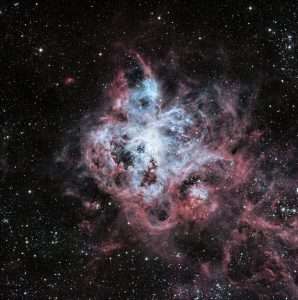
The Tarantula Nebula (also known as 30 Doradus) is a giant star-forming region in the Large Magellanic Cloud (LMC), a satellite galaxy of the Milky Way, about 160,000 light-years away from Earth. Located in the constellation Dorado, the nebula is one of the largest and most active star nurseries in our local group of galaxies, spanning about 1,000 light-years across. Its structure is filled with gas and dust filaments resembling a spider’s legs, which is how it earned the name “Tarantula.”
Key Features of the Tarantula Nebula:
- Star Formation: The Tarantula Nebula is an extremely active region where new stars are constantly forming. The intense ultraviolet radiation from young, massive stars within the nebula causes it to glow brightly and energizes the surrounding gas.
- Massive Stars: Within the nebula lies the R136 star cluster, home to some of the most massive and luminous stars known, some exceeding 100 times the mass of our Sun. These stars are incredibly hot and emit intense radiation, shaping the surrounding gas and dust.
- Supernovae: The nebula has been a site for supernova explosions, the most famous being SN 1987A, one of the brightest supernovae observed in the last few centuries. The remnants of these explosions interact with the surrounding material, creating shock waves and further triggering star formation.
- Potential Future: With so many massive stars concentrated in one area, the Tarantula Nebula could eventually form a super star cluster, a rare cluster with a high concentration of stars.
In visible light, the nebula’s structure is bright and detailed, while in other wavelengths, such as infrared and X-rays, it reveals hidden details like newborn stars still embedded in clouds of dust and energetic outflows from massive stars. Because of its proximity and intensity, the Tarantula Nebula is an invaluable site for studying star formation and the evolution of massive stars.