The Rosette Nebula

Key Features of this Nebula
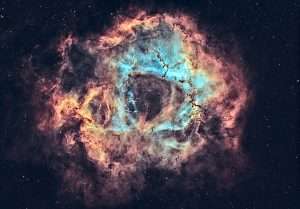
The Rosette Nebula (NGC2237) is a large, circular region of ionized hydrogen gas and dust in the constellation Monoceros. And near the border with the constellation Orion. It is an emission nebula and glows because of the intense radiation of nearby stars, which ionises hydrogen gas.
Key Features of the Nebula:
- Distance: The nebula is approximately 5,000 light-years away from Earth.
- Size: It spans about 130 light-years across, making it one of the largest observable nebulae in the sky.
- Star Formation: At its centre is a cluster of young, massive stars known as NGC 2244. These stars were formed from the nebula’s material and their intense ultraviolet radiation causes the surrounding hydrogen gas to glow.
- Shape: The name “Rosette” comes from its resemblance to a Tudor rose in astrophotographs, with its circular shape and intricate structure of gas and dust.
Observation:
- You can see this Nebula with binoculars or small telescopes under dark skies. Astrophotography is better to capture the details. I captured this image using a dual narrow-band filter and a Canon 1200D-modified camera with my Esprit 100ED.
- Coordinates: It lies in the celestial coordinates near RA 06h 33m, Dec +04° 59′.
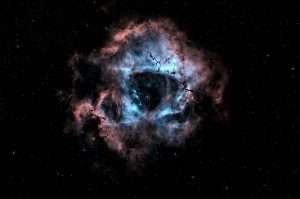
Image of Rosette Nebula using Narrowband filers
I captured this extra image on a moonlit night (65%) in January using Ha/OIII/SII filters. The scope I used was an Esprit 100ED with ZWO filters and 100x lights at 60 seconds for each filter. I stacked and processed the image set in Pixinsight.