The Hunter’s Moon 2024
When does it occur?
The Hunter’s Moon is traditionally given to the full moon that occurs after the Harvest Moon. This is the full moon closest to the autumnal equinox (around September 22-23). This full moon typically appears in October, though occasionally, it can fall in early November.
Origins of the Name
The name comes from traditional agricultural and hunting practices. After the harvest, hunters took advantage of the bright moonlight to hunt game, which was often easier to spot in fields cleared of crops. This was important for preparing food stores for the winter.
Unique Characteristics
- Bright and Early Rise: This autumnal moon rises around the same time as the sun sets, providing extra illumination for several nights. This happens because the moon’s orbit during this time of year has a relatively shallow angle to the horizon.
- Larger and More Colorful Appearance: While the Moon is not actually larger or closer to Earth, it may appear bigger or more colourful (orange or red) when it is near the horizon. This effect is due to the Earth’s atmosphere scattering shorter wavelengths of light.
The Hunter’s Moon, like other full moons, has been a subject of folklore, cultural traditions, and celestial observation throughout history.
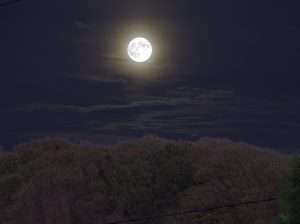
This image is a one-shot photograph looking east from our house on the South Coast and taken on October 17, 2024. With a Canon R10 and standard kit lens and processed in Affinity Photo. Affinity Photo was used to calm the moon’s brightness and bring up the foreground woodland.
William Shakespeare and The Hunter’s Moon
William Shakespeare mentioned the Hunter’s Moon in his play “Henry IV, Part I.” In Act I, Scene 2, the character Falstaff humorously refers to the Hunter’s Moon:
“Dost thou not see, thou knave, that it is past ten o’clock, and the moon shines fair? Thou sayest true; the moon shines fair; you are a leader of the moonshine company.”
Though Falstaff doesn’t explicitly say “Hunter’s Moon,” this phrase often refers to the bright, autumnal full moon that would have been familiar in Shakespeare’s time. Shakespeare’s works frequently allude to natural phenomena, including lunar phases, but his specific reference is tied more to poetic imagery and interpretation rather than naming it directly.