Rho Ophiuchi
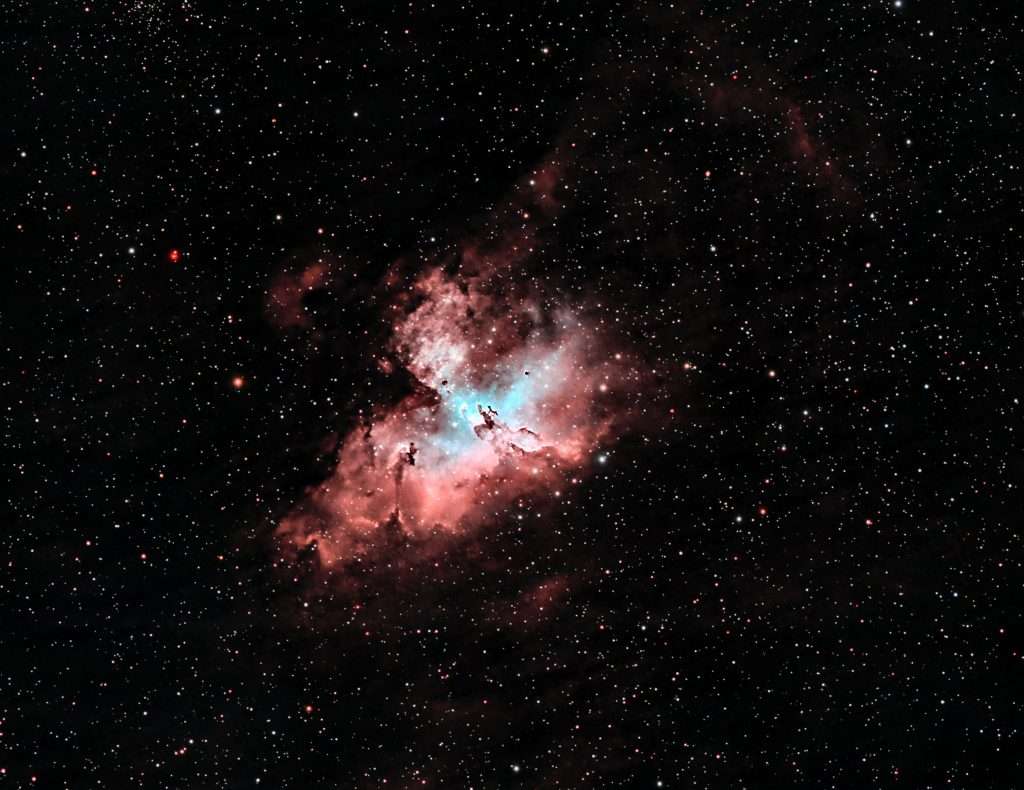
The Rho Ophiuchi complex is a molecular cloud and star-forming region, containing areas of both dark nebulae and reflection nebulae. It is also home to emission nebulae, where ionized gas glows due to energetic radiation. This image was created from six hours of RGB data from Telescope Live. The FITS images had several annoying defects but I was able to remove these during processing. Pixinsight was used to preprocess, stack, and stretch the images.
Some details about Rho Ophiuchi
- Location and Distance:
It is located about 394 light-years from Earth, making it one of the closest star-forming regions to our solar system. - Size and Structure:
The cloud complex spans about 14 light-years and is divided into several distinct regions. These are identified by their catalogue designations, such as L1688 one of the most active star-forming parts of the complex. - Associated Stars:
- The Rho Ophiuchi complex gets its name from Rho Ophiuchi, a multiple-star system embedded in the region. This system has young, hot stars that contribute to the illumination of the surrounding gas and dust.
- Young stars and protostars, surrounded by disks of gas and dust, are scattered throughout the complex.
- Features:
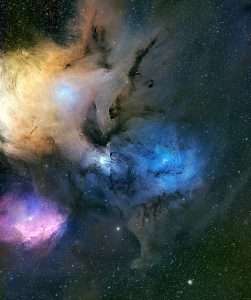
- Reflection Nebulae: The bluish glow in some parts of the complex comes from light scattering off dust particles again from hot, young stars.
- Dark Nebulae: Other areas appear as dark patches when dense dust clouds block the background starlight.
- Emission Nebulae: Intense ultraviolet radiation from nearby stars ionises hydrogen gas causing the Red and Pink hues seen in the image.
- Star Formation:
- The Rho Ophiuchi complex is an active stellar nursery, with stars in various stages of formation, from collapsing protostars to fully formed young stars.
- Many of these young stars are T Tauri stars, which are in the pre-main-sequence phase of stellar evolution