The Carina Nebula
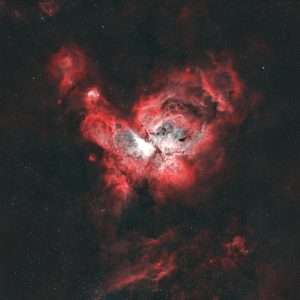
The Carina Nebula (NGC 3372) is one of the largest, brightest, and most dynamic star-forming regions in the Milky Way. It is in the constellation Carina and is a spectacular area of gas, dust, and young stars.
Key Characteristics
- The Carina Nebula is a giant emission nebula and stellar nursery, known for active star formation and massive, luminous stars.
- It lies about 8,500 light-years away from Earth and spans roughly 460 light-years across. This makes it one of the largest nebulae visible in our galaxy.
- The nebula is a vibrant mix of red, pink, and orange hues, produced by ionized hydrogen gas emitting light due to intense ultraviolet radiation from nearby massive stars.
- It also features dark nebulae, intricate filaments of dense dust, which block light from behind.
- The Carina Nebula is roughly four times the size and significantly brighter than the Orion Nebula, but its southern location makes it less known to observers in the Northern Hemisphere.
Prominent Stars and Features:
- Eta Carinae: One of the most famous stars in the nebula, Eta Carinae is a volatile and massive binary star system with an estimated mass of over 100 solar masses. This binary system will end in a supernova or hypernova soon (astronomically speaking).
- Trumpler 14 and 16: These are young, bright open star clusters within the nebula.
- Homunculus Nebula: A bipolar nebula surrounding Eta Carinae, formed by a massive eruption in the 19th century.
Scientific Importance
- Star Formation:
- The Carina Nebula is a stellar nursery where hundreds of massive stars and thousands of smaller stars are being born.
- Proto and newborn stars can be observed in it’s dense gas clouds. This gives us valuable insights into the early stages of stellar evolution.
- Massive Stars and Supernovae:
- Many of the stars in the nebula are among the most massive and luminous known, contributing to the nebula’s intense radiation and energetic winds.
- The Carina Nebula contains remnants of past supernovae and is likely to produce more, particularly when Eta Carinae eventually explodes.
- Dust and Molecular Clouds:
- Dense molecular clouds in the nebula are sites of star formation, while the radiation from massive stars sculpts and disperses the gas and dust, creating striking structures.
Visibility
- The Carina Nebula is in the Southern Hemisphere and this image was created using a remote telescope in Australia using Telescope Live. Pixinsight was used to stack and process the 12 hours of LRGB data.
- It is visible to the naked eye as a diffuse patch of light under dark skies and in binoculars or telescopes, the nebula reveals intricate details of its glowing gas and star clusters.