The Fireworks Galaxy
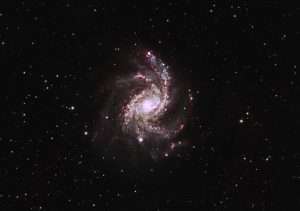
The Fireworks Galaxy (NGC 6946) is a beautiful, face-on spiral galaxy known for its vibrant appearance and extraordinary rate of supernova events. Located on the border of the constellations Cepheus and Cygnus, it is a prominent target for both professional astronomers and amateur astrophotographers.
Key Characteristics
Type:
The Fireworks Galaxy is classified as an intermediate spiral galaxy, meaning it has features of both barred and unbarred spirals.Location and Distance:
- NGC 6946 is about 25.2 million light-years away from Earth.
- It is positioned near the plane of the Milky Way, which causes its light to be somewhat obscured by interstellar dust in our galaxy.
Size:
The galaxy spans about 40,000 light-years, making it smaller than the Milky Way.Apparent Magnitude:
NGC 6946 has an apparent magnitude of 9.6, meaning it is too faint to be seen with the naked eye but can be observed with small telescopes under dark skies.
Features and Appearance
Spiral Structure:
- The Fireworks Galaxy has loosely wound spiral arms filled with bright star-forming regions, giving it a vibrant and “explosive” appearance resembling fireworks.
Star Formation:
- It is a starburst galaxy, with extremely high rates of star formation compared to other galaxies.
- Bright, blue areas in the spiral arms indicate regions of young, hot stars.
Dust and Gas:
- The galaxy contains significant amounts of gas and dust, fueling its star-forming activity.
- Its core is obscured by interstellar dust, making observations in infrared and radio wavelengths particularly valuable.
Supernova Activity
“Supernova Factory”:
- NGC 6946 is famously referred to as a “supernova factory” because it has hosted 10 supernovae over the past century—an unusually high number for a galaxy of its size.
- This high rate of supernova explosions is linked to its vigorous star formation.
Supernova History:
- The galaxy’s recorded supernovae include SN 1917A, SN 2004et, and SN 2017eaw, among others. These events provide valuable opportunities to study the life cycles of massive stars and their explosive deaths.
| Target: | Date: | Time: |
|---|---|---|
| Scope: | ||
| Camera: | ||
| Filters: | ||
| Lights: | ||
| Calibration: | ||
| Processing: | ||
| Seeing: |