Small Magellanic Cloud (SMC)
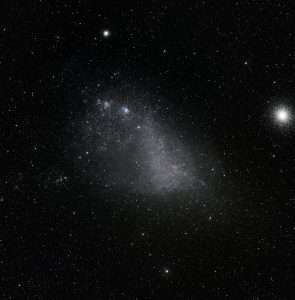
The Small Magellanic Cloud (SMC) is a dwarf irregular galaxy and one of the closest galaxies to the Milky Way. It is a satellite galaxy of our own and is visible to the naked eye from the Southern Hemisphere.
Key Characteristics
- Type:
- The SMC is classified as a dwarf irregular galaxy, lacking a well-defined spiral structure.
- Some observations suggest it may have once been a barred spiral galaxy, distorted over time due to gravitational interactions.
- Location and Distance:
- The SMC is located near the LMC (Large Magellanic Cloud) in the constellation Tucana.
- It lies about 200,000 light-years from Earth, making it one of the closest galaxies to the Milky Way.
- Size and Mass:
- It spans about 7,000 light-years across.
- The SMC contains about 3 billion stars, much fewer than the Milky Way, which has hundreds of billions.
- It has a mass of around 7 billion solar masses.
- Apparent Magnitude:
- With an apparent magnitude of +2.7 to +3.0, it is visible to the naked eye under dark skies.
The Small Magellanic Cloud (SMC) is a fascinating dwarf galaxy that provides insights into cosmic evolution, star formation, and galactic interactions. As one of our closest galactic neighbours, it remains a crucial target for astronomers studying the history and future of galaxies.
Cultural and Historical Significance
- Named After Ferdinand Magellan:
- The Magellanic Clouds were named after the Portuguese explorer Ferdinand Magellan, who documented them during his voyage around the world in 1519-1522.
- Recognized by Ancient Cultures:
- Indigenous cultures in South America, Australia, and Africa have long known about the SMC and included it in their myths and legends.