Pickering’s Triangle
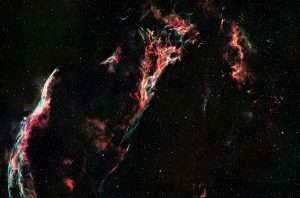
Pickering’s Triangle is a delicate filamentary structure within the Veil Nebula, a large supernova remnant in the constellation Cygnus. It is one of the most striking features of the Veil Nebula due to its intricate, web-like appearance and faint, glowing filaments of ionised gas. And it represents a segment of the shock wave from the supernova explosion. Pickering’s Triangle is named after Edward Charles Pickering, the director of the Harvard College Observatory,
This structure is notable for its intricate filamentary patterns, created by the interaction of the supernova’s shock wave with the surrounding interstellar medium. The filaments are primarily composed of ionized gas, which glows due to the energy from the shock wave. Pickering’s Triangle is a popular target for astrophotographers and astronomers due to its complex and visually striking appearance.
Structure and Appearance
- Filamentary Structure:
- Pickering’s Triangle consists of thin, glowing filaments of ionised hydrogen, oxygen, and sulphur.
- These filaments trace the edges of the expanding shock wave from a supernova explosion.
- Part of the Veil Nebula:
- The Veil Nebula is the remnant of a supernova explosion that occurred around 10,000–20,000 years ago.
- Other prominent parts of the Veil Nebula include the Western Veil (Witch’s Broom Nebula, NGC 6960) and the Eastern Veil (NGC 6992/6995).
- Ionisation and Colour:
- The nebula’s glow comes from ionised gases:
- Oxygen (O III) produces a blue-green glow.
- Hydrogen (Hα) and Sulphur (S II) create reddish-pink hues.
- The nebula’s glow comes from ionised gases:
Conclusion
Pickering’s Triangle is a stunning feature of the Veil Nebula, known for its intricate glowing filaments shaped by a supernova shock wave. Though faint, it is a remarkable target for astrophotographers and astronomers, providing insights into supernova physics, interstellar chemistry, and the evolution of massive stars.