Centaurus A: A Galaxy Torn Apart and Powered from Within
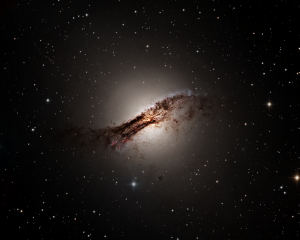
Among the many galaxies in the southern sky, Centaurus A (NGC 5128) stands out as one of the strangest—and most energetic. About 12 million light-years away, this galaxy is a cosmic mash-up, the aftermath of a collision between a massive elliptical galaxy and a smaller spiral. The result is a spectacular hybrid: a giant elliptical body wrapped in a thick, dark dust lane that cuts across its centre like a cosmic scar.
At the Heart: A Monster Black Hole
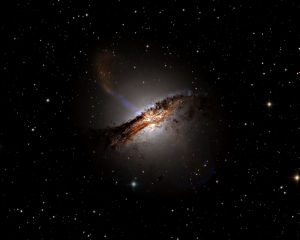
Deep inside that dust lane sits a supermassive black hole with a mass of roughly 55 million Suns. As gas and dust spiral inward, they heat to incredible temperatures, forming a brilliant accretion disk. This disk funnels magnetic energy that launches one of Centaurus A’s most iconic features.
The Relativistic Jet
Centaurus A produces a colossal, high-energy jet that blasts out from its core at nearly the speed of light. This jet stretches thousands of light-years into space in visible and radio wavelengths—and in radio it balloons into enormous lobes spanning over a million light-years.
What makes this jet so remarkable?
- Powered by the black hole’s rotation and twisted magnetic fields
- Bright in radio, X-ray, and gamma-ray wavelengths
- Packed with ultra-relativistic particles
- Strong enough to sculpt the surrounding intergalactic medium
It’s one of the closest active galactic nuclei (AGN) to Earth, giving astronomers a front-row seat to study how black holes launch such extreme jets.
A Galaxy in Transformation
The dramatic dust lane, chaotic star-forming regions, and warped structure all tell the story of a galaxy still recovering from its past merger. Meanwhile, the jet reveals the tremendous power of the central engine still feeding on the debris.
🔭 A Target That Never Disappoints
For observers and imagers lucky enough to view the southern sky, Centaurus A is a favourite:
- Its dark dust band shows striking detail even with amateur telescopes.
- Long-exposure imaging captures its radio-bright lobes and hints of the central jet.
- Multi-wavelength data from professional observatories reveal layer upon layer of complex activity.