IC 342: The Hidden Galaxy
Often called the “Hidden Galaxy” or “The Hidden Treasure Galaxy,” IC 342 is one of the most intriguing spiral galaxies in our cosmic neighbourhood. Located about 10–11 million light-years away in the constellation Camelopardalis, it sits near the plane of the Milky Way, where dense fields of stars and interstellar dust obscure it from view. This makes IC 342 challenging to study and image in visible light—hence its nickname.

A Grand Design Spiral Galaxy
IC 342 is classified as a SAB(rs)cd galaxy:
- SAB — a weakly barred spiral
- (rs) — showing a subtle ring-like structure
- cd — loosely wound, patchy spiral arms rich in gas and star-forming regions
It’s often referred to as a “grand design” spiral, meaning its arms trace a clear, well-defined pattern rather than a chaotic or flocculent structure.
A Large Member of the Local Cosmic Neighbourhood
Although obscured, IC 342 is big—roughly comparable in size to the Milky Way. If not for the foreground dust, it would be one of the brightest galaxies in the sky. Its mass and luminosity make it a major component of the IC 342/Maffei Group, one of the closest galaxy groups to our own.
A Star-Forming Powerhouse
Under the dust, IC 342 is bustling with activity:
- It contains many H II regions and giant molecular clouds.
- Its central region is undergoing intense star formation, sometimes considered a mild starburst nucleus.
- Infrared observations reveal strong emission from warm dust heated by young stars.
Why It’s Hard to Observe
Because it lies almost exactly along the Galactic equator, dust in the Milky Way absorbs and scatters visible light. Observers rely on:
- Infrared,
- Radio, and
- X-ray wavelengths to view IC 342 clearly, making it a great target for multi-wavelength astronomy.
A Rewarding Target for Astrophotographers
For astrophotographers, IC 342 is both a challenge and a gem:
It requires dark skies, long exposures, and often narrowband or IR-sensitive equipment to pull out its subtle spiral structure.
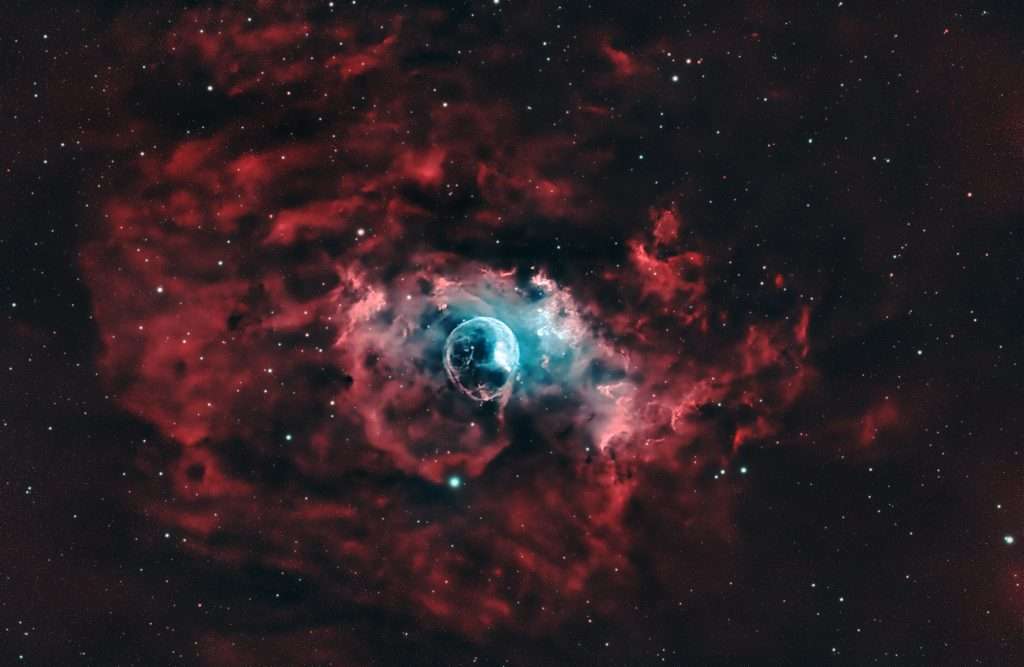
This image integration time was 137×300 seconds RGB from a OSC camera with 90x300seconds Ha.