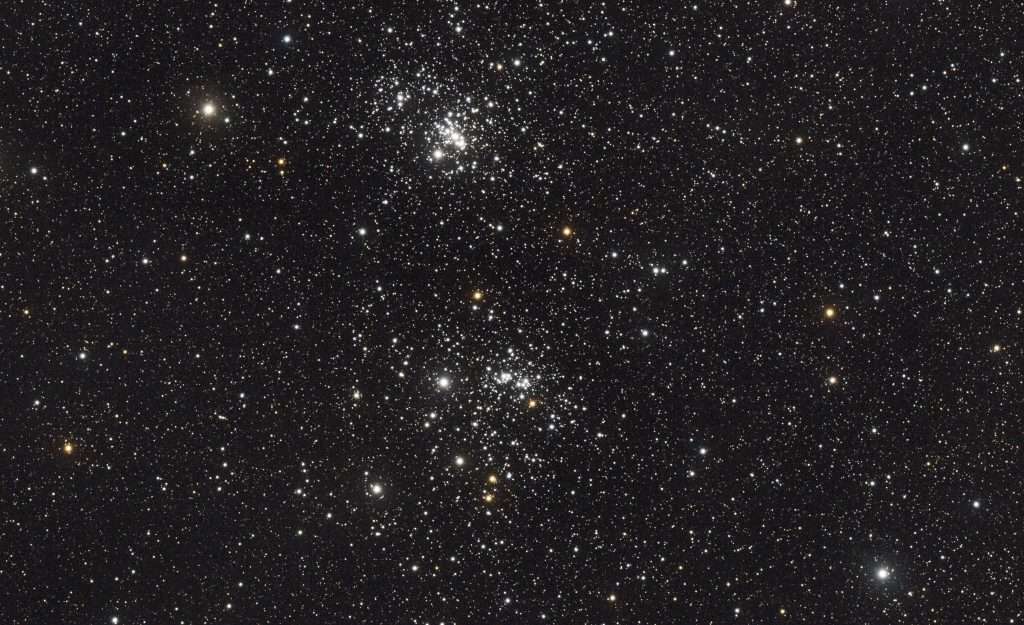
The Pleiades Star Cluster
The Pleiades, also known as Messier 45 (M45) or the Seven Sisters, is one of the most famous open star clusters in the night sky. Located in the constellation Taurus, the Pleiades is a stunning group of young, bright stars known since antiquity.

Here’s an overview:
- Type: An open star cluster, consisting of stars formed from the same molecular cloud.
- Location: The Pleiades lies about 444 light-years away from Earth, making it one of the closest star clusters to us.
- Age: The cluster is relatively young at about 100 million years old. Its stars are still in their early stages of stellar evolution.
- Size: The cluster spans about 17.5 light-years and contains over 1,000 stars, though only a few are visible to the naked eye.
- Brightest Stars:
The brightest stars in the cluster are:- Alcyone
- Atlas
- Electra
- Maia
- Merope
- Taygeta
- Pleione
These stars give the Pleiades its nickname, the “Seven Sisters,” although most people can see only 6 or fewer stars with the naked eye.
The Mythology is world-wide
- In Greek mythology, the Pleiades were seven sisters, daughters of the titan Atlas and the oceanid Pleione. Zeus placed the seven sisters in the sky to escape Orion the hunter when he pursued them.
- Similar stories about the Pleiades exist in cultures worldwide, including in Native American, Aboriginal, Japanese (where it is called “Subaru”), and Hindu mythology.
The Nebula
- A blue reflection nebula surrounds the cluster, (shown in my image above), caused by interstellar dust scattering the light of its hot, blue stars. This nebula was originally thought to be leftover material from the stars’ formation but is now believed to be a cloud of interstellar dust that the cluster is passing through.
- Visibility:
- The Pleiades are visible from most parts of the world to the naked eye.
- It appears as a small, glittering cluster in the night sky and is best seen during autumn and winter in the Northern Hemisphere. This cluster makes an easy and striking astrophotography target and I have imaged it many times through different telescopes.