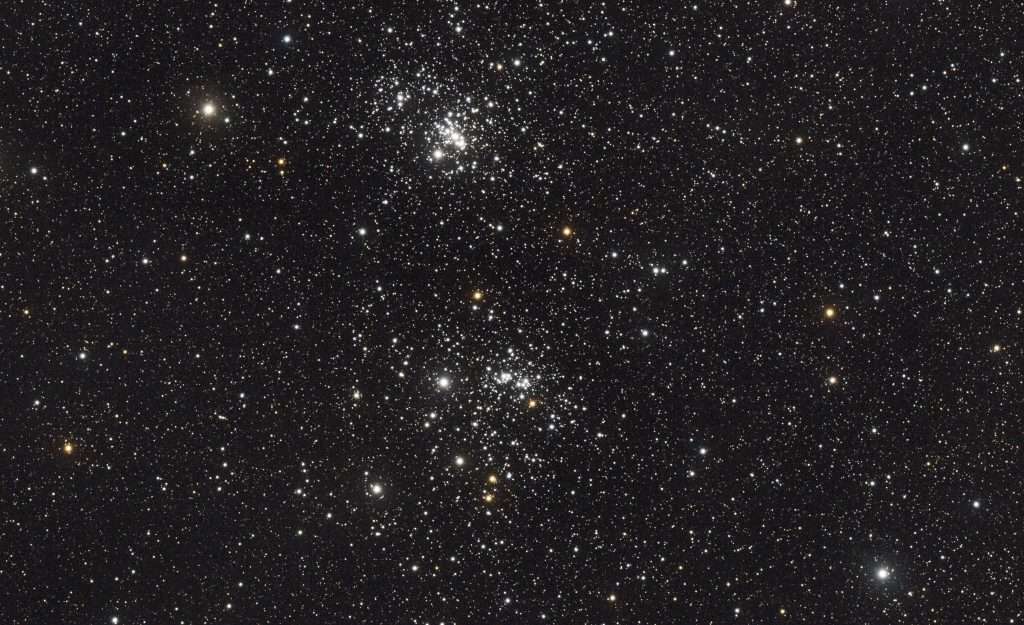
What are Globular Clusters
Globular clusters are dense, spherical collections of ancient stars that orbit the cores of galaxies. Their origin is still an active area of astrophysical research, but several key theories explain how they might have formed:
Formation in the Early Universe
- Globular clusters are among the oldest known stellar systems, with ages often exceeding 10–13 billion years (nearly as old as the Universe itself).
- They likely formed during the early epochs of galaxy formation, when the Universe was rich in gas and star formation occurred in intense bursts.
- Their high stellar density suggests they formed in regions where gas was extremely compressed, possibly due to turbulence, dark matter halos, or cosmic filaments.
Connection to Galaxy Formation
- Many globular clusters appear to have formed alongside their host galaxies, possibly within giant molecular clouds or protogalactic fragments.
- Some may have originated in dwarf galaxies and later been absorbed by larger galaxies (like the Milky Way). This may explain why some clusters have distinct chemical compositions.
Role of Dark Matter
- Some theories suggest that the earliest clusters may have formed within small dark matter halos in the young Universe, before galaxies fully assembled.
- However, observations show that most globular clusters today have little to no dark matter. This means they either lost it over time or formed differently.
Multiple Generations of Stars
- Unlike typical star clusters (which have a single stellar population), some globular clusters show multiple generations of stars with varying chemical abundances.
- This suggests they underwent prolonged star formation, possibly due to gas accretion or self-enrichment from supernovae and stellar winds.
Tidal Stripping and Dynamical Evolution
- Over billions of years, they have been shaped by tidal forces from their host galaxies, leading to mass loss and, in some cases, complete dissolution.
- The most massive and dense clusters survived, while weaker ones were torn apart.
Key Observations Supporting These Theories
- Hubble Space Telescope studies show globular clusters in distant, young galaxies, supporting their early formation.
- Chemical signatures (e.g., helium and nitrogen variations) hint at complex star-forming environments.
- Kinematic studies suggest some clusters were captured from satellite galaxies.
Outstanding Mysteries
- Why do some galaxies (like the Milky Way) have hundreds of globular clusters, while others have very few?
- How did some clusters retain multiple stellar generations despite their strong gravity preventing gas retention?
- Did dark matter play a role in their formation, or were they always dark-matter-free?
Conclusion
Globular clusters are fossils of the early Universe, offering clues about the conditions of star and galaxy formation. While much progress has been made, their exact origins remain a fascinating topic in astrophysics.