The California Nebula
The California Nebula NGC 1499
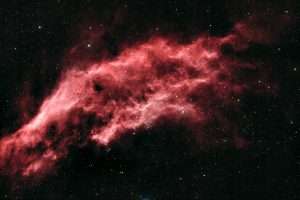
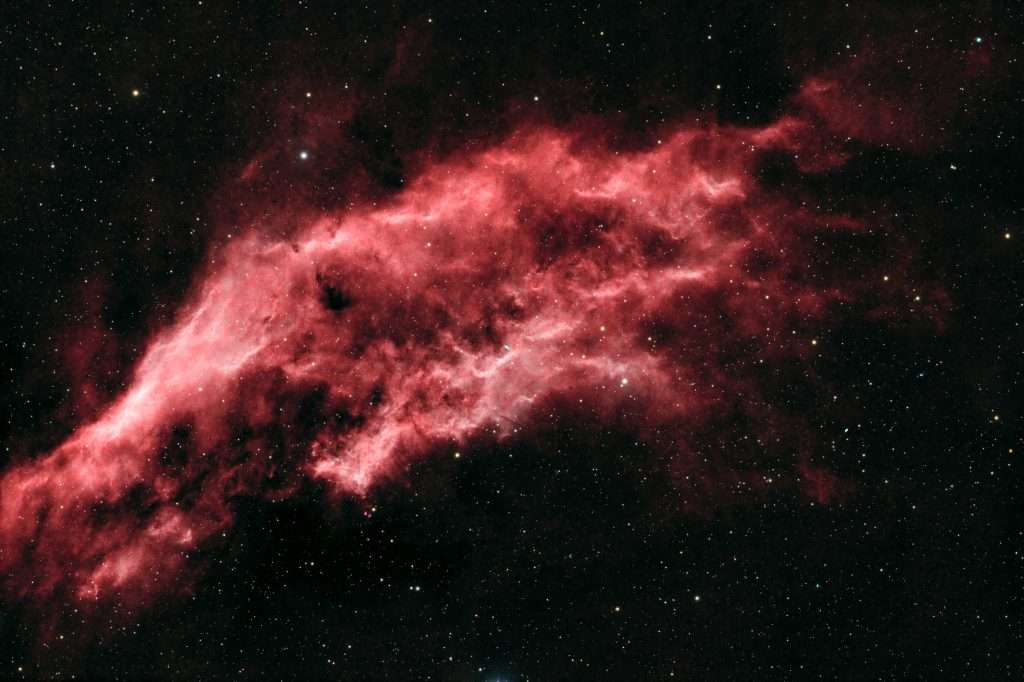
The California Nebula (NGC 1499) is an emission nebula in the Perseus constellation. It gets its name because its shape resembles the outline of the state of California in the United States. The nebula is a large cloud of glowing hydrogen gas that spans about 100 light-years across, making it one of the larger nebulae visible from Earth.
Key features of NGC 1499:
- Location: Constellation Perseus
- Distance: Approximately 1,000 light-years from Earth
- Type: An Emission nebula – a glowing gas cloud or primarily hydrogen
- Appearance: The nebula glows red due to ionized hydrogen atoms. Nearby stars, particularly the hot and bright star Xi Persei (Also known as Menkib), are the source of the ionisation energy,
- Visibility: The nebula is relatively faint and can be difficult to see with the naked eye. It is a popular target for long-exposure astrophotography because of its size and distinctive shape and this was the reason I chose it as a target.
Acquisition:
- An Esprit 100ED triplet on an EQ6R-pro mount was used to get this image,
- I used a Canon 1200D astro-modified camera,
- 97X 240-second lights at 800 ISO, 31 Flats, 21 Darks and 35 Biases,
- The moon was just over 4 days old at 17% illuminated and the seeing was moderate
Overall this nebula is almost 2.5° and as it has low surface brightness (apparent magnitude/ area), it is difficult to observe visually. It took me a large number of exposures over two days to reveal the details. Processing was in Pixinsight by Pleiades software.