The Pinwheel Galaxy M101
M101 the Pinwheel Galaxy
Messier 101 (M101) – The Pinwheel Galaxy:
M101 is a spiral galaxy in the constellation Ursa Major, approximately 21 million light-years from Earth. It’s also known as the Pinwheel Galaxy due to its prominent spiral arms. It was discovered by Pierre Méchain in 1781 and later catalogued by Charles Messier as part of his famous list. It’s a popular target for amateur astronomers because of its brightness and structure. And I have imaged this target many times.
- Appearance: The Pinwheel Galaxy is notable for its grand design spiral structure. It has well-defined spiral arms that radiate from its centre. These arms are rich in star-forming regions illuminated by young, hot stars.
- Size: It has a diameter of about 170,000 light-years and is bigger than our Milky Way galaxy, which has a diameter of about 100,000 light-years.
- Brightness and Magnitude: The galaxy has an apparent magnitude of about 7.9, making it relatively bright and observable with amateur telescopes under good conditions.
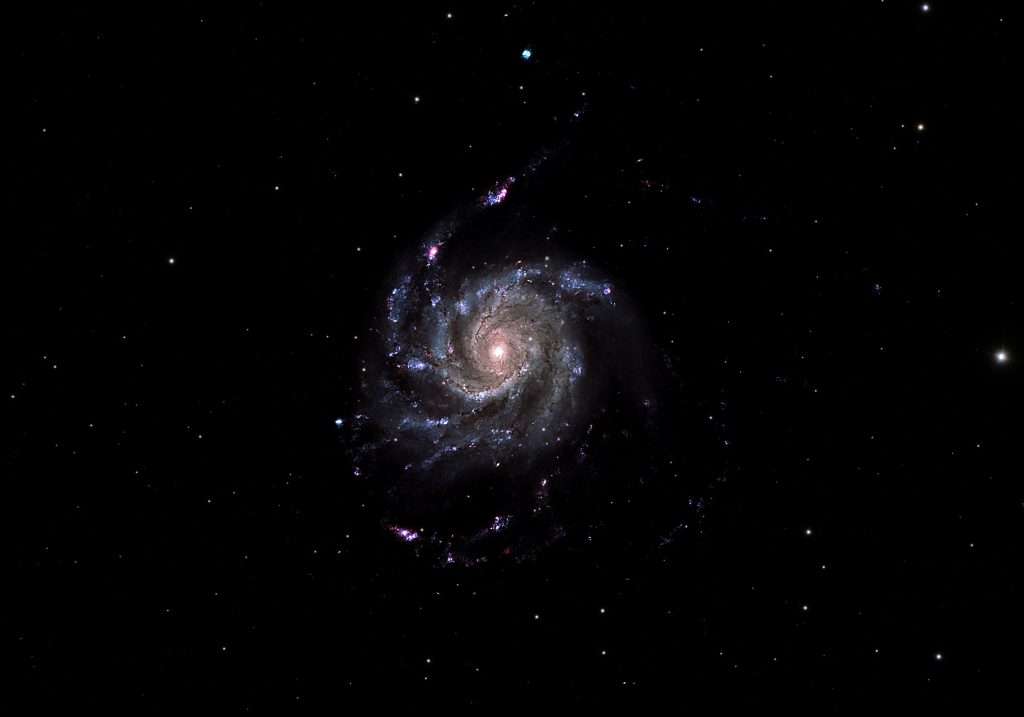
- Star Formation: The Pinwheel Galaxy is known for its vigorous star formation activity. The spiral arms contain numerous Ha regions – large clouds of ionized hydrogen where new stars are being born. You can see these areas in the image above.
- Companion Galaxies: M101 has several satellite galaxies, including NGC 5474, NGC 5477, and NGC 5485, which interact gravitationally with the main galaxy, influencing its structure and star formation.
- Discovery: The galaxy was discovered by Pierre Méchain in 1781 and later catalogued by Charles Messier.
Observation
- I imaged the Pinwheel Galaxy during February when Ursa Major was high in the sky. You can see in this image the detail of the spiral arms and Ha regions of intense star formation. Take a look at the image in the gallery is you need a full-sized photo.
- Acquisition: I photographed this image with an ASI294MC pro OSC camera in 56x300s shots plus 30x300s Duo narrowband from which I extracted the Ha.