Filter posts by category

The Eagle Nebula

The Eagle Nebula


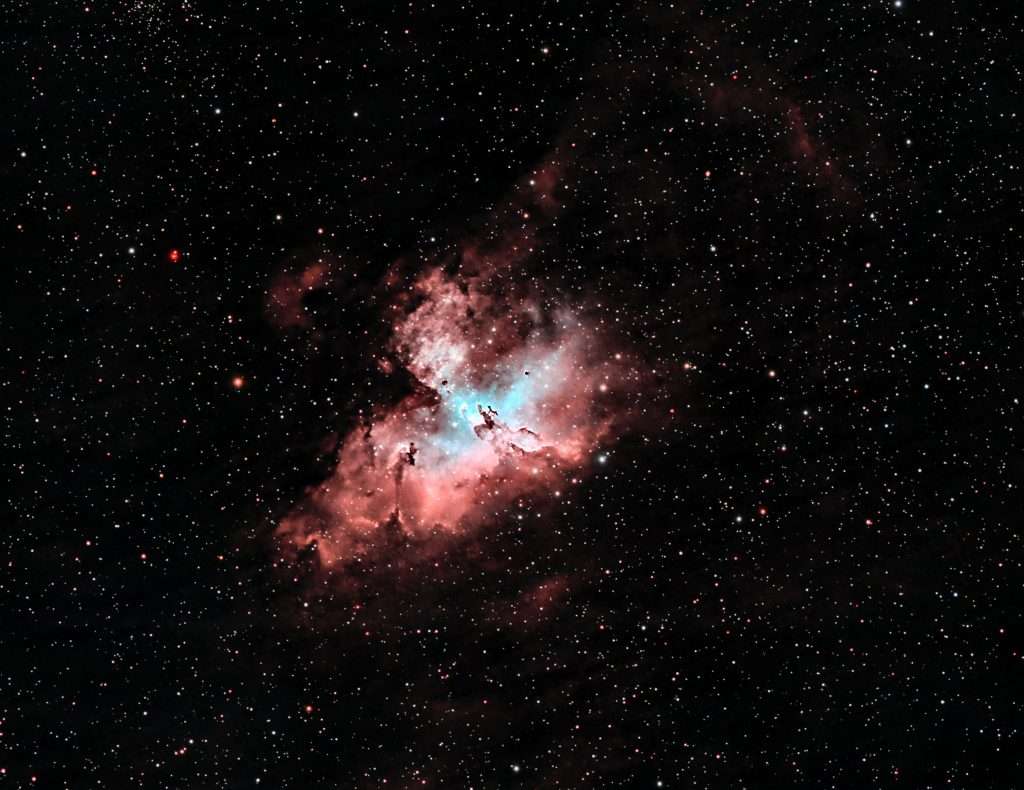
The Eagle Nebula (M16) is a young open star cluster and is surrounded by a region of active star formation. It is one of the most famous nebulae in the sky. Primarily because of its iconic feature, the ‘Pillars of Creation’, made famous by images from the Hubble Space Telescope.
Here’s more about M16:

Characteristics

  • M16 is an open star cluster as well as an emission nebula. It contains newly formed stars embedded within a region of glowing hydrogen gas.
  • The Eagle Nebula is in the constellation Serpens approximately 7,000 light-years away from Earth. It is part of a larger star-forming region the Sagittarius Arm of our galaxy.
  • The entire nebula spans about 70 by 55 light-years and appears as a glowing, eagle-shaped cloud of gas and dust. The open cluster at its center contains about 8,100 stars, some of which are only a few million years old.
  • M16 is an active star-forming region, with new stars being born from the dense knots of gas and dust within the nebula. The radiation from young massive stars heats the surrounding gas. This causes it to glow and creating the characteristic red and pink hues seen in the nebula.

The most famous feature of the Eagle Nebula is the Pillars of Creation, towering columns of gas and dust where new stars are being born. The Pillars of Creation are about 4-5 light-years long and they are being eroded by the intense ultraviolet light and stellar winds from massive stars.

Acquisition

This was a difficult target to image because of its low altitude in the UK. It is only 26°  above the horizon at transit on the 26th May 2024. Over two nights due to poor weather and only moderate seeing I managed only 90 minutes of imaging time and had to discard close to one third of the captures. On the plus side I used my fully portable rig  with its own intranet to acquire the target.

  • 31X 120 second lights (processed), 32 flats, 20 darks and 23 biases,
  • Esprit 100ED triplet on AM5 mount control by NINA with Optolong duo narrow band filter (sky glow),
  • Processed in SIRIL to separate Ha and OIII then processed in Pixinsight.
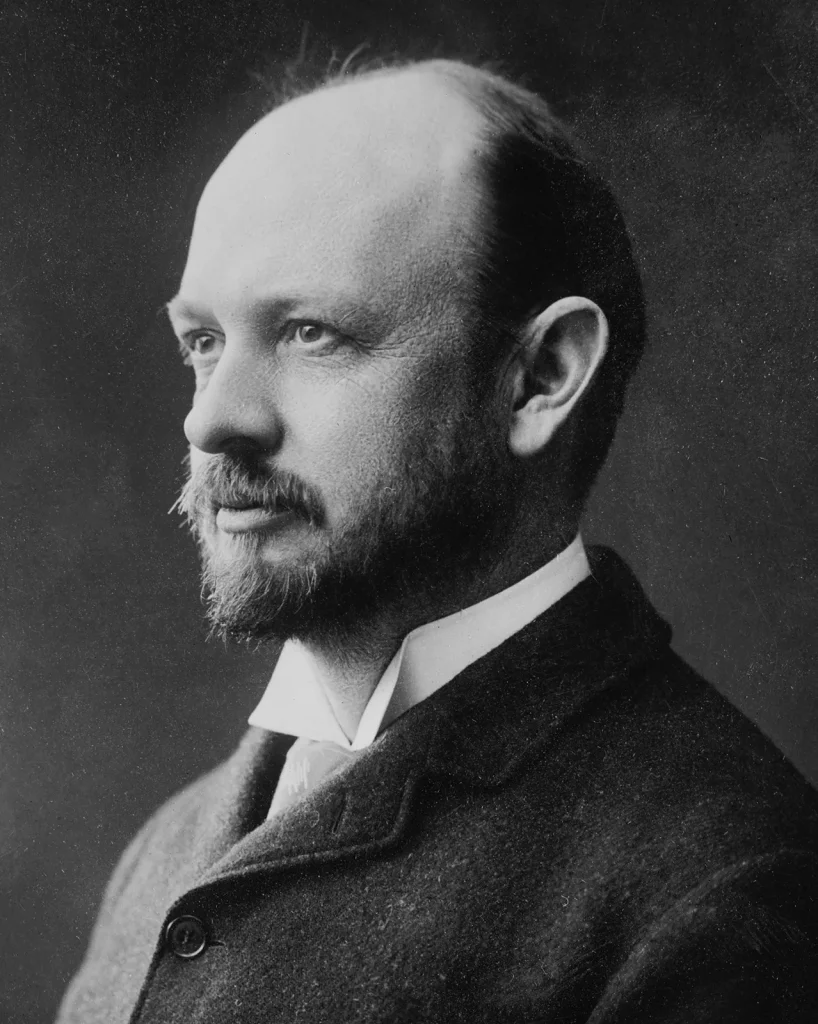
The Pickering scale for astronomical seeing

The Pickering scale quantifies astronomical visibility

In astrophotography, the Pickering scale refers to a system used to quantify and describe the visibility of details in astronomical images. Developed an American astronomer William H. Pickering (1858–1938) of Harvard College Observatory, using a 5″ (13 cm) refractor. This scale is particularly relevant for lunar and planetary observations. The Pickering scale typically ranges from 1 to 10, with higher numbers indicating better seeing conditions and finer detail visibility.

Here’s a general breakdown below:

  • P1 Star image shows around one third of the diffraction ring,
  • P2 Star image sometimes 2X 13″,
  • p3 star image same diameter second ring 6.7″ and has bright centre,
  • p4 central airy disk visible,
  • p5 airy disk always visible and arcs are sometimes seen,
  • p6 airy disk always visible arcs always seen,
  • p7 disk sometimes sharp with complete rings,
  • P8 disk always sharp with long arcs but in motion and complete rings,
  • p9 inner diffraction ring stationary outer rings momentary stationary,
  • p10 complete diffraction pattern stationary.

Pickering’s scale is practically expressed as:

  • Pickering 1-2: Extremely poor seeing conditions. Images appear severely blurred, with little to no detail visible.
  • Pickering 3-4: Poor seeing conditions. Details are visible intermittently but atmospheric turbulence affects overall image quality.
  • Pickering 5-6: Fair seeing conditions. Moderate detail is visible with some stability but the image still suffers from atmospheric disturbances.
  • Pickering 7-8: Good seeing conditions. Details are clearer and more stable with less atmospheric distortion.
  • Pickering 9-10: Excellent seeing conditions. Images exhibit high clarity and sharpness, allowing for fine details to be observed with exceptional stability.

Astrophotographers and astronomers often refer to the Pickering scale when assessing the quality of their observations. And determining the best times for imaging celestial objects. It helps astrophotographers  gauge the atmospheric conditions and adjust their imaging setups to capture the best possible images.

The Andromeda Galaxy M31

The Andromeda Galaxy M31 (NGC 224)

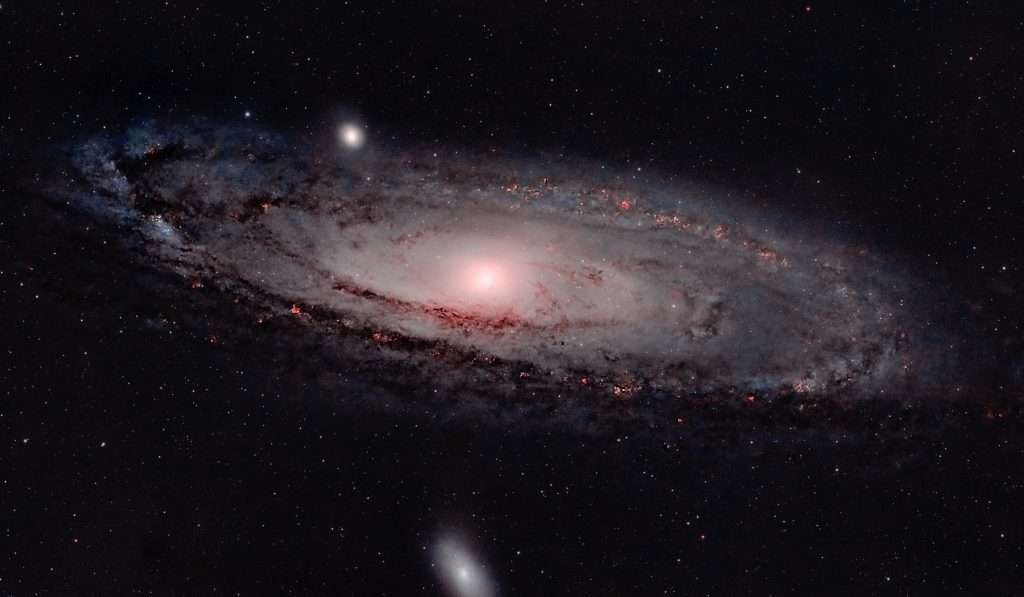
Andromeda M31 our closest neighbour

The Andromeda Galaxy is located in the constellation of andromeda with a bright core is visible to the naked eye under dark skies.  Andromeda is the nearest spiral galaxy to our own milky way and the farthest object that can be seen with the naked eye. It lies at a distance of approximately 2.537 million light-years.

M31 brief details
  • It spans a diameter of about 220,000 light-years, making it significantly larger than the milky way. The Milky way has a diameter of about 100,000 light years.
  • M31 is a barred spiral galaxy, similar in structure to the milky way. It contains billions of stars, as well as dust and gas clouds that form new stars.
  • M31 has several satellite galaxies, including m32 and m110, which are visible as smaller, fainter patches of light near m31 as shown above.
  • It’s also large in the sky, spanning around 3deg at its greatest extent (physically, about 220,000 light years), six times the diameter of the full moon along its major axis.

Andromeda is getting closer!

In around 4 billion years, the Andromeda galaxy is projected to collide with the Milky Way. This event is known as the Andromeda–Milky Way collision. This will result in the formation of a single larger galaxy.

Acquisition details: 
  • Esprit 100ED Triplet on AM5 mount,
  • Canon 1200D modified with optolong duo-narrowband filter canon camera,
  • Integration time 6.9 hours with 5 min exposures,
  • Weather clear with with moon > 90% full.
  • Processed in SIRIL to extract Ha and OIII and create RGB stars image processed in Pixinsight.

An earlier image of the andromeda galaxy 

The Andromeda Galaxy in RGB

Scroll to Top