roymogg

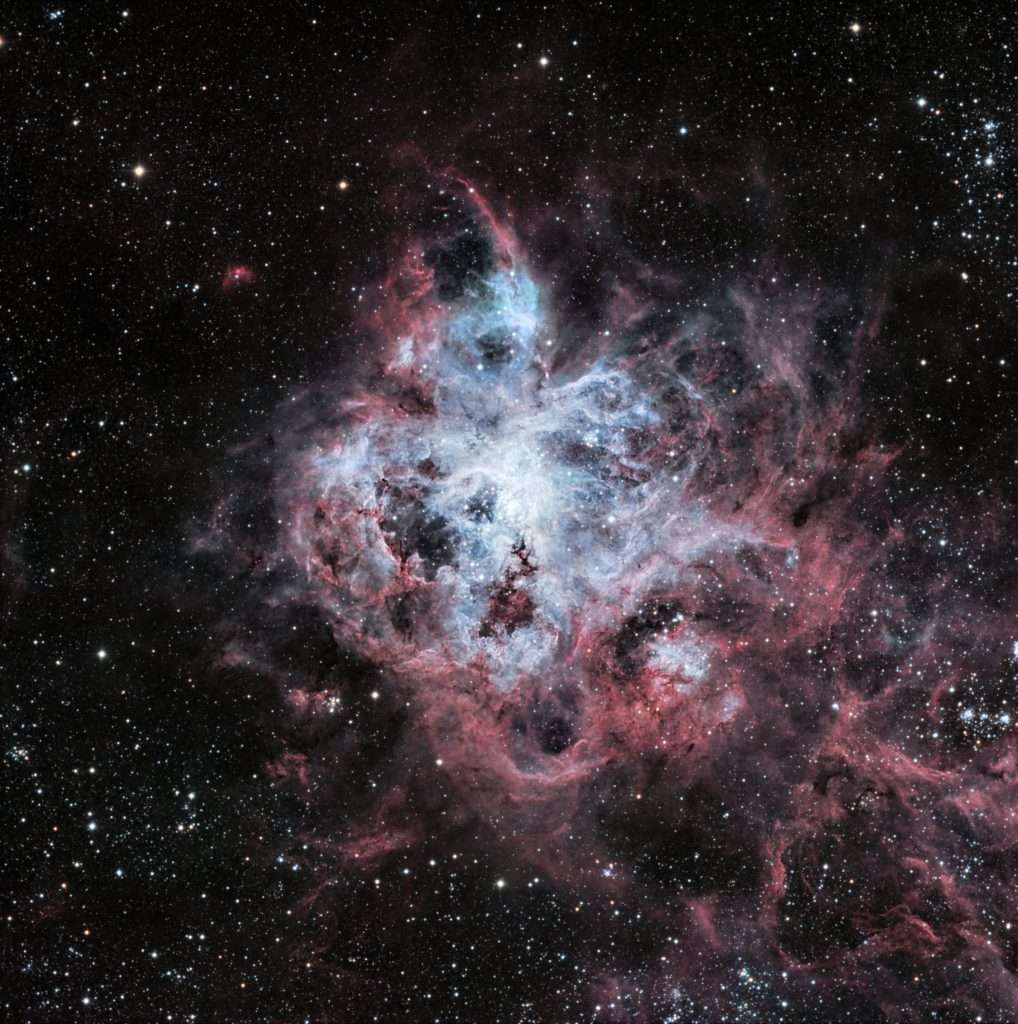
The Tarantula Nebula

Tarantula Nebula

The Tarantula Nebula
The Tarantula Nebula

The Tarantula Nebula (also known as 30 Doradus) is a giant star-forming region in the Large Magellanic Cloud (LMC), a satellite galaxy of the Milky Way, about 160,000 light-years away from Earth. Located in the constellation Dorado, the nebula is one of the largest and most active star nurseries in our local group of galaxies, spanning about 1,000 light-years across. Its structure is filled with gas and dust filaments resembling a spider’s legs, which is how it earned the name “Tarantula.”

Key Features of the Tarantula Nebula:

  1. Star Formation: The Tarantula Nebula is an extremely active region where new stars are constantly forming. The intense ultraviolet radiation from young, massive stars within the nebula causes it to glow brightly and energizes the surrounding gas.
  2. Massive Stars: Within the nebula lies the R136 star cluster, home to some of the most massive and luminous stars known, some exceeding 100 times the mass of our Sun. These stars are incredibly hot and emit intense radiation, shaping the surrounding gas and dust.
  3. Supernovae: The nebula has been a site for supernova explosions, the most famous being SN 1987A, one of the brightest supernovae observed in the last few centuries. The remnants of these explosions interact with the surrounding material, creating shock waves and further triggering star formation.
  4. Potential Future: With so many massive stars concentrated in one area, the Tarantula Nebula could eventually form a super star cluster, a rare cluster with a high concentration of stars.

In visible light, the nebula’s structure is bright and detailed, while in other wavelengths, such as infrared and X-rays, it reveals hidden details like newborn stars still embedded in clouds of dust and energetic outflows from massive stars. Because of its proximity and intensity, the Tarantula Nebula is an invaluable site for studying star formation and the evolution of massive stars.
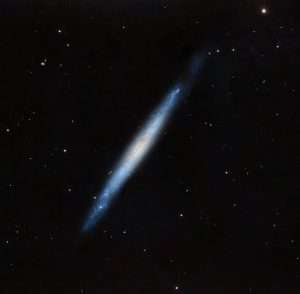
The Silver Needle Galaxy

The Silver Needle galaxy NGC 4244

The Silver Needle Galaxy

The Silver Needle Galaxy

About NGC 4244

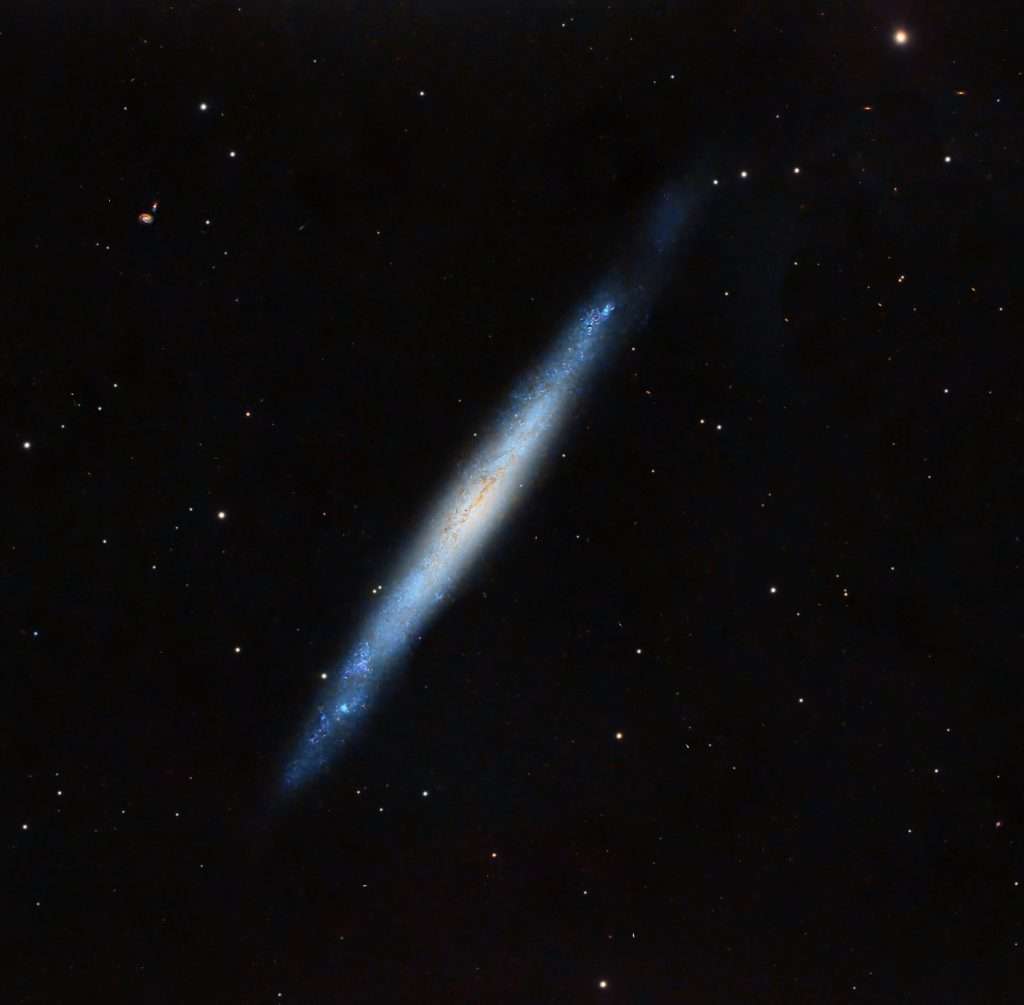
The Silver Needle Galaxy, NGC 4244, is an edge-on spiral galaxy located about 14 million light-years away in the constellation Canes Venatici. It earned the nickname “Silver Needle” because, when viewed from Earth, it appears as a thin, elongated sliver of light.

Features:

  1. Structure: NGC 4244 is classified as an SA(s)cd galaxy it is an unbarred spiral galaxy with loosely wound arms. It is edge-on and we see its thin disk almost perfectly aligned from our perspective. This obscures some of its internal structure but gives it a unique, narrow profile.
  2. Size and Brightness: This galaxy spans about 70,000 light-years, making it smaller than our Milky Way. Its brightness is relatively low as much of its light is dimmed by interstellar dust within its disk.
  3. Star Formation: Despite its relatively faint appearance, the Silver Needle Galaxy is a site of active star formation. Especially within its central regions and spiral arms. Observations in wavelengths such as infrared, show clusters of young, bright stars scattered throughout the disk.
  4. Halo of Stars: Like many spiral galaxies, NGC 4244 has a faint, extended halo of stars surrounding it. Studies of this halo provide insights into the galaxy’s formation history, including ancient star formation activity and potential interactions with nearby galaxies.
  5. Disk Structure: Its nearly perfect edge-on alignment makes it an excellent candidate for studying the structure and behavior of galactic disks, as we can observe features like dust lanes, star clusters, and gas distribution without interference from other viewing angles.
Acquisition

During February and March 2024, I imaged during a brief break in the clouds and was one of several galaxies I captured during Galaxy Seascon.

The Butterfly Nebula

THe Butterfly Nebula IC13182

The Butterfly Nebula in Cygnus

The Butterfly Nebula

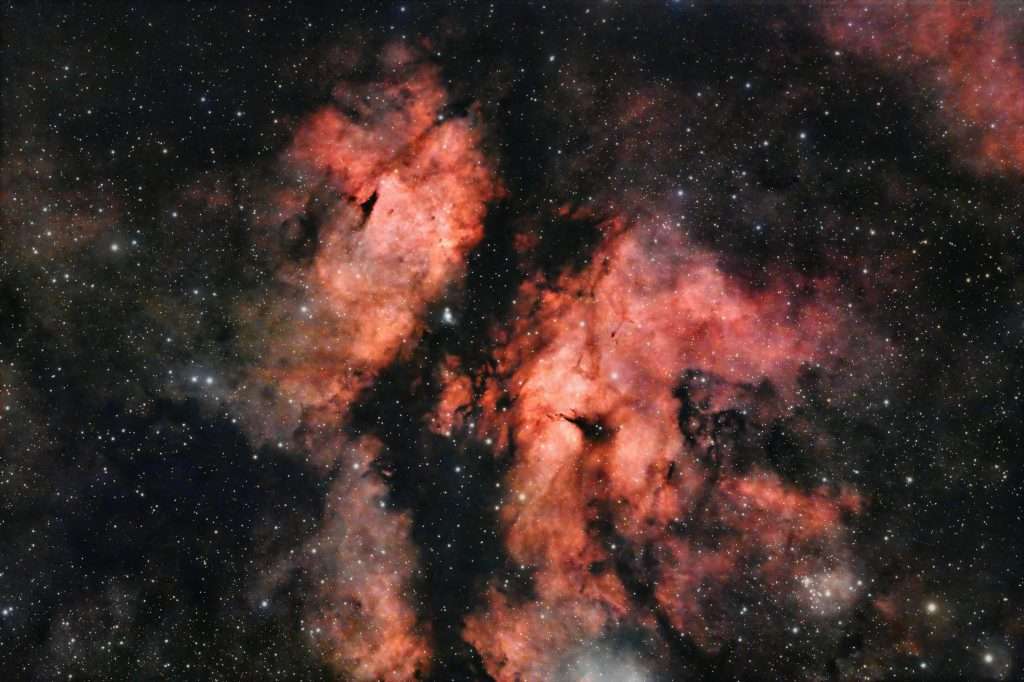
The Butterfly Nebula, IC 1318 in the constellation Cygnus, is a prominent emission nebula surrounding the bright star Sadr** (Gamma Cygni). The nebula is called Gamma Cygni although, the star Sadr is not associated with the nebula – it is much closer. This region is a complex, bright area of hydrogen gas ionised by nearby young, massive stars. Its red glow appears in images taken through H-alpha (Ha) filters. IC 1318 has its distinctive shape, reminiscent of butterfly wings,  caused by a dense band of dark dust, known as LDN 889, separating the nebula’s two main lobes. This dust band obscures parts of the nebula and gives it a striking appearance.

The Butterfly Nebula lies approximately 2,000 to 5,000 light-years from Earth and spans about three degrees of the sky. To capture its detailed structure, astrophotographers often use narrowband filters, like Hα or OIII. These will emphasize the rich red hues of ionized hydrogen gas and the blue-green shades of oxygen and sulfur. Narrow-band imaging enables false-colour imaging techniques. A Canon 1200D captured the image in broadband without filters.

Acquisition:

  • 45X 4 minute exposures for a total integration time of 3.8 hours,
  • Skywatcher Esprit 100ED super triplet on EQR-pro,
  • Canon 1200D modified camera.

To enhance the details in the nebula structure this object will be reimaged using narrow-band filters.


**With an apparent visual magnitude of 2.23 Gamma Cygni is among the brighter stars in the night sky. The star’s stellar classification is F8 Iab, indicating that it has reached the supergiant stage of its stellar evolution see more about Sadr on Wikipedia.


The Orion Nebula M42

The Orion Nebula

The Orion Nebula M42

The Orion Nebula M42

Characteristics

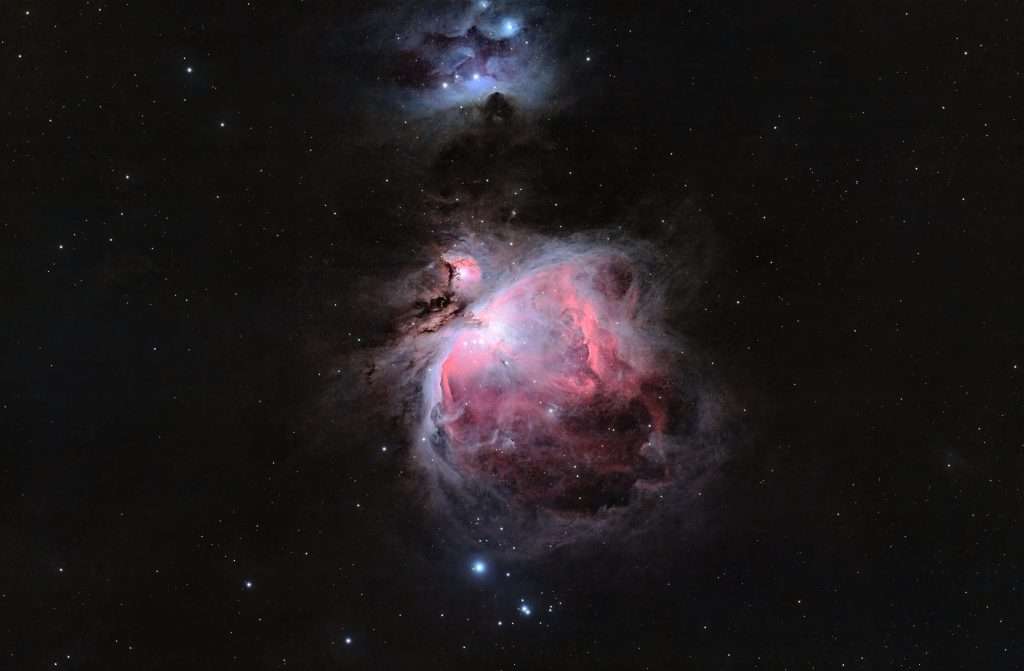
The Orion Nebula (Messier 42) is located in the constellation Orion, approximately 1,344 light-years from Earth. The nebula spans about 24 light-years, making it one of the brightest and most massive star-forming regions visible in the night sky.

  1. Star Formation: The Orion Nebula is a stellar nursery, where new stars are born from vast clouds of gas and dust. It contains young, hot stars that emit powerful radiation, shaping the surrounding nebula.
  2. Trapezium Cluster: At its core is the Trapezium Cluster, a group of four massive, young stars that illuminate much of the nebula. Unfortunately, they are only just visible in this image. Their intense ultraviolet radiation causes the surrounding hydrogen gas to glow, giving the nebula its distinctive bright and colourful appearance.
  3. HII Region: The Orion Nebula is classified as an HII region and is filled with ionized hydrogen, which emits light when the high-energy radiation from young stars excites it.
  4. Protoplanetary Disks (Proplyds): The nebula contains many protoplanetary disks, or proplyds, which are the early stages of solar system formation. These disks around young stars could one day evolve into planets.
  5. Observability: The Orion Nebula is visible to the naked eye under good conditions and appears as a faint, fuzzy patch in the “sword” of Orion. Through a pair of binoculars or a telescope, the nebula reveals its intricate, glowing structure.

Acquisition:

I imaged this target during a brief respite in the weather and was only able to collect limited data. The strategy was to take two sets of images at 30-second and 180-second exposures. This was a mistake. The 180-second exposures aimed to catch the outer fainter nebula while the 30-second frames hopefully caught the core without overexposure. And could be used in processing as a mask to control the longer exposure images. This approach was only partially successful due to extreme exposure of the core at 180 seconds.

  • Esprit 100ED triplet using a Canon 1200D modified camera on a Skywatcher EQ6R-pro,
  • Lights 28X at 180 seconds, 14X at 30; 20X Flats, 24X biases and 20X darks at 180 and 30 seconds respectively.
  • Weather poor rain moving in the moon was at 5%.
Whale Galaxy

The Whale Galaxy NGC 4631

The Whale Galaxy

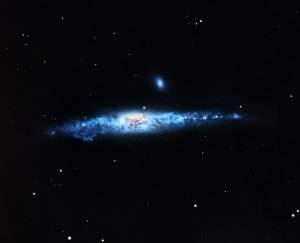
The Whale Galaxy (NGC 4631), also known as the Herring Galaxy, is a barred spiral galaxy located about 25 million light-years away in the constellation Canes Venatici. It has an apparent magnitude of 9.8 and appears almost edge-on. When viewed from Earth the shape resembles a whale, hence its name. It is classified as a starburst galaxy, meaning that it has an unusually high rate of star formation compared to most galaxies.

Characteristics of the NGC4631

  • Size: The galaxy spans approximately 140,000 light-years, making it slightly larger than the Milky Way.
  • Companion: The Whale Galaxy has a small elliptical companion galaxy, NGC 4627, often referred to as the “Pup.” Together, they form a system catalogued as Arp 281.
  • Starburst activity: The high rate of star formation is likely due to gravitational interactions with nearby galaxies, which can trigger bursts of star formation.
  • X-ray halo: Observations in X-rays show that the Whale Galaxy has a large, hot gas halo around it, indicating vigorous star formation and supernova activity.
Acquisition

The optical disk of NGC 4631 occupies an area of 15’.5 by 2’.7

The California Nebula

The California Nebula NGC 1499

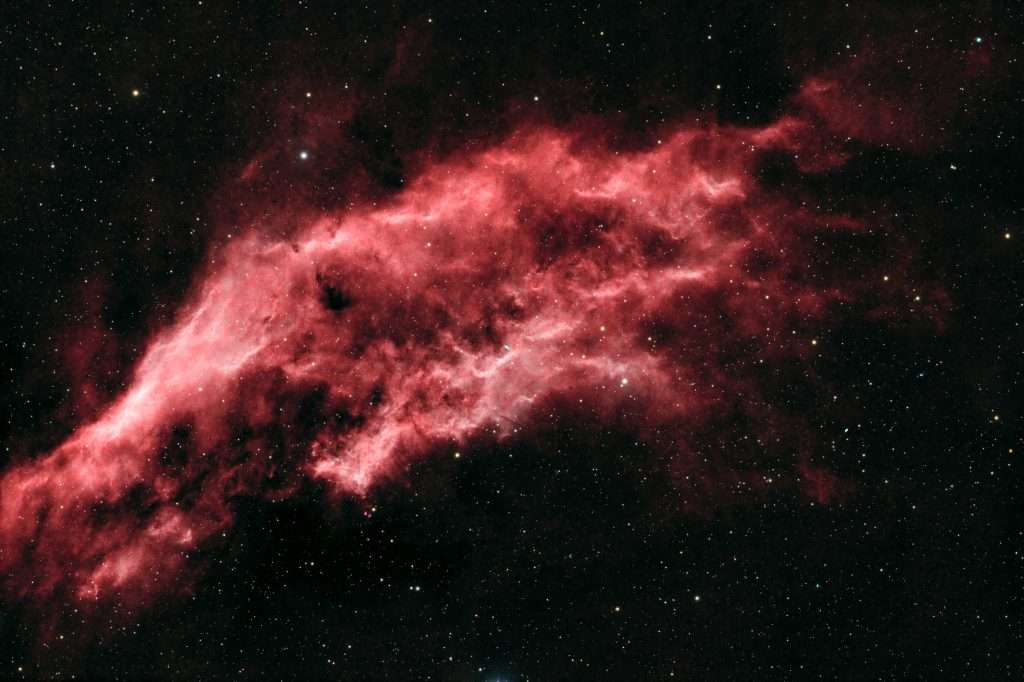
The California Nebula (NGC 1499) is an emission nebula in the Perseus constellation. It gets its name because its shape resembles the outline of the state of California in the United States. The nebula is a large cloud of glowing hydrogen gas that spans about 100 light-years across, making it one of the larger nebulae visible from Earth.

Key features of NGC 1499:

  • Location: Constellation Perseus
  • Distance: Approximately 1,000 light-years from Earth
  • Type: An Emission nebula – a glowing gas cloud or primarily hydrogen
  • Appearance: The nebula glows red due to ionized hydrogen atoms.  Nearby stars, particularly the hot and bright star Xi Persei (Also known as Menkib), are the source of the ionisation energy,
  • Visibility: The nebula is relatively faint and can be difficult to see with the naked eye. It is a popular target for long-exposure astrophotography because of its size and distinctive shape and this was the reason I chose it as a target.
Acquisition:
  • An Esprit 100ED triplet on an EQ6R-pro mount was used to get this image,
  • I used a Canon 1200D astro-modified camera,
  • 97X 240-second lights at 800 ISO,  31 Flats, 21 Darks and 35 Biases,
  •  The moon was just over 4 days old at 17% illuminated and the seeing was moderate

Overall this nebula is almost 2.5°  and as it has low surface brightness (apparent magnitude/ area), it is difficult to observe visually. It took me a large number of exposures over two days to reveal the details. Processing was in Pixinsight by Pleiades software.


NGC7635

The Bubble Nebula NGC7635

The Bubble Nebula NGC 7635

NGC7635

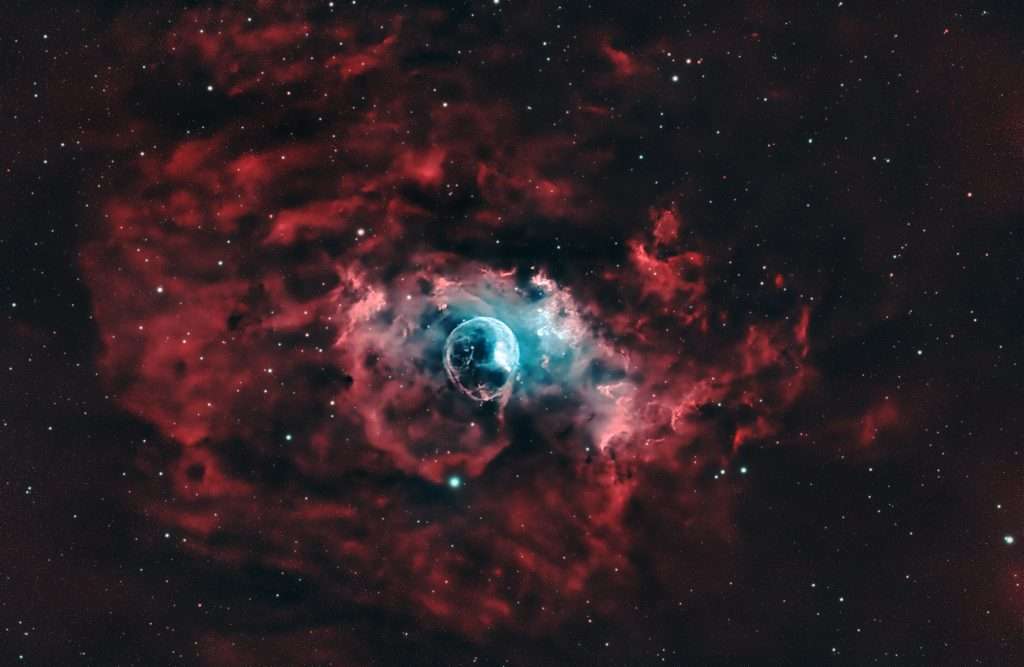
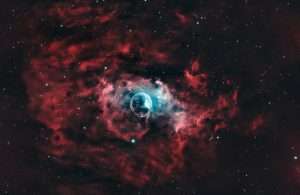
The Bubble Nebula (also known as NGC 7635) is a dynamic emission nebula located in the constellation Cassiopeia. Its nickname comes from its distinctive ‘bubble-like’ appearance. Which is formed by the interaction between a hot, massive star and the surrounding interstellar material.

The Bubble Nebula:

  1. Location and Distance:
    • The Bubble Nebula lies about 7,100 light-years away from Earth.
    • It is part of a larger complex of interstellar gas and dust interacting with nearby star-forming regions.
  2. Central Star (SAO 20575):
    •  A massive O-type star called SAO 20575 (BD+60°2522) is at the heart of the Bubble Nebula. It is about 40 times more massive than the Sun and much hotter and brighter. It has a surface temperature of 37,500K and is 400,000 times more luminous than the sun.
    • This star is classified as a Wolf-Rayet star. A Wolf-Rayet star is a class of very hot and massive stars that are in a late stage of evolution and losing mass at a very high rate through powerful stellar winds.

Formation of the Bubble Nebula

  •  The intense stellar wind (streams of charged particles) emanating from the central star formed the  “bubble”. These stellar winds, moving at speeds of around 6.5 million km/h (4 million mph), push the surrounding gas outward, creating a spherical cavity or “bubble” in the surrounding interstellar gas.
  • The expanding bubble is 7 light-years in diameter, meaning it is large on a cosmic scale, though it appears small in telescopes due to its distance.
  • The gas in the nebula glows due to ionization from the central star’s radiation. The star’s intense ultraviolet radiation excites the gas in the surrounding material, causing it to emit light, predominantly in the H-alpha line and is why the nebula is classified as an emission nebula. An emission nebular shines due to the excitation of its gas by the central star.
  • The nebula is not a perfect sphere because its expansion is slowed down by denser regions of the interstellar medium. In other directions, the bubble expands more freely.

Acquisition:

This was imaged when the moon was 74% illuminated so I elected to use a duo narrow-band filter to manage moon glow.

  • Celestron Edge HD800 on EQ6R-pro camera ASI294MC-pro with optolong duo L-Enhanced filter,
  • 74X300 second lights, 30 Flats, 15 Darks and 30 Biases,
  • Processed in SIRIL for stacking of separate Ha and OIII channels post this Pixinsight for final processing.
M15

The M15 Globular Cluster

The M15 Globular Cluster


M15

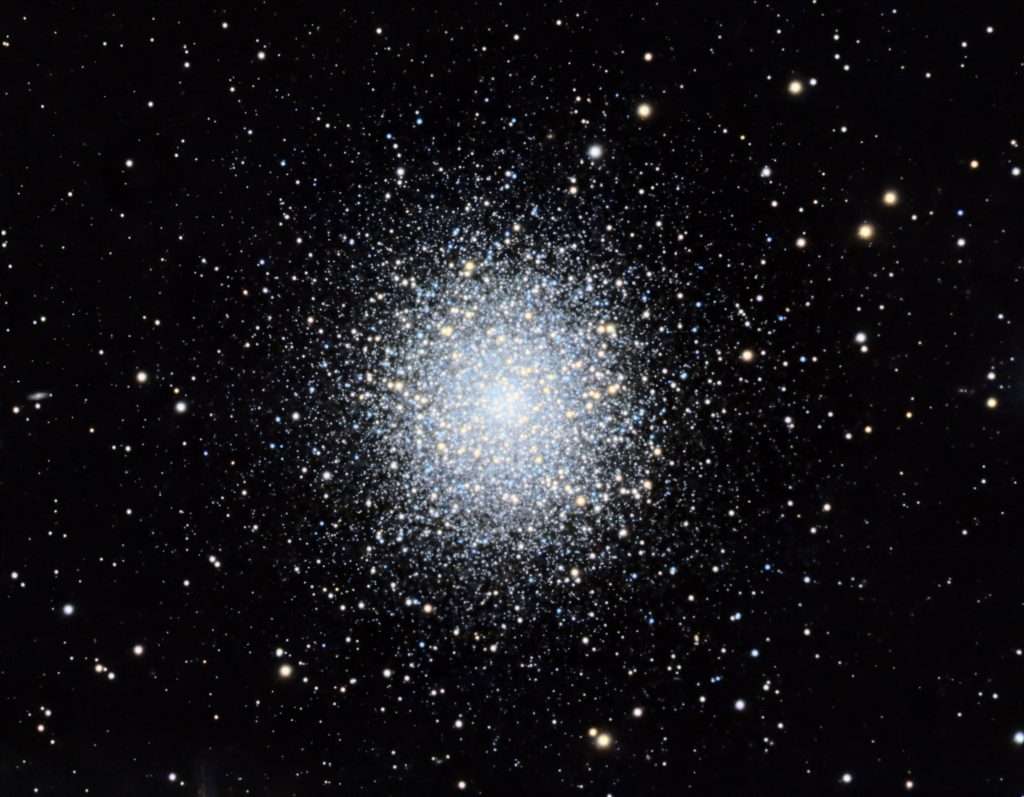
M15 (also known as NGC 7078) is a remarkable globular cluster in the constellation Pegasus lying about 33,600 light-years away from Earth. It’s one of the oldest and most densely packed globular clusters known, . 

M15 Characteristics:

  • Apparent Magnitude: Around 6.2 means it’s just on the edge of naked-eye visibility under excellent conditions.
  • Its age is roughly 12 billion years, making it one of the oldest known globular clusters.
  • Its Diameter is approximately 175 light-years across.
  • A low abundance of elements heavier than hydrogen and helium makes M15 metal-poor and is a feature of ancient stellar populations.

Structure and Stellar Population:

  • M15 contains over 100,000 stars packed into a relatively small volume, making it extremely dense.
  • It exhibits a phenomenon known as core collapse where its core has contracted significantly due to gravitational interactions between its stars. This has resulted in an extremely bright, dense core.
  • The cluster is home to many blue stragglers stars that appear younger than the rest of the cluster’s stars.  Stellar mergers and interactions have likely played a role in their formation.
  • M15 also contains a pulsar (PSR B2127+11C) and several variable stars, including RR Lyrae variables.

Central Black Hole:

There is some evidence that M15 might harbour a central black hole.  If true M15 would be added to the list of globular clusters with intermediate-mass black holes at their centers.

Nebula:

M15 contains a planetary nebula known as Pease 1.  Planetary nebulae are rare for globular clusters and are normally associated with individual stars in less dense regions of space.

Acquisition:

I targeted M15 due to very limited time for imaging due to continued poor weather in the southern UK.

  • Celestron Edge HD 800 on Skywatcher EQ6R-pro imaging camera ZwoASI 294mc pro,
  • I took; 81X 60-second lights,  23 flats, 23 dark flats and 20 darks,
  • Processed in Pixinsight with basic background extraction and noise reduction

Meadow Brown Butterfly

This year has been really bad for butterflies, with The Big Butterfly Count indicating that the average number of butterflies seen fell to 7 (12 the previous year) with many species showing over 50% decline. Certainly we only saw a few this year, unlike previous years where our Budlejas have attracted multiple butterflies at each count.

The Meadow Brown (Maniola jurtina) is one of the most common and widespread butterflies in Europe and parts of Asia. It is often found in a variety of habitats, particularly in grassy areas like meadows, fields, and parklands, hence its name. However, this year it was certainly not very common! A clear indication that there are problems and we need to take action.

Rhododendron Flower

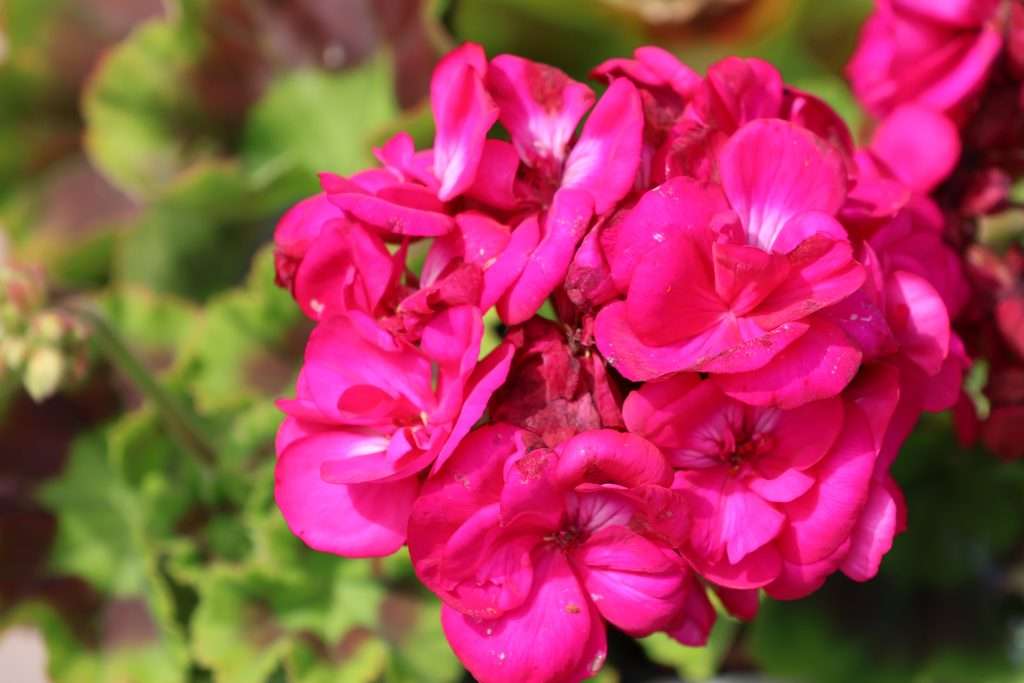
The picture does not do it justice. These flowers are HUGE. The bees loved them (although bees seem to be in trouble too this year so we did not get as many as in previous years). There are some who say we should not have Rhododendron’s in the garden in the UK, as they are not native and can reduce the number of native plants. However, as with all things perhaps a mix is a good idea. We are fortunate to have a large garden so rather than dig up these lovely flowers we have been adding some native plants to the area.

Scroll to Top