roymoggadmin

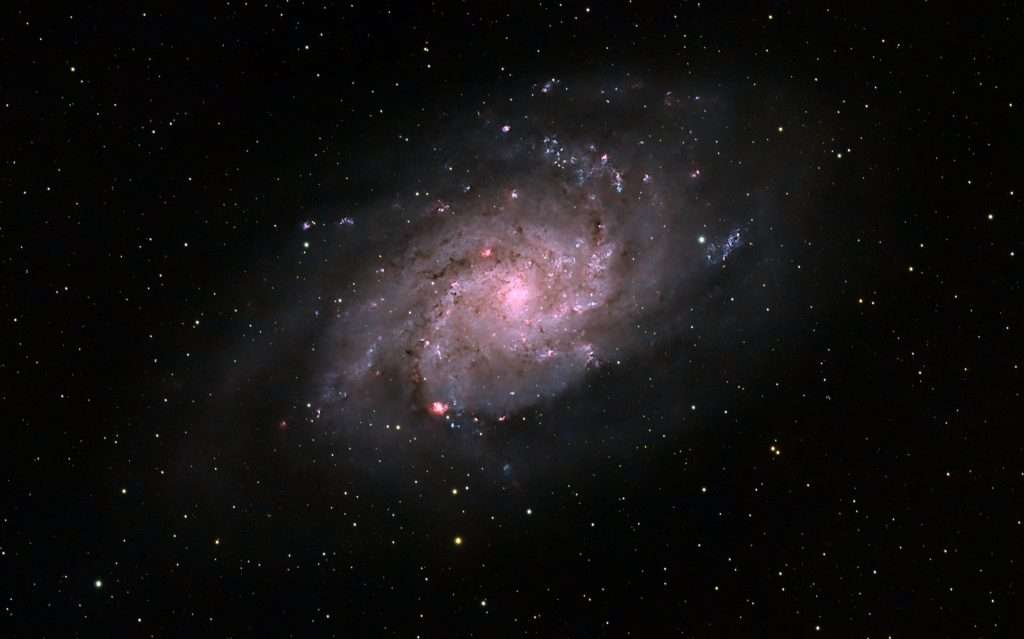
M33 Triangulum galaxy

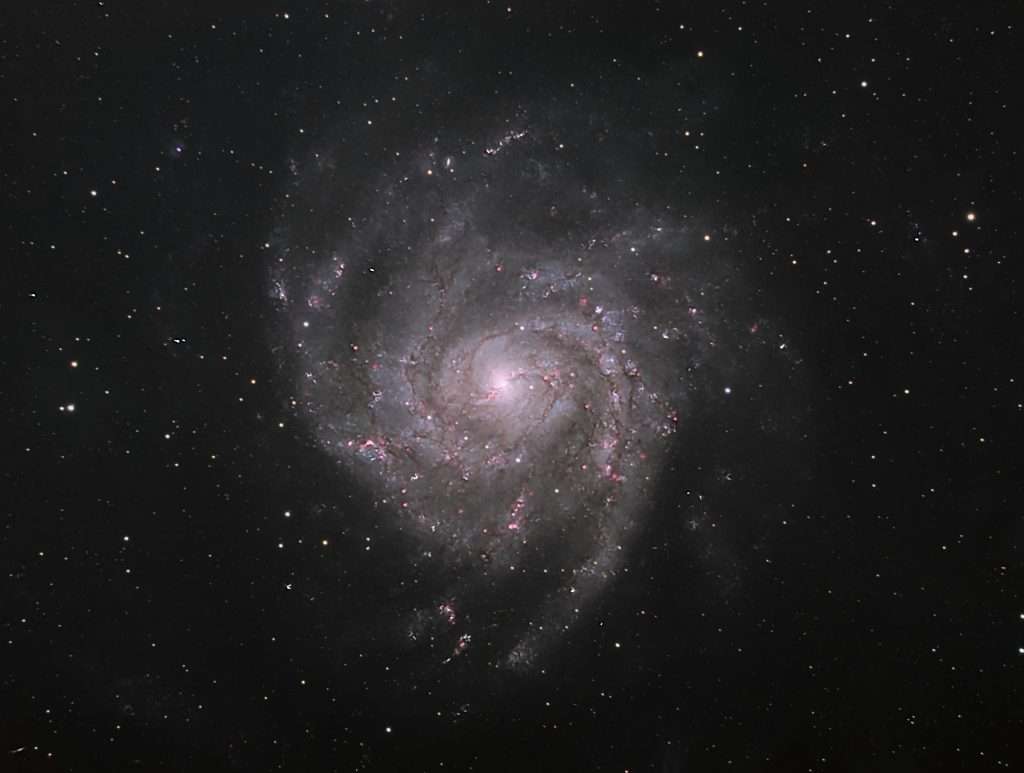
M33 Galaxy

M33 the Triangulum Galaxy
 

The Triangulum Galaxy (Messier 33, or M33) is a stunning spiral galaxy in the small northern constellation Triangulum. It is one of the closest galaxies to the Milky Way and an important member of the Local Group of galaxies. Key Features

  • Type: The Triangulum Galaxy is classified as a spiral galaxy with a flocculent (loosely wound and fragmented) structure, giving it a less-defined appearance compared to tightly wound spirals like the Andromeda Galaxy.
  • Location and Distance:
    • M33 lies about 2.73 million light-years from Earth.
    • It is in the Triangulum constellation, near the Andromeda Galaxy (M31).
  • Size and Mass:
    • M33 spans about 60,000 light-years in diameter, making it smaller than the Milky Way and Andromeda.
    • It contains an estimated 40 billion stars (compared to the Milky Way’s 100-400 billion).
    • Its mass is roughly 10-20 billion solar masses.
  • Brightness: With an apparent magnitude of 5.7, M33 is faintly visible to the naked eye under very dark skies and appears as a diffuse object in binoculars or small telescopes.

Structure and Features

  1. Spiral Arms:
    • M33’s spiral arms are rich in gas and dust, showing ongoing star formation. The arms are dotted with bright regions of young, hot stars.
  2. Star-Forming Regions:
    • M33 is home to some of the most active H II regions (areas of ionized hydrogen gas) in the Local Group.
    • NGC 604, a massive star-forming region within M33, is one of the largest H II regions known, spanning nearly 1,500 light-years. This is very prominent in the image I took above.
  3. Nucleus:
    • The central nucleus of M33 is relatively small and faint compared to other spiral galaxies.
  4. Metallicity:
    • The galaxy has a relatively low metallicity (abundance of elements heavier than hydrogen and helium), typical of smaller galaxies.

Acquisition Details


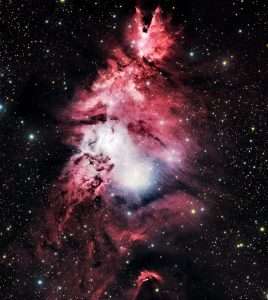
The Christmas Tree Cluster

The Christmas Tree Cluster

The Christmas Tree Cluster in Monoceros

The Christmas Tree Cluster
The Christmas Tree Cluster, officially designated as NGC 2264, is an open cluster of stars in the constellation Monoceros. It is part of a complex region that includes a nebula and star-forming regions, and it gets its name because the arrangement of its stars resembles the shape of a Christmas tree when viewed from Earth.

Key Facts about the Christmas Tree Cluster:

  1. Distance: Approximately 2,500 light-years from Earth.
  2. Age: The cluster is relatively young, about 3–5 million years old.
  3. Size: The cluster spans about 20 light-years across.
  4. Components:
    • The Cone Nebula forms part of this complex, appearing as a dark interstellar dust and gas pillar.
    • The Fox Fur Nebula is another feature in the same region, showing a textured, fur-like appearance.
  5. Visibility:
    • It can be seen with small telescopes or binoculars under dark skies.
    • Best observed during winter in the Northern Hemisphere which is when I imaged this.

Why the Name?

The bright stars form a triangular shape reminiscent of a Christmas tree, with the “trunk” pointing downward. One of the brightest stars at the top of the tree is S Monocerotis.

The Christmas Tree Cluster is an active site of star formation, with many young, hot, blue stars illuminating the surrounding nebulae. It is a favorite target for amateur astronomers and astrophotographers due to its unique appearance and location in a relatively rich star field

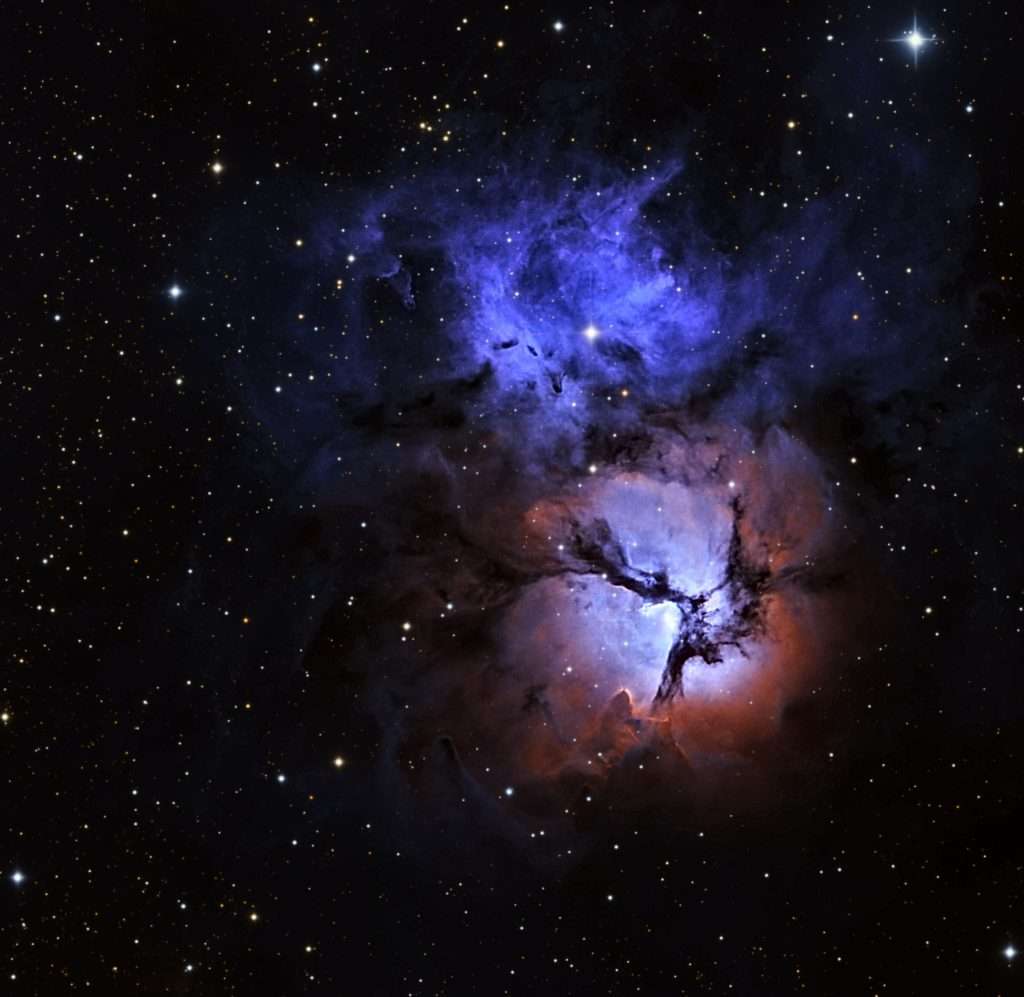
The Triffid Nebula

The Trifid Nebula

The Trifid Nebula

The Triffid Nebula

Key Features of the Trifid Nebula

The Trifid Nebula (Messier 20, or M20) is a complex Nebula in the constellation Sagittarius. Known for its striking combination of emission, reflection, and dark nebulae, it is a favourite among astronomers and astrophotographers (see the full image here).

  1. Type: The Trifid Nebula is a combination nebula, consisting of:
    • Emission nebula: Glowing red regions from ionized hydrogen gas energized by ultraviolet radiation from nearby hot stars.
    • Reflection nebula: Bluish regions where starlight is scattered by surrounding dust particles.
    • Dark nebula: Opaque regions of dense dust obscuring the background light, creating the nebula’s characteristic “trifid” (three-lobed) appearance.
  2. Location and Distance:
    • The Trifid Nebula is about 4,100 light-years from Earth.
    • It is located in the Milky Way‘s Sagittarius arm, in the direction of the galactic centre.
  3. Size: The nebula spans about 50 light-years across, appearing roughly 28 arcminutes wide in the sky, about the size of the full moon.
  4. Illuminating Star: The bright, massive star at the centre of the emission nebula, HD 164492, is the primary source of ultraviolet radiation that ionizes the surrounding gas.

Features and Structure

  1. Three Lobes (Trifid): The dark nebula at the centre divides the red emission region into three distinct sections, giving the nebula its name, “Trifid.”
  2. Reflection Nebula: The blue regions of the Nebula result from the reflection of starlight off surrounding dust particles. These regions contrast beautifully with the red emission nebula.
  3. Star Formation:
    • The Nebula is a stellar nursery, containing numerous young stars and protostars in various stages of development.
    • Herbig-Haro objects (jets of gas from young stars) highlight active star formation.
  4. Dark Nebula: Dense dust clouds obscure parts of the nebula, creating intricate patterns and adding depth to the nebula’s appearance.

Acquisition Trifid Nebula

This image was stacked and processed in Pixinsight from GHaSIIOIII data from Telescope Live. I emphasised the faint blue glow from the reflection nebula to show its complex structure.


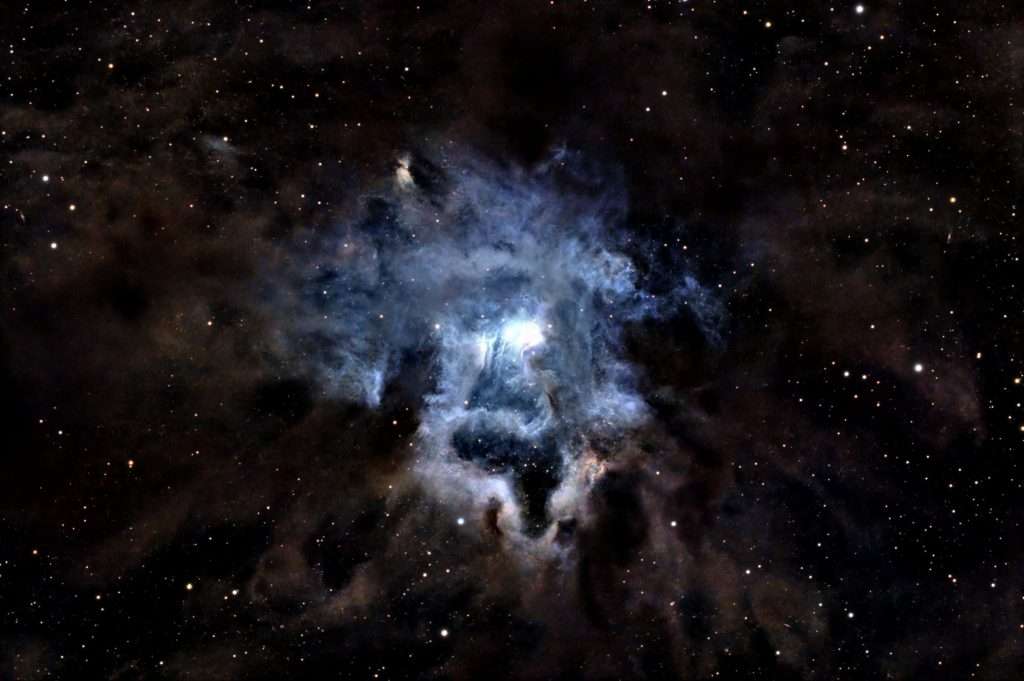
The Iris Nebula

The Iris Nebula

The Iris Nebula

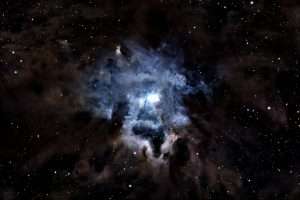
The Iris Nebula (NGC 7023) is a beautiful reflection nebula located in the constellation Cepheus. Known for its striking blue hues and intricate dust structures, it is a popular target for astronomers and astrophotographers. I created this image using my Celestron Edge 800 HD telescope and ASI294mm pro camera from 76x 3-minute exposures. This gave a total integration time of 3.9 hours. I then processed the data in Pixinsight.

Key Characteristics

  1. The Iris Nebula is a reflection nebula its glow comes from starlight scattered off interstellar dust rather than being produced by ionized gas.
  2. The nebula is approximately 1,300 light-years from Earth and spans about 6 light years.
  3. The central star of the Iris Nebula is a hot, young star called HD 200775. A B-type star that provides the energy responsible for the nebula’s glow.
  4. The nebula glows predominantly blue due to light scattering by fine interstellar dust particles, similar to why Earth’s sky appears blue, Surrounding the central blue region are darker, dense clouds of dust, adding depth and contrast to the nebula’s appearance. You can see in some areas a faint reddish hue which is caused by emissions from complex hydrocarbons known as polycyclic aromatic hydrocarbons (PAHs).

The structure of the Iris Nebula

  1. Reflection Nebulae: The Iris Nebula is an excellent example of how starlight interacts with interstellar dust. Its study helps astronomers understand the composition and properties of cosmic dust.
  2. Star Formation: The region contains dense molecular clouds, indicating ongoing or future star formation activity. HD 200775 is a young star that is still evolving, making the nebula a valuable laboratory for studying early stellar evolution.
  3. Dust Properties: The dense clouds around the nebula provide insights into the size, shape, and composition of interstellar dust grains.

Cultural and Aesthetic Appeal

  • The Iris Nebula gets its name from its resemblance to the iris of a flower. Its intricate structure and interplay of light and shadow have made it a favourite for astrophotographers.

The Iris Nebula (NGC 7023) is a stunning and scientifically rich object, showcasing the beauty of the cosmos, while offering a glimpse into the mysteries of interstellar dust and star formation. Its serene blue glow contrasts dramatically with the dark clouds that surround it, making it a captivating sight in the night sky.

The Carina Nebula

Carina Nebula

The Carina Nebula

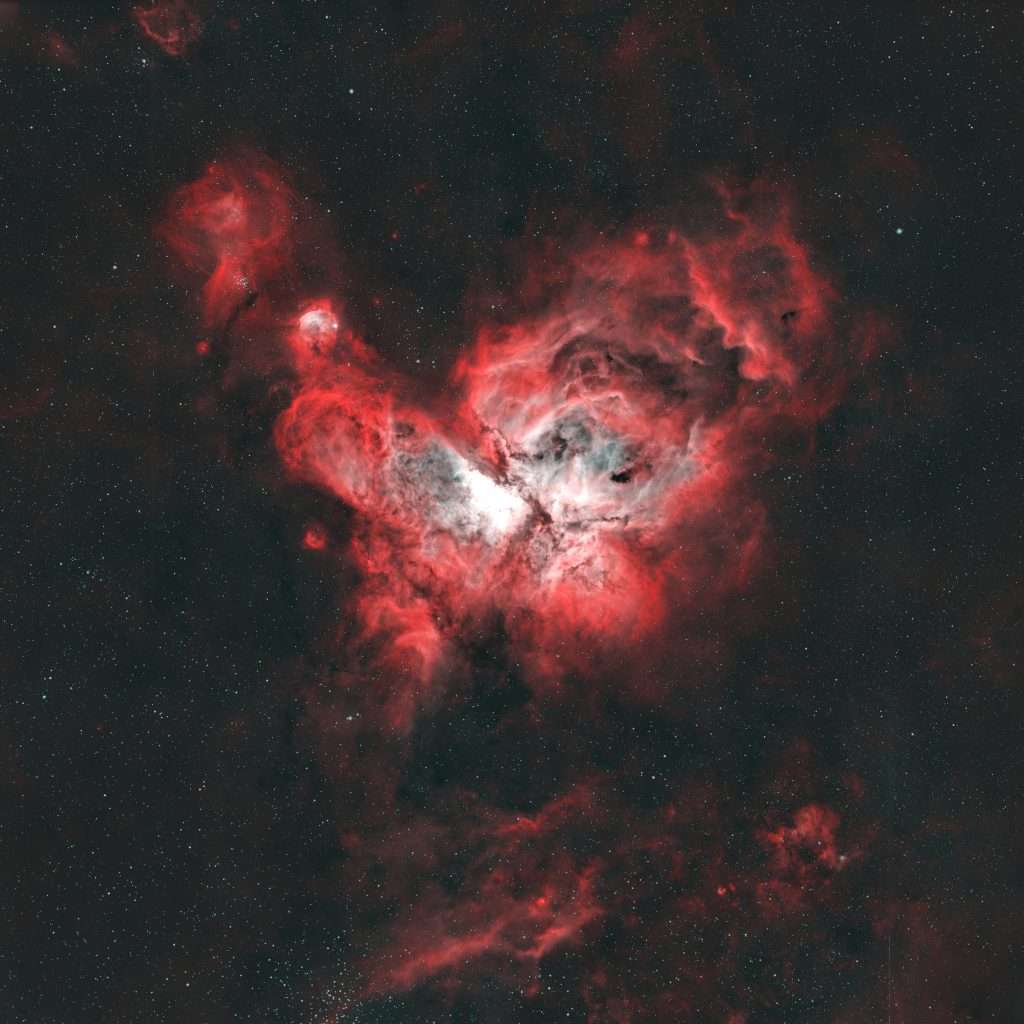
The Carina Nebula (NGC 3372) is one of the largest, brightest, and most dynamic star-forming regions in the Milky Way. It is in the constellation Carina and is a spectacular area of gas, dust, and young stars.

Key Characteristics

  1. The Carina Nebula is a giant emission nebula and stellar nursery, known for active star formation and massive, luminous stars.
  2. It lies about 8,500 light-years away from Earth and spans roughly 460 light-years across. This makes it one of the largest nebulae visible in our galaxy.
  3. The nebula is a vibrant mix of red, pink, and orange hues, produced by ionized hydrogen gas emitting light due to intense ultraviolet radiation from nearby massive stars.
  4. It also features dark nebulae, intricate filaments of dense dust, which block light from behind.
  5. The Carina Nebula is roughly four times the size and significantly brighter than the Orion Nebula, but its southern location makes it less known to observers in the Northern Hemisphere.
Prominent Stars and Features:
    • Eta Carinae: One of the most famous stars in the nebula, Eta Carinae is a volatile and massive binary star system with an estimated mass of over 100 solar masses. This binary system will end in a supernova or hypernova soon (astronomically speaking).
    • Trumpler 14 and 16: These are young, bright open star clusters within the nebula.
    • Homunculus Nebula: A bipolar nebula surrounding Eta Carinae, formed by a massive eruption in the 19th century.

Scientific Importance

  1. Star Formation:
    • The Carina Nebula is a stellar nursery where hundreds of massive stars and thousands of smaller stars are being born.
    • Proto and newborn stars can be observed in it’s dense gas clouds. This gives us valuable insights into the early stages of stellar evolution.
  2. Massive Stars and Supernovae:
    • Many of the stars in the nebula are among the most massive and luminous known, contributing to the nebula’s intense radiation and energetic winds.
    • The Carina Nebula contains remnants of past supernovae and is likely to produce more, particularly when Eta Carinae eventually explodes.
  3. Dust and Molecular Clouds:
    • Dense molecular clouds in the nebula are sites of star formation, while the radiation from massive stars sculpts and disperses the gas and dust, creating striking structures.

Visibility

  • The Carina Nebula is in the Southern Hemisphere and this image was created using a remote telescope in Australia using Telescope Live.   Pixinsight was used to stack and process the  12 hours of LRGB data.
  • It is visible to the naked eye as a diffuse patch of light under dark skies and in binoculars or telescopes, the nebula reveals intricate details of its glowing gas and star clusters.


Rho Ophiuchi

Rho Ophiuchi

Rho Ophiuchi

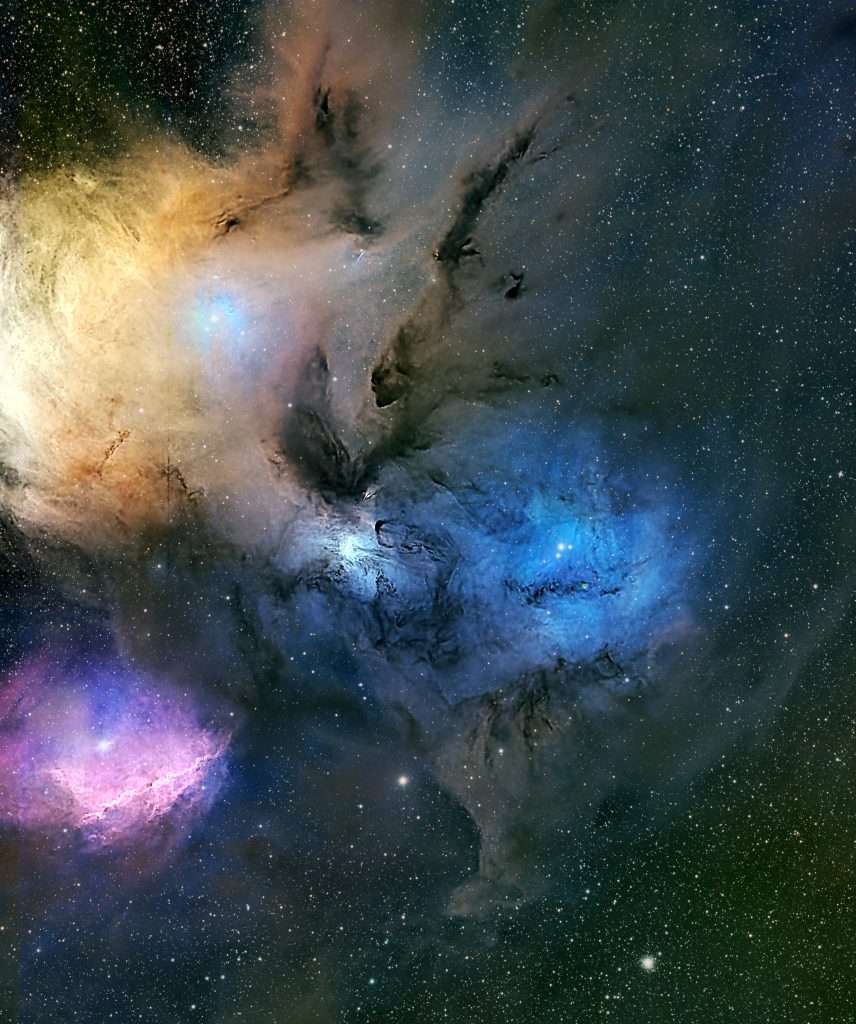
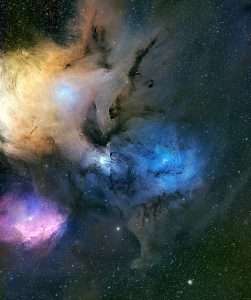
The Rho Ophiuchi complex is a molecular cloud and star-forming region, containing areas of both dark nebulae and reflection nebulae. It is also home to emission nebulae, where ionized gas glows due to energetic radiation. This image was created from six hours of RGB data from Telescope Live. The FITS images had several annoying defects but I was able to remove these during processing. Pixinsight was used to preprocess,  stack, and stretch the images.

Rho Ophiuchi

Some details about Rho Ophiuchi

  • Location and Distance:
    It is located about 394 light-years from Earth, making it one of the closest star-forming regions to our solar system.
  • Size and Structure:
    The cloud complex spans about 14 light-years and is divided into several distinct regions. These are identified by their catalogue designations, such as L1688 one of the most active star-forming parts of the complex.
  • Associated Stars:
    • The Rho Ophiuchi complex gets its name from Rho Ophiuchi, a multiple-star system embedded in the region. This system has young, hot stars that contribute to the illumination of the surrounding gas and dust.
    • Young stars and protostars, surrounded by disks of gas and dust, are scattered throughout the complex.
  • Features:
    • Reflection Nebulae: The bluish glow in some parts of the complex comes from light scattering off dust particles again from hot, young stars.
    • Dark Nebulae: Other areas appear as dark patches when dense dust clouds block the background starlight.
    • Emission Nebulae: Intense ultraviolet radiation from nearby stars ionises hydrogen gas causing the Red and Pink hues seen in the image.
  • Star Formation:
    • The Rho Ophiuchi complex is an active stellar nursery, with stars in various stages of formation, from collapsing protostars to fully formed young stars.
    • Many of these young stars are T Tauri stars, which are in the pre-main-sequence phase of stellar evolution
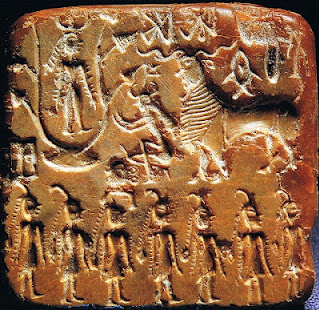
Sapta Matrikas

Krittikas (the Pleiades) in Hindu Culture

 Krittikas, a group of six (or sometimes seven) sisters in Hindu mythology is the Pleiades star cluster and plays a significant role in Vedic and Puranic traditions.

Krittikas in Hindu Mythology

  1. Identity as the Wives of the Saptarishis:
    • In Hindu mythology, the Krittikas were the wives of the Saptarishis (the seven great sages).
    • They were separated from their husbands due to a celestial event. This gave rise to their connection with the Pleiades.
  2. Association with Kartikeya (Skanda):
    • The Krittikas are the foster mothers of Kartikeya, the god of war and son of Shiva and Parvati.
    • The six Krittikas raised and nurtured Kartikeya who was born from the divine sparks of Shiva and Pavitti.
    • Kartikeya is thus sometimes called Kartikeya (or Kartik)  after the Krittikas.
  3. Astronomical and Vedic Significance:
    • The Pleiades are Krittika Nakshatra in Vedic astrology and are one of the 27 lunar mansions or nakshatras.
    • It is considered a fiery and transformative nakshatra, associated with the deity Agni, the fire god. The connection with Agni symbolizes purification, courage, and energy.
    • The nakshatra is significant in the Hindu calendar and determines auspicious days and festivals.
  4. Symbolism:
    • The Krittikas represent nurturing and maternal qualities as well as fierceness and independence.
    • Their association with Kartikeya emphasizes their protective and warrior-like aspects, as they prepared Kartikeya to defeat the demon Tarakasura.
The Sapta Kritikas (the seven divine mothers)

Sapta Matrikas

Mythological Stories

  1. Separation from the Saptarishis:
    • In some versions of the mythology, the Krittikas were estranged from their husbands due to a misunderstanding. This separation is reflected in the fact that only six stars of the Pleiades are prominently visible, with the seventh being faint or “hidden.”
  2. Role in the Skanda Purana:
    • The Krittikas’ role in nurturing and raising Kartikeya is detailed in the Skanda Purana which is one of the major Hindu scriptures. The Skanda Purana illustrates their devotion and importance in preparing Kartikeya to fulfil his destiny as a demon slayer.

Cultural Importance

  • Festivals: The Pleiades’ rising often coincides with agricultural festivals and rituals in honour of fertility, fire, and protection.
  • Astronomical Observation: The visibility of the Krittika Nakshatra in the sky was historically used to mark the transition between seasons and to align religious rituals.

The Tale of the Separation of the Krittikas (ChatGPT’s summary)

  1. Agni’s Infatuation:
    • Agni, the fire god, was overwhelmed by a divine passion for the wives of the Saptarishis, the Krittikas. His desire grew uncontrollable but he was torn by guilt because the Krittikas were devoted and chaste.
    • To resolve his inner turmoil Agni went into the forest to perform penance and rid himself of this desire.
  2. The Encounter with Svaha:
    • Svaha, a goddess who loved him deeply met Agni in the forest. Svaha realized Agni’s feelings for the Krittikas and devised a plan to win his affection.
    • Svaha transformed herself into the likeness of each Krittikas, one by one, and approached Agni, convincing him that his desire was fulfilled.
  3. The Rumor of Infidelity:
    • Svaha’s actions started a rumour that the Krittikas had been unfaithful to their husbands. The Saptarishis, misled by appearances became suspicious.
    • Feeling dishonoured and unable to live with the perceived betrayal the sages decided to leave their wives.
  4. The Birth of Kartikeya (Skanda):
    • Svaha collected the divine essence of Agni and the sages’ blessings, which led to the birth of Kartikeya (Skanda), the god of war.
  5. Ascension to the Sky:
    •  The Krittikas remained estranged from their husbands because their honour had been questioned and were elevated to the heavens where they became the stars of the Krittika Nakshatra (Pleiades).
    • The faintness of one of the stars is sometimes explained as the hidden or “lost” seventh wife who is absent in some versions of the story.

Symbolism of the Story

  • Chastity and Duty: The Krittikas symbolize purity and their role as foster mothers to Kartikeya underscores their nurturing and protective nature.
  • Cosmic Order: The separation and ascension of the Krittikas signify the cosmic consequences of human emotions like jealousy, desire, and misunderstanding.
  • Astronomical Connection: The “missing” seventh star of the Pleiades mirrors the mythological account of one estranged or hidden wife.


The Pleiades

The Pleiades

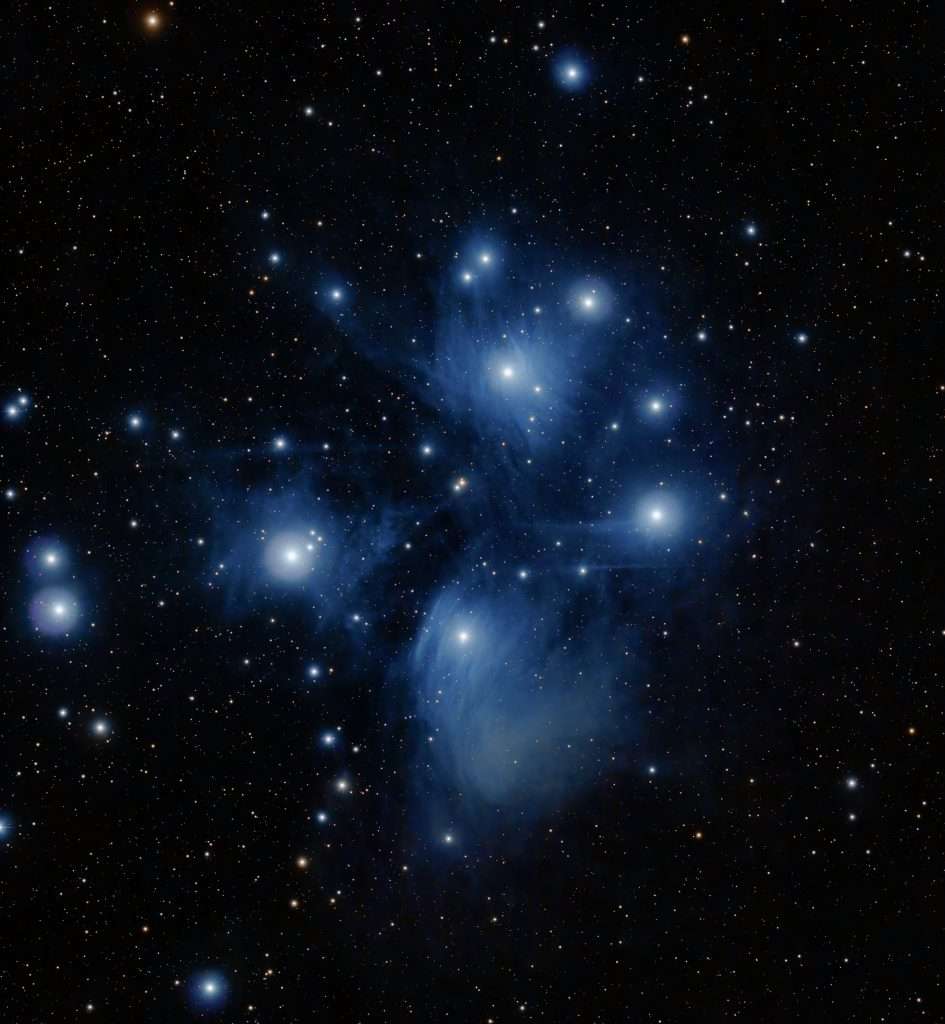
The Pleiades Star Cluster

The Pleiades, also known as Messier 45 (M45) or the Seven Sisters, is one of the most famous open star clusters in the night sky. Located in the constellation Taurus, the Pleiades is a stunning group of young, bright stars known since antiquity.

The Pleiades

Here’s an overview:

  • Type: An open star cluster, consisting of stars formed from the same molecular cloud.
  • Location: The Pleiades lies about 444 light-years away from Earth, making it one of the closest star clusters to us.
  • Age: The cluster is relatively young at about 100 million years old. Its stars are still in their early stages of stellar evolution.
  • Size: The cluster spans about 17.5 light-years and contains over 1,000 stars, though only a few are visible to the naked eye.
  • Brightest Stars:
    The brightest stars in the cluster are:

    • Alcyone
    • Atlas
    • Electra
    • Maia
    • Merope
    • Taygeta
    • Pleione

These stars give the Pleiades its nickname, the “Seven Sisters,” although most people can see only 6 or fewer stars with the naked eye.

The Mythology is world-wide

  • In Greek mythology, the Pleiades were seven sisters, daughters of the titan Atlas and the oceanid Pleione.  Zeus placed the seven sisters in the sky to escape Orion the hunter when he pursued them.
  • Similar stories about the Pleiades exist in cultures worldwide, including in Native American, Aboriginal, Japanese (where it is called “Subaru”), and Hindu mythology.

The Nebula

  • A blue reflection nebula surrounds the cluster, (shown in my image above), caused by interstellar dust scattering the light of its hot, blue stars. This nebula was originally thought to be leftover material from the stars’ formation but is now believed to be a cloud of interstellar dust that the cluster is passing through.
  • Visibility:
    • The Pleiades are visible from most parts of the world to the naked eye.
    • It appears as a small, glittering cluster in the night sky and is best seen during autumn and winter in the Northern Hemisphere. This cluster makes an easy and striking astrophotography target and I have imaged it many times through different telescopes.
The hidden galaxy

The Hidden Galaxy

The Hidden Galaxy IC 342

The hidden galaxy

Key Features of IC 342:

IC 342, often called the “Hidden Galaxy,” is a barred spiral galaxy located in the constellation Camelopardalis. Its nickname comes from its challenging visibility due to its position near the plane of the Milky Way, where dense clouds of gas, dust, and stars obscure it. Despite this, IC 342 is relatively close in astronomical terms, at approximately 7 million light-years from Earth.

  1. Type: IC 342 is classified as a SAB(rs)cd galaxy, indicating it is an intermediate spiral galaxy with loosely wound arms and a small central bar.
  2. Size: It spans about 75,000 light-years in diameter, making it one of the larger nearby galaxies.
  3. Proximity to the Milky Way: IC 342 is part of the IC 342/Maffei Group, one of the closest galaxy groups to our Local Group.
  4. Active Star Formation: The galaxy’s central region is rich in gas and dust, fueling intense star formation. Its core is particularly bright and shows evidence of nuclear activity.
  5. Challenges in Observation: The interstellar dust from the Milky Way dims and reddens the light from IC 342, making detailed studies more difficult compared to other nearby galaxies.

Despite the challenges, IC 342 is of significant interest to astronomers because of its proximity and its close resemblance to our own Milky Way, providing valuable insights into the structure and dynamics of spiral galaxies.

Hunters Moon

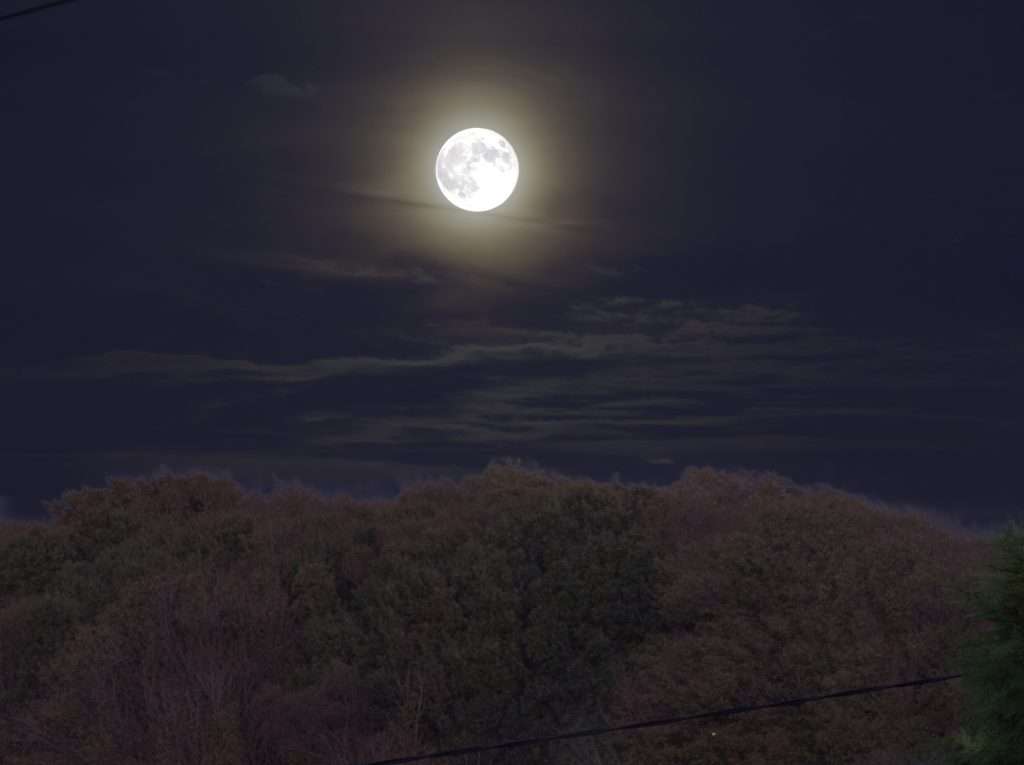
The Hunter’s Moon

The Hunter’s Moon 2024

When does it occur?

The Hunter’s Moon is traditionally given to the full moon that occurs after the Harvest Moon. This is the full moon closest to the autumnal equinox (around September 22-23). This full moon typically appears in October, though occasionally, it can fall in early November.

Origins of the Name

The name comes from traditional agricultural and hunting practices. After the harvest, hunters took advantage of the bright moonlight to hunt game, which was often easier to spot in fields cleared of crops. This was important for preparing food stores for the winter.

Unique Characteristics

  • Bright and Early Rise: This autumnal moon rises around the same time as the sun sets, providing extra illumination for several nights. This happens because the moon’s orbit during this time of year has a relatively shallow angle to the horizon.
  • Larger and More Colorful Appearance: While the Moon is not actually larger or closer to Earth, it may appear bigger or more colourful (orange or red) when it is near the horizon. This effect is due to the Earth’s atmosphere scattering shorter wavelengths of light.

The Hunter’s Moon, like other full moons, has been a subject of folklore, cultural traditions, and celestial observation throughout history.

This image is a one-shot photograph looking east from our house on the South Coast and taken on October 17, 2024. With a Canon R10 and standard kit lens and processed in Affinity Photo.  Affinity Photo was used to calm the moon’s brightness and bring up the foreground woodland. 

William Shakespeare  and The Hunter’s Moon

William Shakespeare mentioned the Hunter’s Moon in his play “Henry IV, Part I.” In Act I, Scene 2, the character Falstaff humorously refers to the Hunter’s Moon:

“Dost thou not see, thou knave, that it is past ten o’clock, and the moon shines fair? Thou sayest true; the moon shines fair; you are a leader of the moonshine company.”

Though Falstaff doesn’t explicitly say “Hunter’s Moon,” this phrase often refers to the bright, autumnal full moon that would have been familiar in Shakespeare’s time. Shakespeare’s works frequently allude to natural phenomena, including lunar phases, but his specific reference is tied more to poetic imagery and interpretation rather than naming it directly.

Scroll to Top